
Hair thinning in androgenetic alopecia develops gradually over many years. The visible changes on the scalp reflect a slow biological transformation occurring deep within the hair follicle itself.
This process is known as follicle miniaturisation.
Miniaturisation is the progressive shrinking of the follicle over successive hair growth cycles. As the follicle becomes smaller, the hair it produces becomes thinner, shorter, and less visible.
Understanding what happens inside a miniaturising follicle helps explain why pattern hair loss develops slowly and why scalp coverage decreases over time.
The normal structure of a healthy follicle
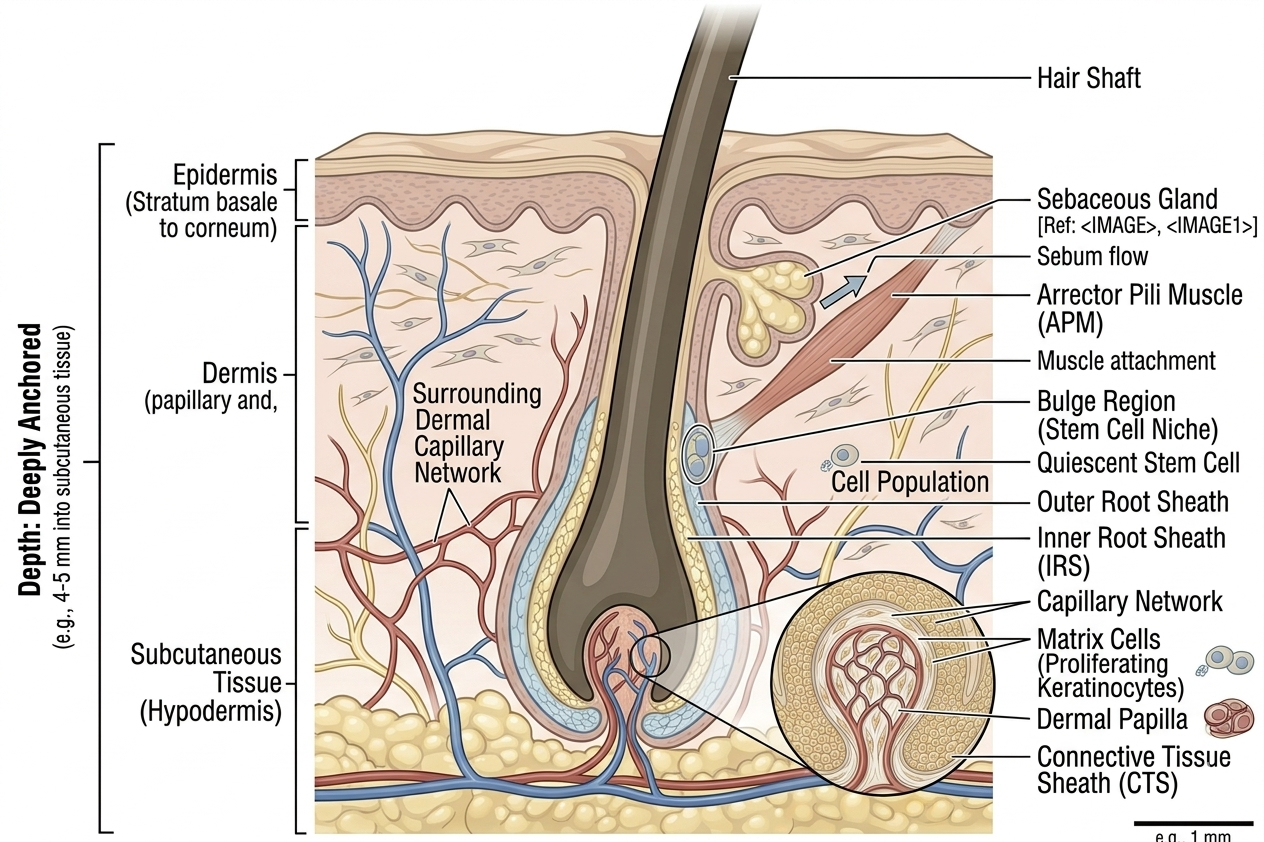
A healthy terminal hair follicle is a large and active structure located deep within the skin.
Key components include:
- the hair bulb
- dermal papilla
- matrix cells
- outer and inner root sheaths
- stem cell regions
- associated blood vessels
Together, these structures produce thick terminal hairs capable of providing substantial scalp coverage.
The dermal papilla regulates growth
At the base of the follicle lies the dermal papilla.
This structure acts as a biological control centre that regulates:
- hair growth duration
- follicle size
- keratin production
- signalling pathways controlling the hair cycle
The dermal papilla communicates continuously with surrounding follicular cells to maintain active hair production.
Miniaturisation begins gradually
Miniaturisation does not occur suddenly.
During the early stages:
- the follicle becomes slightly smaller
- the growth phase shortens modestly
- the hair shaft becomes subtly finer
These changes may initially be microscopic and not immediately visible externally.
Over multiple growth cycles, however, the cumulative effect becomes more apparent.
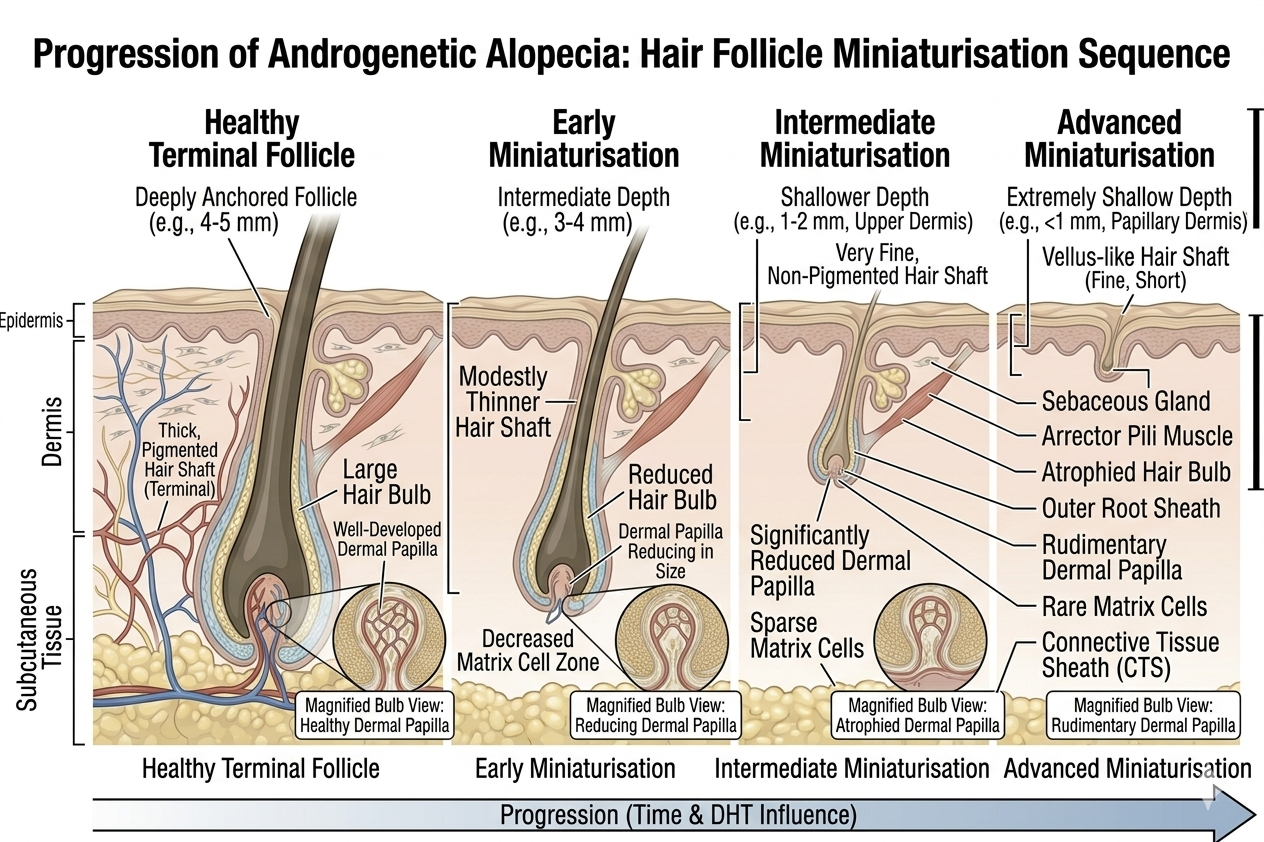
The follicle produces thinner hairs
As miniaturisation progresses:
- matrix cell activity decreases
- keratin production becomes reduced
- the hair shaft diameter declines
The follicle gradually transitions from producing thick terminal hairs to producing much finer hairs resembling vellus hairs.
These finer hairs:
- provide less scalp coverage
- reflect light differently
- become less visible overall
The growth phase becomes shorter
One of the most important changes inside a miniaturising follicle is shortening of the anagen phase.
Healthy scalp follicles may remain in anagen for several years.
Miniaturised follicles:
- stay in the growth phase for shorter periods
- produce shorter hairs
- cycle more rapidly into resting phases
This contributes to reduced hair length and visible density.
The resting phase becomes relatively longer
At the same time:
- follicles may spend proportionally more time resting
- fewer follicles remain actively growing simultaneously
This shift further decreases visible scalp coverage.
Even when follicles remain alive, their productivity declines substantially.
The follicle moves closer to the skin surface
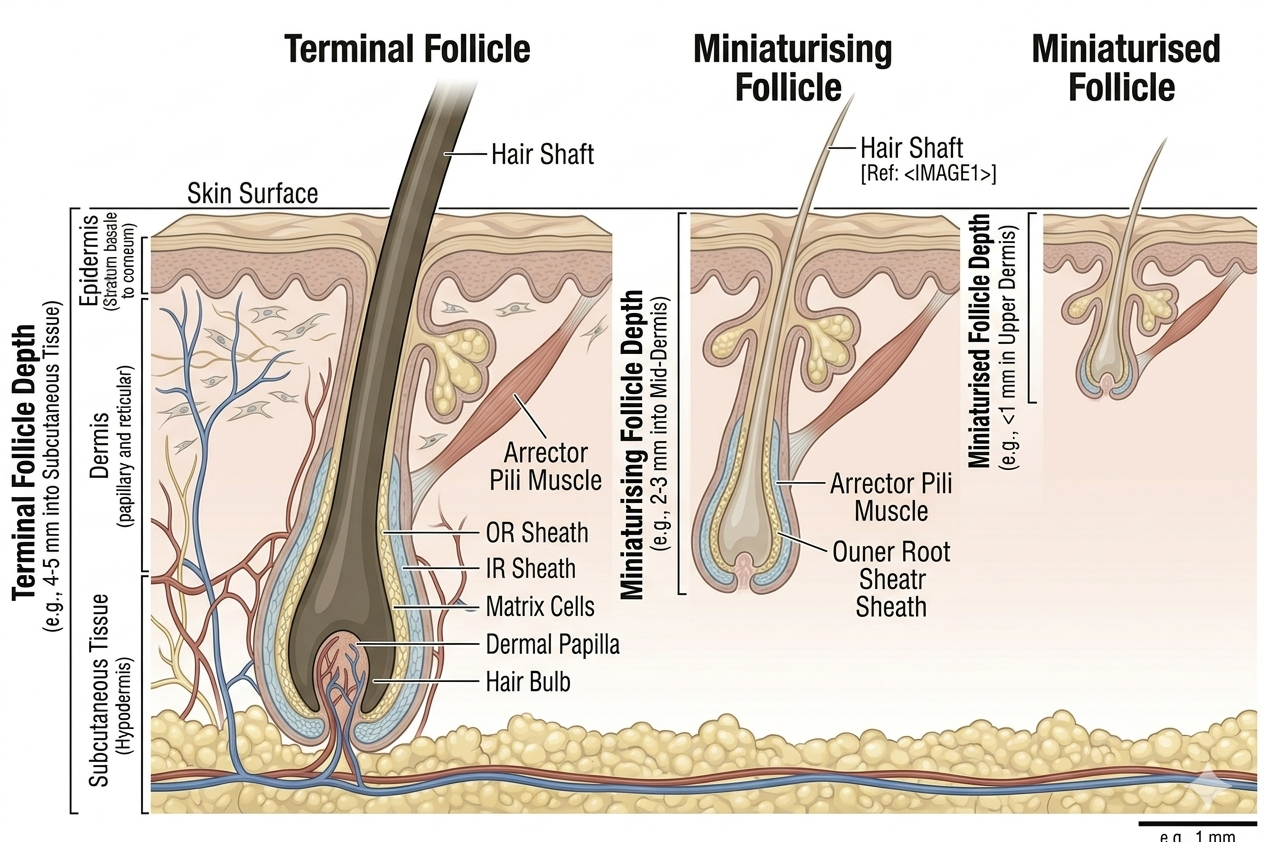
Healthy terminal follicles extend relatively deep into the scalp.
As miniaturisation occurs:
- follicles gradually become smaller and shallower
- the lower portion of the follicle regresses
- the active growth region sits closer to the skin surface
This reflects the reduced structural size of the follicle.
Blood vessel networks become smaller
Miniaturised follicles require less metabolic support because they produce smaller hairs.
As a result:
- surrounding capillary networks may also diminish
- the dermal papilla becomes smaller
- vascular support becomes less prominent
These vascular changes appear secondary to the miniaturisation process itself.
Hormonal sensitivity drives the process
In androgenetic alopecia, genetically susceptible follicles are sensitive to androgen-related signals.
Dihydrotestosterone influences:
- follicle cycling
- dermal papilla signalling
- growth phase duration
- follicle size regulation
Not all follicles respond equally.
Follicles at the:
- temples
- crown
- frontal scalp
are often more sensitive than follicles on the sides and back of the scalp.
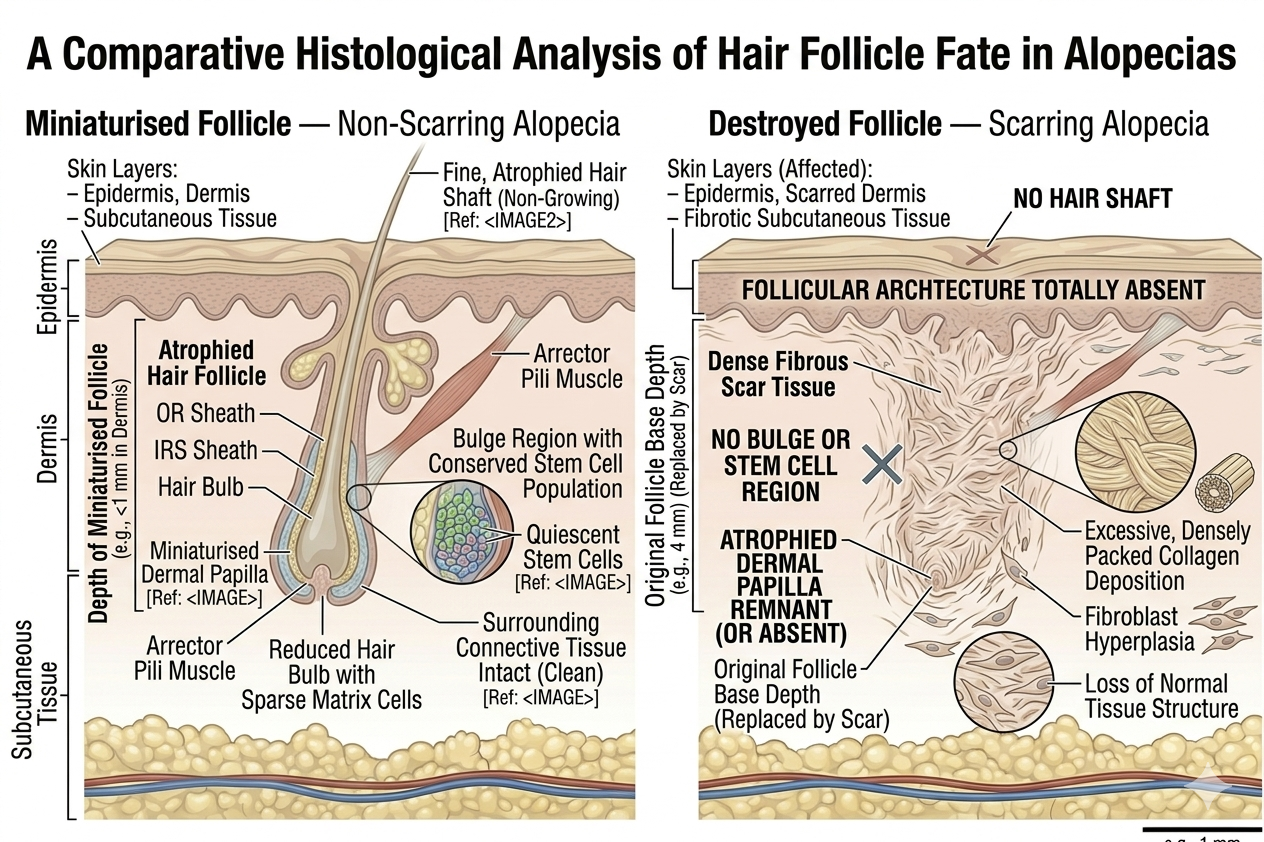
Stem cells often remain present
Importantly, many miniaturised follicles still contain stem cell populations.
This means:
- the follicle is not completely destroyed
- some regenerative capacity remains
- very fine hairs may still be produced
This distinction explains why androgenetic alopecia differs from scarring alopecias, where follicles are permanently destroyed.
Why scalp visibility increases
As more follicles miniaturise:
- hair shafts become progressively thinner
- scalp coverage decreases
- light penetrates more easily between hairs
Even when follicles remain present, the overall appearance becomes thinner because fine hairs provide much less visual density than terminal hairs.
The process unfolds slowly
Miniaturisation occurs gradually across many years because follicles function through long biological cycles.
A single cycle may last several years on the scalp.
As a result:
- changes accumulate slowly
- thinning progresses progressively
- early stages may be difficult to recognise
A progressive change in follicle behaviour
Inside a miniaturising follicle, the entire biological environment gradually changes.
The follicle:
- becomes structurally smaller
- produces thinner hairs
- shortens its growth phase
- spends more time resting
- generates less visible scalp coverage
Although the follicle often remains alive, its capacity to produce robust terminal hair progressively declines.
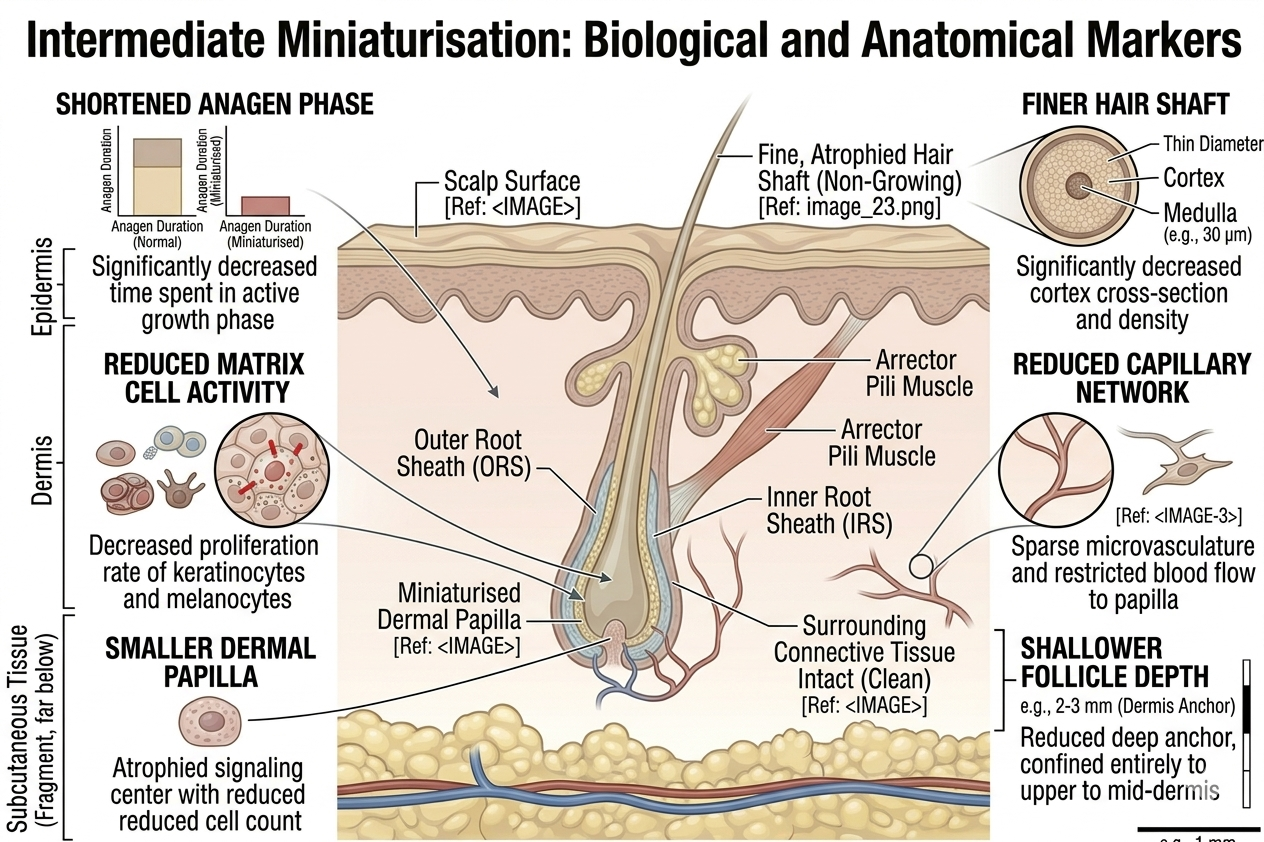
Understanding these internal changes helps explain the gradual nature of androgenetic alopecia and why visible hair thinning reflects a long-term biological transformation occurring within the follicle itself.
Author: Dr. Priya Goswami
Medical review: Dr. Denis Broun
Next step
If you notice coverage changes without increased shedding, confirm what process is occurring.
Take the Hair Assessment to have a physician review your pattern, identify whether miniaturization is present, and determine appropriate staging and next steps.



Add Comment