Biotin has become one of the most recognisable ingredients in the hair industry. It appears in supplements, shampoos, conditioners, masks, gummies, sprays, and increasingly, scalp serums.
The marketing is often confident. Stronger hair. Faster growth. Follicle nourishment. Vitamin-powered regrowth.
But once biotin moves from a tablet into a topical serum, an important question appears: can biotin applied to the scalp actually do what oral biotin is supposed to do?
The answer is less straightforward than many advertisements suggest.
Biotin is a real vitamin with genuine biological functions. Severe deficiency can affect hair and nails. But the evidence supporting topical biotin for hair growth is currently limited, and many commercial claims go beyond what research clearly supports.
What biotin actually is
Biotin is also known as vitamin B7 or vitamin H.
It plays a role in several metabolic processes, particularly those involving enzymes linked to fat, carbohydrate, and protein metabolism. Because hair shafts are made largely of keratin protein, biotin became associated with hair and nail health.
True biotin deficiency can contribute to:
Hair thinning
Brittle nails
Skin changes
Neurological symptoms
However, genuine deficiency is relatively uncommon in healthy individuals eating a varied diet.
This distinction matters because correcting a deficiency is very different from adding extra biotin to someone who already has adequate levels.
Why biotin became so popular in hair marketing
Hair loss is emotionally difficult, and vitamins feel safe, accessible, and natural to many consumers.
Biotin also fits neatly into the idea that hair problems can be “fed” back to health through nutrients. As a result, the ingredient became commercially powerful long before strong evidence developed for widespread supplementation in non-deficient people.
Topical products followed naturally.
Companies began adding biotin to:
- Scalp serums
- Leave-in treatments
- Shampoos
- Conditioners
- Hair masks
- Styling products
But the biological questions are more complicated than simply placing a vitamin onto the scalp surface.
Oral biotin and topical biotin are not equivalent
This is the central issue.
When biotin is taken orally, it enters the bloodstream through digestion and becomes systemically available. Even then, evidence for improving hair growth in non-deficient individuals remains limited.
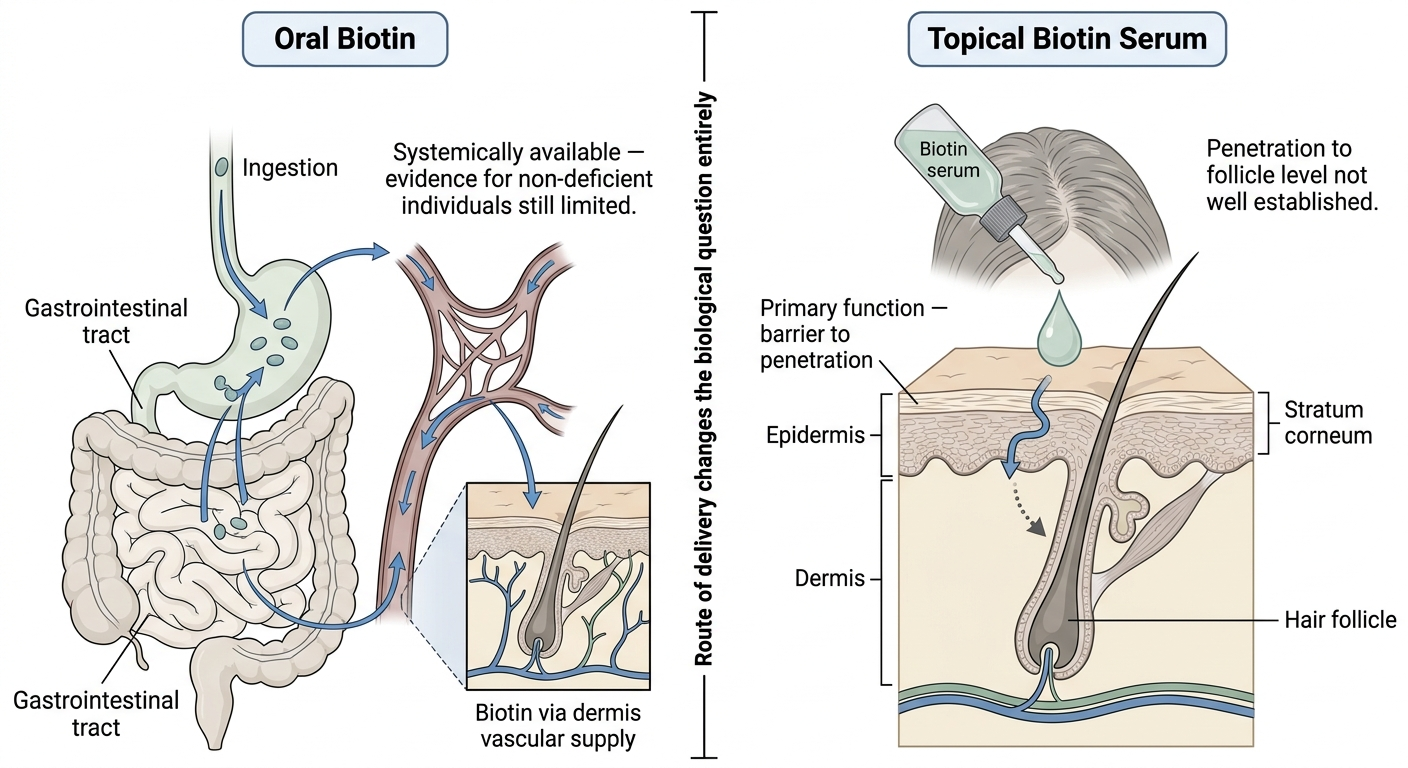
Topical biotin works differently. For a scalp serum to meaningfully affect follicle biology, several things would need to happen:
The ingredient would need to penetrate the scalp barrier effectively
It would need to reach biologically relevant areas around the follicle
It would need to influence follicle function in a meaningful way
The amount delivered would need to matter clinically
At present, there is limited strong evidence proving that topical biotin consistently achieves these outcomes in real-world hair loss conditions.
Most evidence around biotin involves deficiency states
The clearest medical role for biotin is in people who are genuinely deficient.
This may occur in rare genetic disorders, severe malnutrition, prolonged parenteral nutrition without supplementation, certain medication situations, or unusual dietary patterns involving excessive raw egg white consumption over time.
In deficiency states, supplementation may improve symptoms including hair thinning.
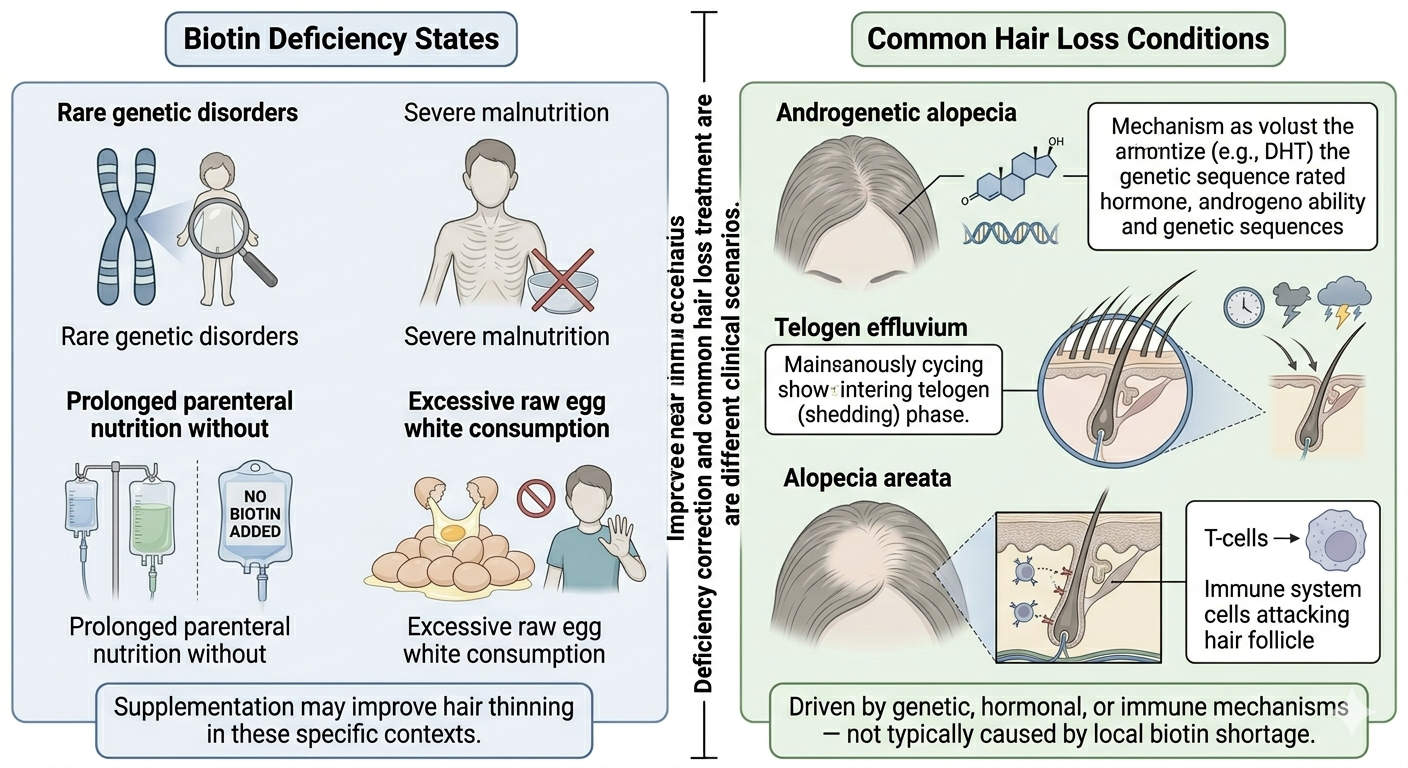
But that does not automatically mean extra biotin helps everyone with common forms of hair loss such as:
Androgenetic alopecia
Telogen effluvium
Alopecia areata
Those conditions usually involve very different biological mechanisms.
There is little high-quality evidence for topical biotin serums
Many topical biotin products rely heavily on marketing rather than strong clinical trials.
Some studies involve:
Very small participant numbers
Combination formulas with many active ingredients
Short observation periods
Manufacturer involvement
Subjective outcome measures
This makes it difficult to know whether biotin itself is doing anything meaningful.
If a serum contains biotin alongside caffeine, niacinamide, peptides, botanical extracts, oils, and conditioning agents, positive results cannot automatically be attributed to biotin.
Cosmetic improvement is not the same as follicle regrowth
Some biotin-containing products may still improve how hair looks or feels.
Conditioning ingredients in serums can reduce friction, improve shine, and temporarily increase the appearance of smoothness or fullness. Hair may seem healthier because breakage decreases.
That does not necessarily mean follicles are producing more hair.
This distinction is important because cosmetic enhancement and biological regrowth are often blurred together in advertising.
Can biotin penetrate the scalp effectively?
This remains an area with limited clarity.
Human skin is designed to function as a barrier. Many substances applied topically do not penetrate deeply or consistently enough to create major biological effects.
Some topical medications do penetrate effectively because they are specifically formulated for delivery through the skin. Whether cosmetic biotin serums consistently deliver meaningful amounts of biotin to follicles is far less certain.
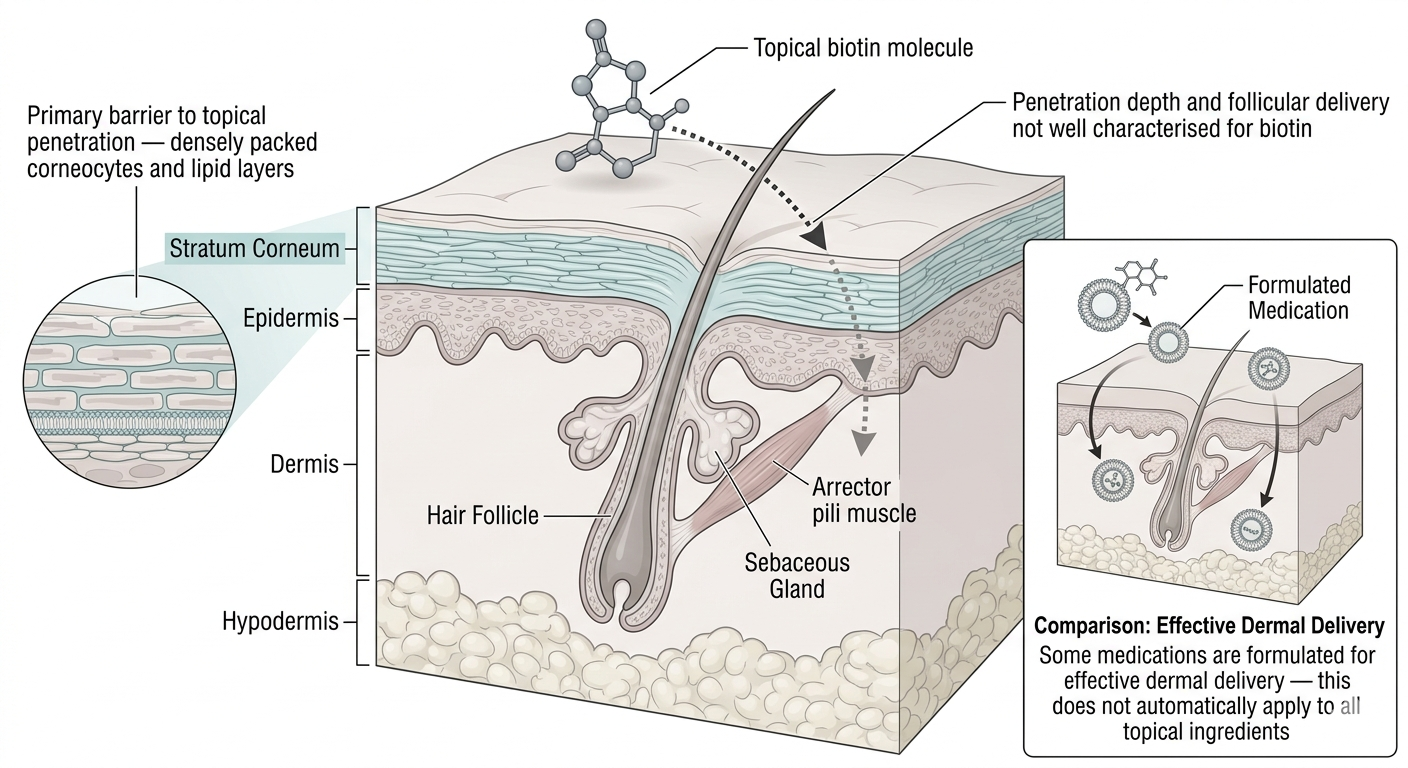
The mere presence of biotin on an ingredient label does not prove clinically relevant follicular absorption.
Hair growth biology is more complicated than adding nutrients
Hair follicles are influenced by:
Genetics
Hormones
Inflammation
Immune activity
Age
Stress
Nutrition
Medical conditions
Most common hair loss disorders are not caused simply by a local vitamin shortage at the scalp surface.
For example, androgenetic alopecia involves progressive follicle miniaturisation driven largely by genetic sensitivity to dihydrotestosterone, or DHT. Applying topical vitamins alone is unlikely to override that process dramatically.
Many biotin serums rely on association marketing
Biotin has strong public recognition. People associate it with healthy hair and nails.
As a result, companies often use biotin more as a symbolic ingredient than a proven topical therapy. The label creates reassurance even when the actual evidence for the product is limited.
This happens frequently in cosmetic industries. An ingredient becomes culturally linked with a desired outcome, and marketing expands faster than the science.
“Vitamin infused” sounds more scientific than it often is
Words like:
Nourishing
Vitamin-rich
Follicle feeding
Nutrient activating
Scalp fortifying
can sound medically convincing without having precise scientific meaning.
A product may contain biotin while providing little evidence that it changes long-term hair growth outcomes.
This does not necessarily make the product fraudulent. It simply means the marketing language may imply more than current evidence can firmly support.
Topical biotin is unlikely to replace evidence-based treatments
People with progressive androgenetic alopecia sometimes delay effective treatment while experimenting with cosmetic serums.
This matters because conditions like male and female pattern hair loss often progress gradually over time.
Evidence-supported treatments such as minoxidil or finasteride have substantially more clinical research behind them than topical biotin serums.
Biotin products should not be viewed as equivalent alternatives simply because they are easier to buy or feel more natural.
Excessive biotin supplementation also has downsides
Although topical products are less likely to create systemic effects, the wider biotin trend has created another issue: unnecessary high-dose supplementation.
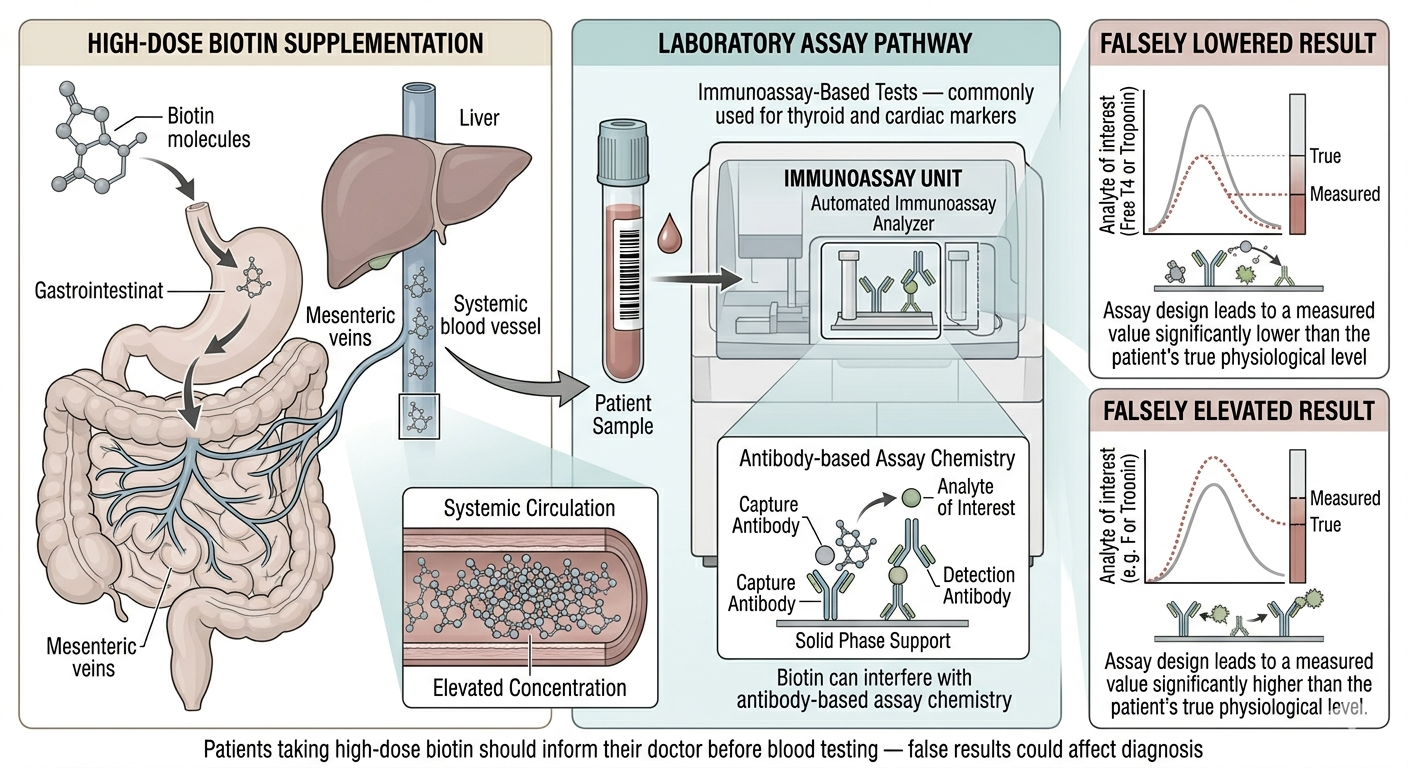
Large doses of oral biotin can interfere with certain laboratory tests, including some thyroid and cardiac investigations. This is medically important because false lab results can potentially affect diagnosis.
Many people taking large biotin doses are unaware of this interaction.
Some people may still enjoy using biotin serums
This does not mean every biotin serum is useless.
Some formulations may improve:
Hair manageability
Smoothness
Conditioning
Breakage reduction
Scalp feel
People may also enjoy the ritual of scalp care itself.
The problem arises when cosmetic support is marketed as proven follicle regeneration without strong evidence.
Hair shedding deserves proper diagnosis
Hair loss is not one condition.
Persistent thinning, sudden shedding, patchy loss, scalp inflammation, or rapid density changes deserve proper evaluation rather than endless cosmetic experimentation.
Important causes of hair loss may include:
Iron deficiency
Thyroid disease
Hormonal disorders
Autoimmune conditions
Nutritional issues
Inflammatory scalp disease
Medication side effects
No serum ingredient can replace proper diagnosis.
What to look for when evaluating a biotin serum
A more realistic approach is to ask:
Is this product making cosmetic claims or medical claims?
Are there actual human clinical studies?
Was biotin studied alone or as part of a mixture?
Is the evidence independent?
Are the promises realistic?
Could improvements simply reflect conditioning effects?
These questions help separate careful marketing from exaggerated claims.
The bottom line
Biotin is an important vitamin, and true deficiency can contribute to hair problems. But the evidence supporting topical biotin serums as major hair growth treatments remains limited.
Most common hair loss conditions are not caused by local scalp biotin deficiency, and it is not yet clear that topical biotin penetrates follicles in clinically meaningful ways. Many products rely more on the popularity of the ingredient than on strong human evidence.
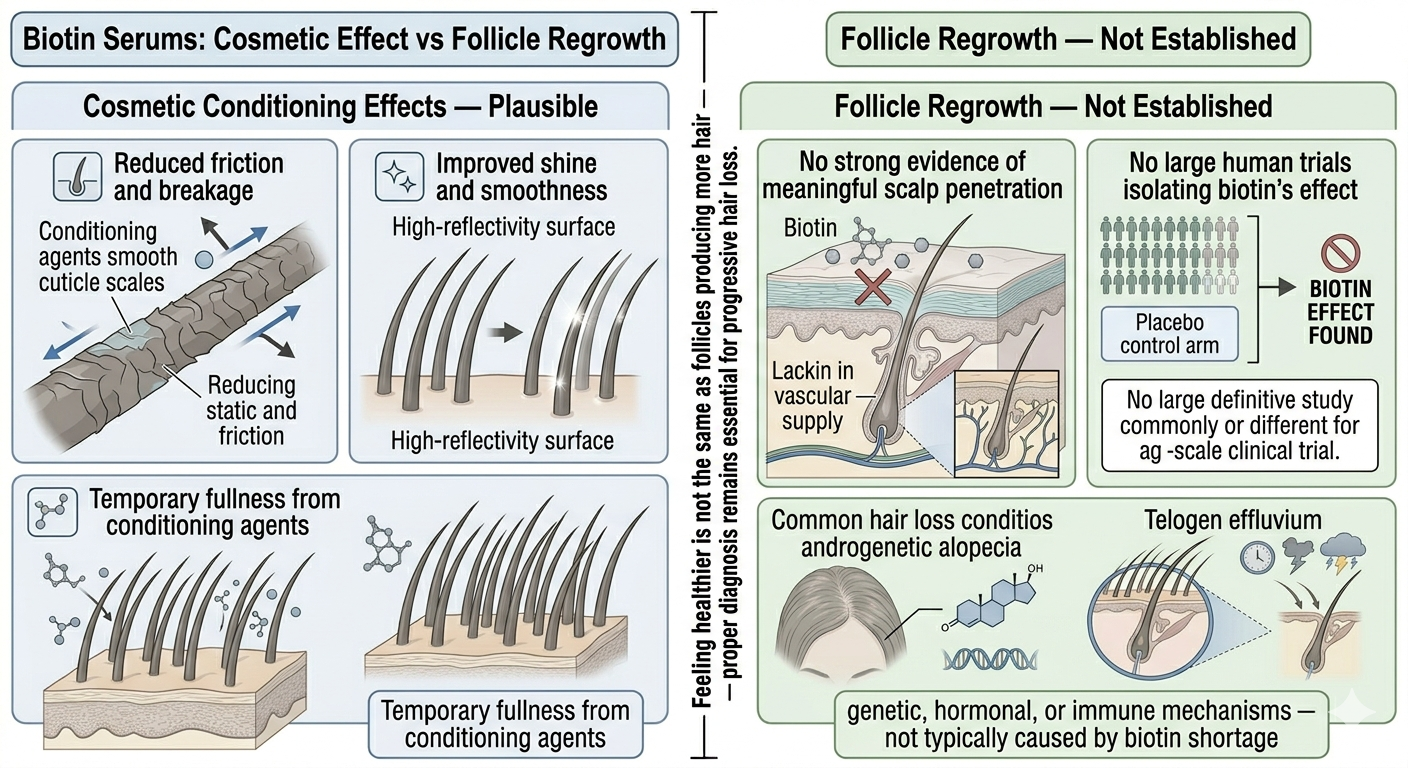
Some biotin serums may still improve cosmetic appearance through conditioning and reduced breakage. But that is different from proven follicle regrowth.
For people with ongoing or progressive hair loss, proper diagnosis and evidence-based treatment remain far more important than vitamin-themed marketing.
Author: Dr. Priya Goswami
Medical review: Dr. Denis Broun
Next step
If you notice coverage changes without increased shedding, confirm what process is occurring.
Take the Hair Assessment to have a physician review your pattern, identify whether miniaturization is present, and determine appropriate staging and next steps.
Add Comment