Peppermint oil appears in countless hair growth products. It is marketed in shampoos, scalp serums, oils, masks, sprays, and “follicle stimulation” treatments. Social media often presents it as a natural alternative to medical hair loss therapies.
Much of that attention traces back to a single animal study that became widely discussed online.
Since then, claims around peppermint oil have expanded far beyond the evidence itself. Some people now believe it can regrow hair rapidly, reverse baldness naturally, or outperform established medical treatments.
The reality is more cautious.
Peppermint oil is biologically interesting. It may affect the scalp in ways that deserve further research. But current evidence in humans remains limited, and many online claims move well ahead of what studies actually show.
Why peppermint oil became popular for hair growth
The ingredient gained major attention after a 2014 study in mice examined topical peppermint oil and hair growth.
Researchers observed increased hair growth measures in mice treated with diluted peppermint oil compared with certain control groups. The study suggested possible effects on follicle depth, dermal thickness, and growth activity.
That study is frequently quoted online. Often without mentioning that it involved mice rather than humans.
Animal studies can be useful starting points in medical research. But results in mice do not automatically predict meaningful clinical benefit in human scalp hair loss.
Human follicles behave differently. Human hair disorders are more complex. And real-world use introduces many variables absent in laboratory settings.
There is very little strong human evidence
This is the most important point.
At present, robust human clinical evidence for peppermint oil in hair loss remains limited.
There are no large, long-term, high-quality trials proving that peppermint oil reliably treats androgenetic alopecia, alopecia areata, or other major hair disorders in the way evidence-supported medical treatments do.
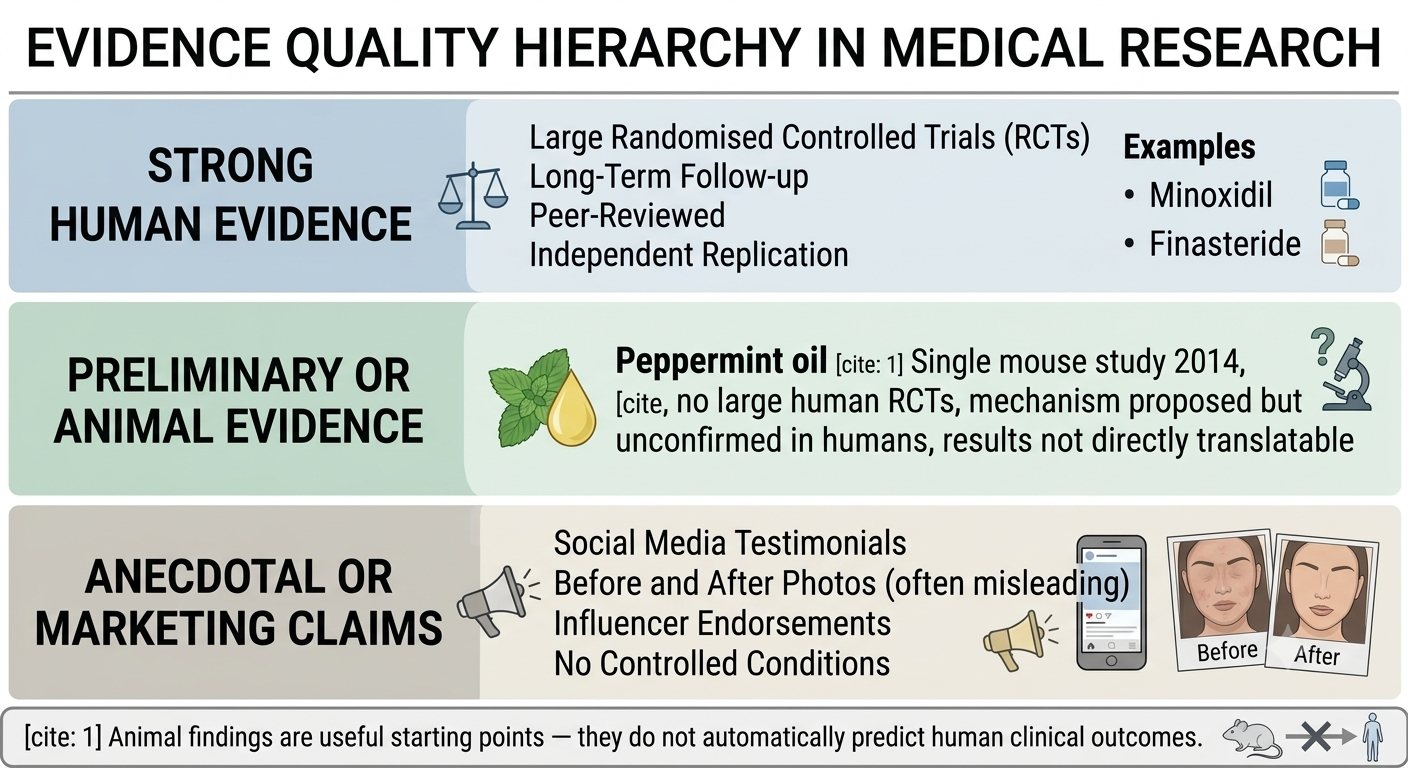
That does not mean it definitely does nothing. It means uncertainty remains significant.
Online discussions often present peppermint oil as though the science is already settled. It is not.
What peppermint oil might theoretically do
Peppermint oil contains menthol and other compounds that create a cooling sensation and may influence local blood flow.
Possible proposed mechanisms include:
Increased microcirculation
Effects on inflammatory signalling
Sensory nerve stimulation
Changes in follicle environment
But proposed mechanisms are not the same thing as proven clinical outcomes.
Many substances can produce measurable biological effects without generating substantial visible hair regrowth in real patients.
Increased blood flow does not automatically mean more hair
This is another area where marketing often oversimplifies biology.
People frequently assume that increasing scalp circulation automatically causes stronger hair growth. Hair follicles do require blood supply, but hair loss conditions are rarely caused simply by “poor circulation”.
Androgenetic alopecia, for example, is driven mainly by genetic sensitivity to dihydrotestosterone, or DHT, along with follicle miniaturisation over time.
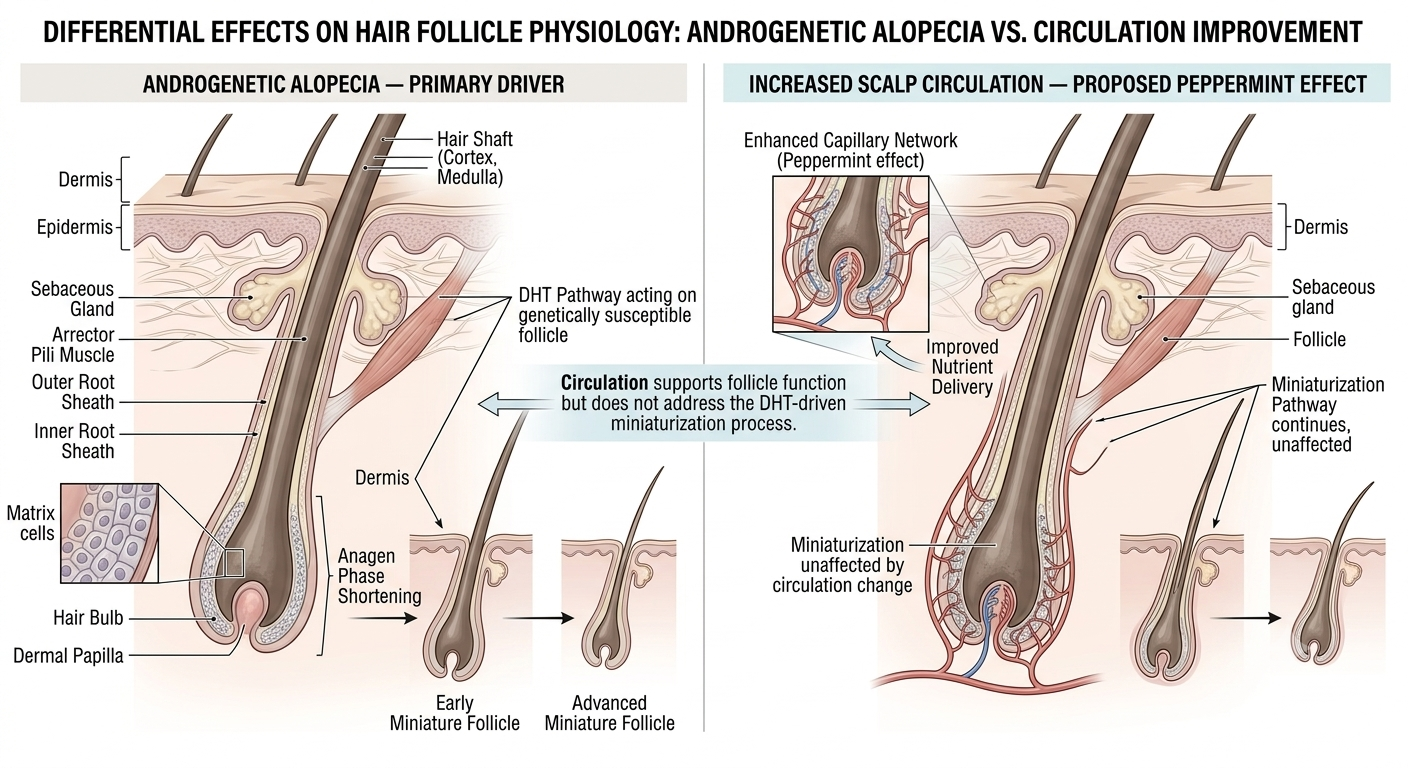
A temporary increase in scalp blood flow does not necessarily reverse that process.
The biology of hair growth is far more complicated than simply delivering more blood to the scalp surface.
Peppermint oil is not equivalent to minoxidil
Some internet discussions compare peppermint oil directly with minoxidil.
That comparison is misleading.
Minoxidil has decades of human clinical research behind it and is approved in many countries for pattern hair loss. Even minoxidil does not work perfectly for everyone, but its evidence base is far stronger.
Peppermint oil does not currently have equivalent clinical support.
People sometimes cite the mouse study to suggest peppermint oil “outperformed minoxidil”, but animal findings cannot be translated that directly into human treatment recommendations.
“Natural” does not mean risk-free
Peppermint oil is often marketed as a safer option because it is natural.
But natural substances can still irritate skin.
Peppermint oil may cause:
Scalp burning
Redness
Contact dermatitis
Irritation
Itching
Dryness
Eye irritation if transferred accidentally
Essential oils are concentrated compounds. Applying undiluted peppermint oil directly to the scalp is not advisable.
People with eczema, sensitive skin, psoriasis, or existing scalp inflammation may react more strongly.
Dilution matters
Essential oils should generally be diluted before scalp application.
Online tutorials sometimes encourage highly concentrated mixtures without discussing irritation risk. More is not necessarily better.
A scalp that becomes inflamed, sore, or repeatedly irritated is not in a healthier condition for hair management.
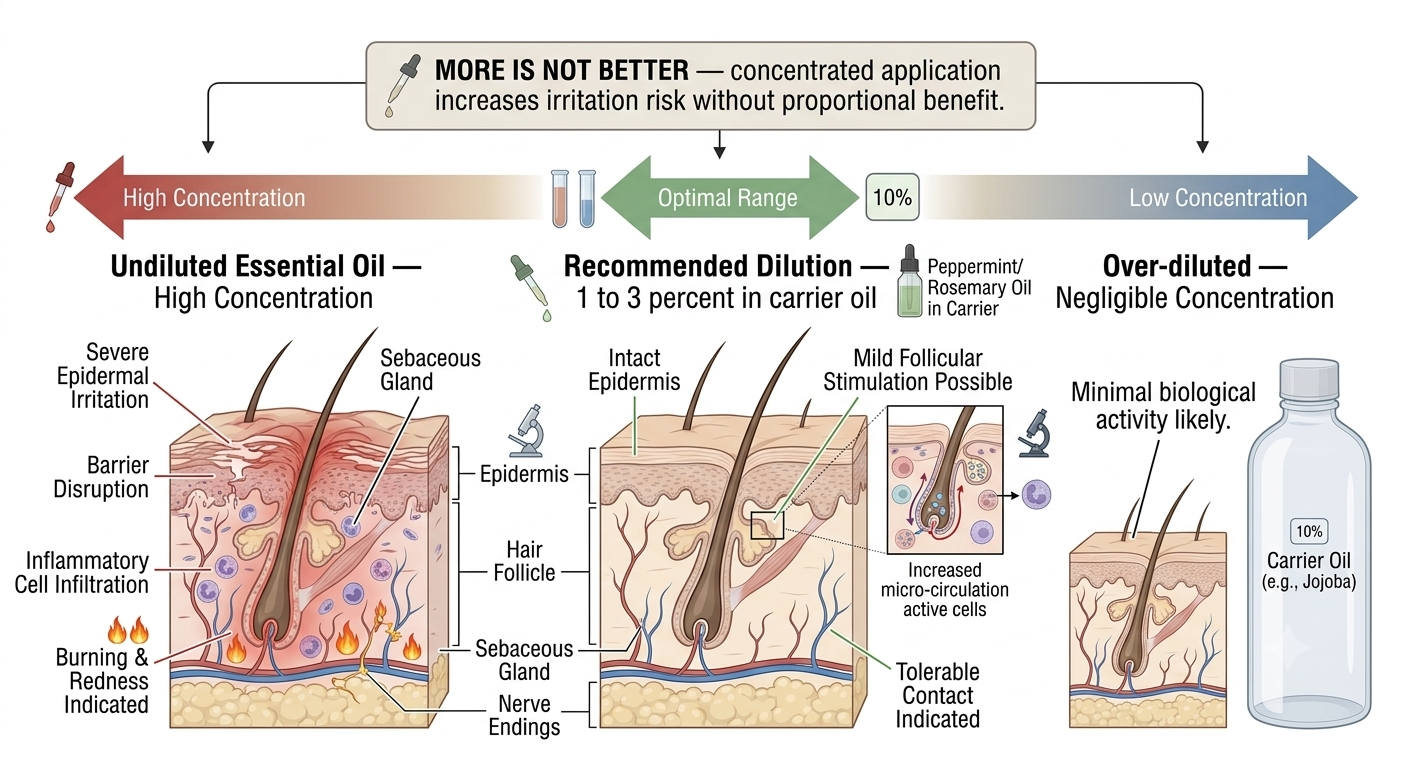
This is especially important because some individuals continue applying irritating products while believing discomfort means the treatment is “working”.
Burning and inflammation are not signs of guaranteed follicle stimulation.
Scalp sensation can create a misleading impression
Peppermint oil produces a cooling, tingling sensation because of menthol.
That sensory effect often makes products feel active or powerful. People naturally associate physical sensation with effectiveness.
But a cooling scalp does not prove meaningful hair regrowth is occurring.
Cosmetic and sensory effects can strongly influence perception even when objective hair changes are limited.
Some people may still find it useful cosmetically
This does not mean peppermint oil has no place in hair care at all.
Some people enjoy the sensory experience. Certain formulations may help hair feel cleaner or fresher. Others may use peppermint-containing products as part of general scalp care routines.
The issue is not whether peppermint oil should exist in hair products. The issue is whether it is being marketed honestly.
There is a difference between saying:
“This ingredient may support scalp comfort and has limited early research interest”
and:
“This reverses hair loss naturally.”
Those are very different claims.
Hair growth and hair breakage are often confused
People sometimes report “faster growth” after using oils when what actually improved was breakage reduction.
Oils can lubricate hair shafts and reduce friction temporarily. Hair that breaks less may appear to grow faster because more length is retained.
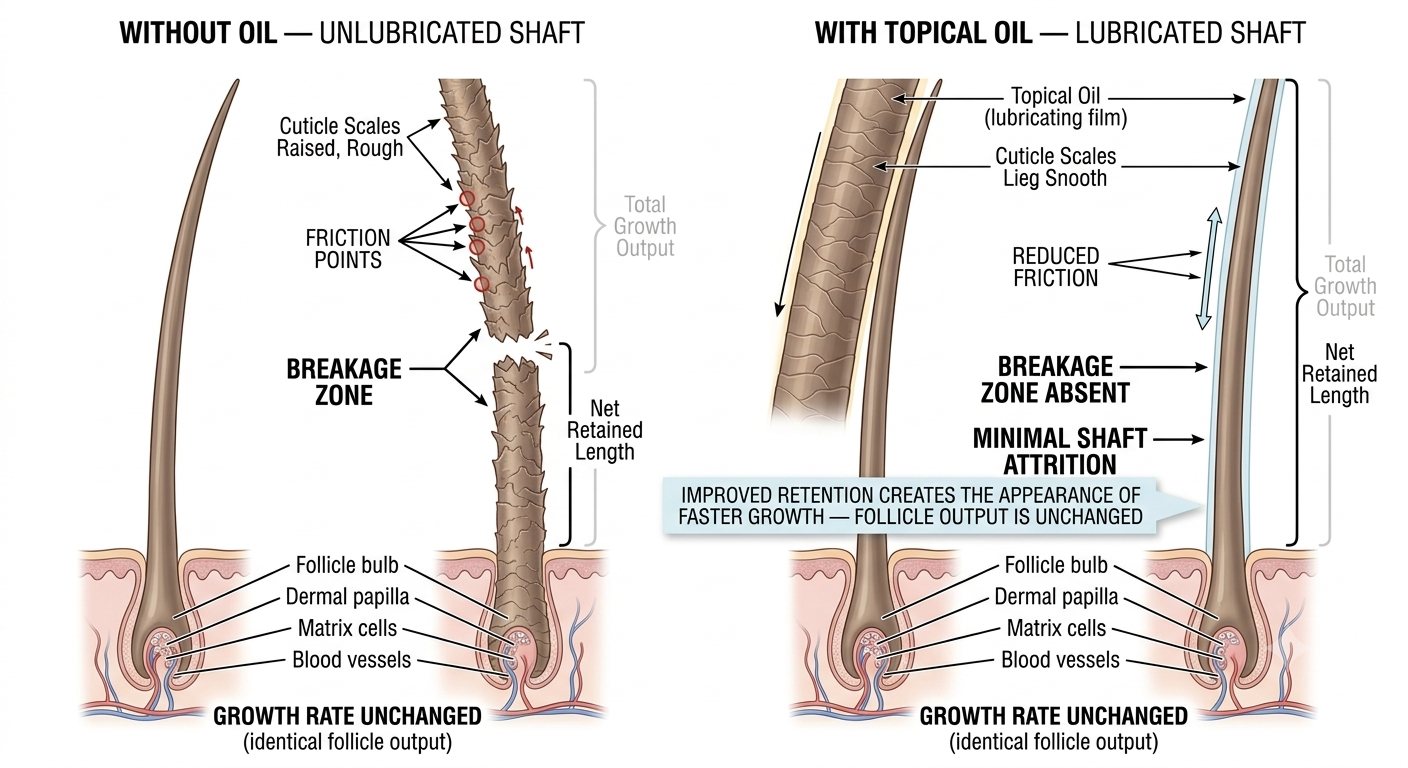
Again, that is different from significantly altering follicle growth biology.
Peppermint oil will not treat every type of hair loss
Hair loss has many causes.
These include:
Androgenetic alopecia
Telogen effluvium
Alopecia areata
Traction alopecia
Scarring alopecias
Inflammatory scalp disease
Hormonal disorders
Nutritional deficiencies
No essential oil has been proven to treat all of these conditions effectively.
Patchy bald spots, scalp pain, rapid shedding, or inflammatory symptoms deserve proper assessment rather than self-treatment alone.
Be cautious with combination products
Many hair serums combine peppermint oil with:
Rosemary oil
Tea tree oil
Caffeine
Biotin
Castor oil
Niacinamide
Botanical extracts
When people believe the product helped, it becomes difficult to know which ingredient, if any, made a meaningful difference.
Combination products also increase the risk of irritation because multiple active compounds are being layered onto the scalp simultaneously.
Social media often exaggerates timelines
One major warning sign is unrealistic speed.
Hair growth is slow. Human scalp hair usually grows roughly one centimetre per month during active growth phases.
Claims of dramatic transformation within days or a couple of weeks should be viewed sceptically.
Even evidence-supported medical treatments require months before meaningful assessment is possible.
Placebo effects are common in cosmetic treatments
Hair treatments are especially vulnerable to placebo effects because appearance is subjective.
Changes in:
Lighting
Hair length
Styling
Scalp oil
Hair fibres
Volume products
Confidence
can all influence perception.
This is one reason controlled clinical trials matter. Personal testimonials alone are unreliable ways to judge effectiveness.
When scalp irritation may worsen the situation
Repeated irritation can create additional problems.
Aggressive oil use, frequent product layering, and excessive scalp manipulation may worsen:
Seborrhoeic dermatitis
Contact dermatitis
Scalp sensitivity
Itching
Inflammation-related shedding
People with active scalp disease should be especially cautious about experimenting with concentrated essential oils.
Why evidence quality matters
Peppermint oil sits in a category common in hair loss care: biologically plausible but not strongly proven.
There are many ingredients like this. Preliminary findings create excitement. Marketing expands rapidly. Public confidence grows faster than the evidence itself.
Sometimes later research supports the early enthusiasm. Sometimes it does not.
Until larger human studies exist, peppermint oil should probably be viewed as an interesting but incompletely proven option rather than a validated standalone treatment for hair loss.
The bottom line
Peppermint oil became popular for hair growth largely because of a single mouse study that suggested possible follicle effects. Since then, online claims have expanded far beyond the available human evidence.
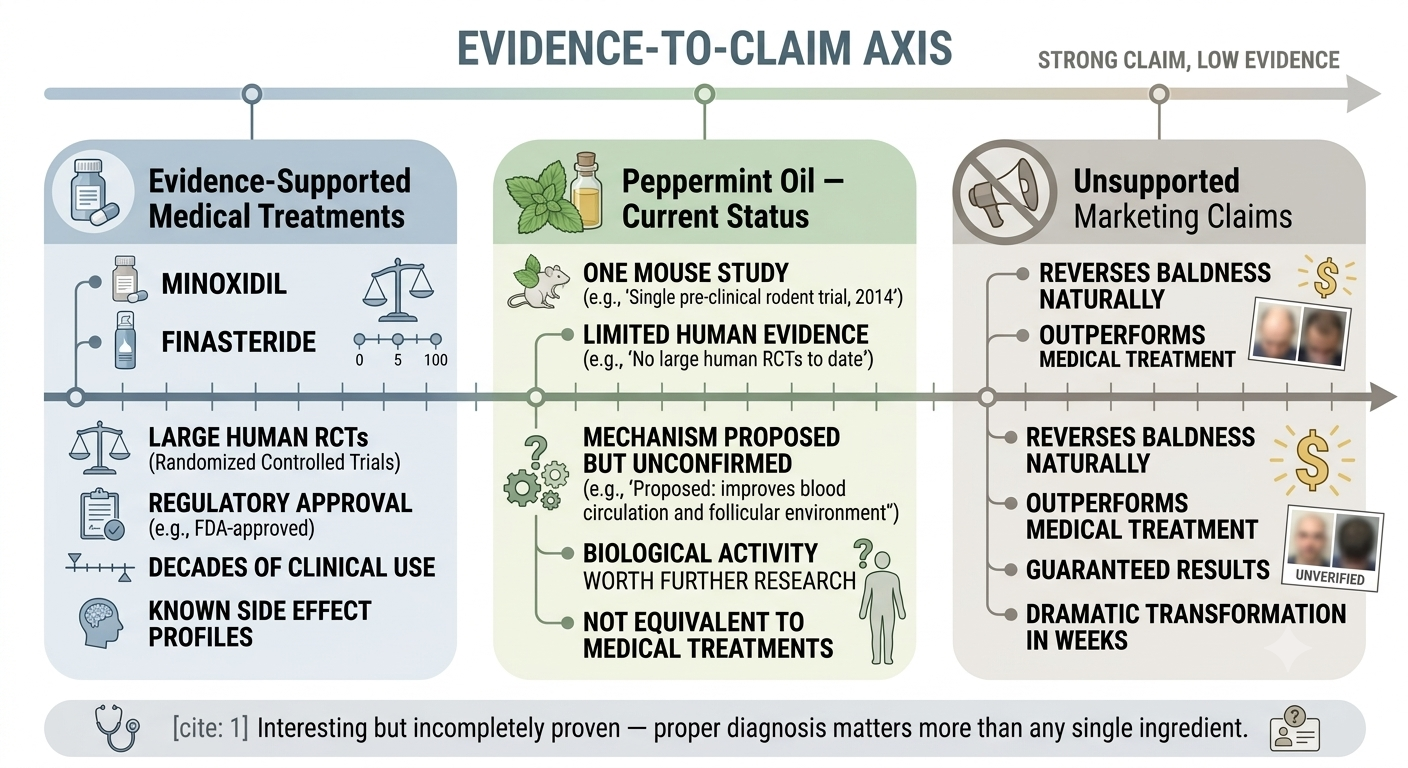
At present, there is limited strong clinical evidence showing that peppermint oil reliably treats common forms of human hair loss. It may have biological activity worth further study, but it should not be viewed as equivalent to evidence-supported medical treatments.
Some people may enjoy peppermint-containing products as part of general scalp care, and certain formulations may help cosmetically or subjectively. But “natural” does not mean risk-free, and irritation is possible, especially when concentrated oils are used improperly.
For people with significant or progressive hair loss, proper diagnosis matters more than internet hype around any single ingredient.
Author: Dr. Priya Goswami
Medical review: Dr. Denis Broun
Next step
If you notice coverage changes without increased shedding, confirm what process is occurring.
Take the Hair Assessment to have a physician review your pattern, identify whether miniaturization is present, and determine appropriate staging and next steps.
Add Comment