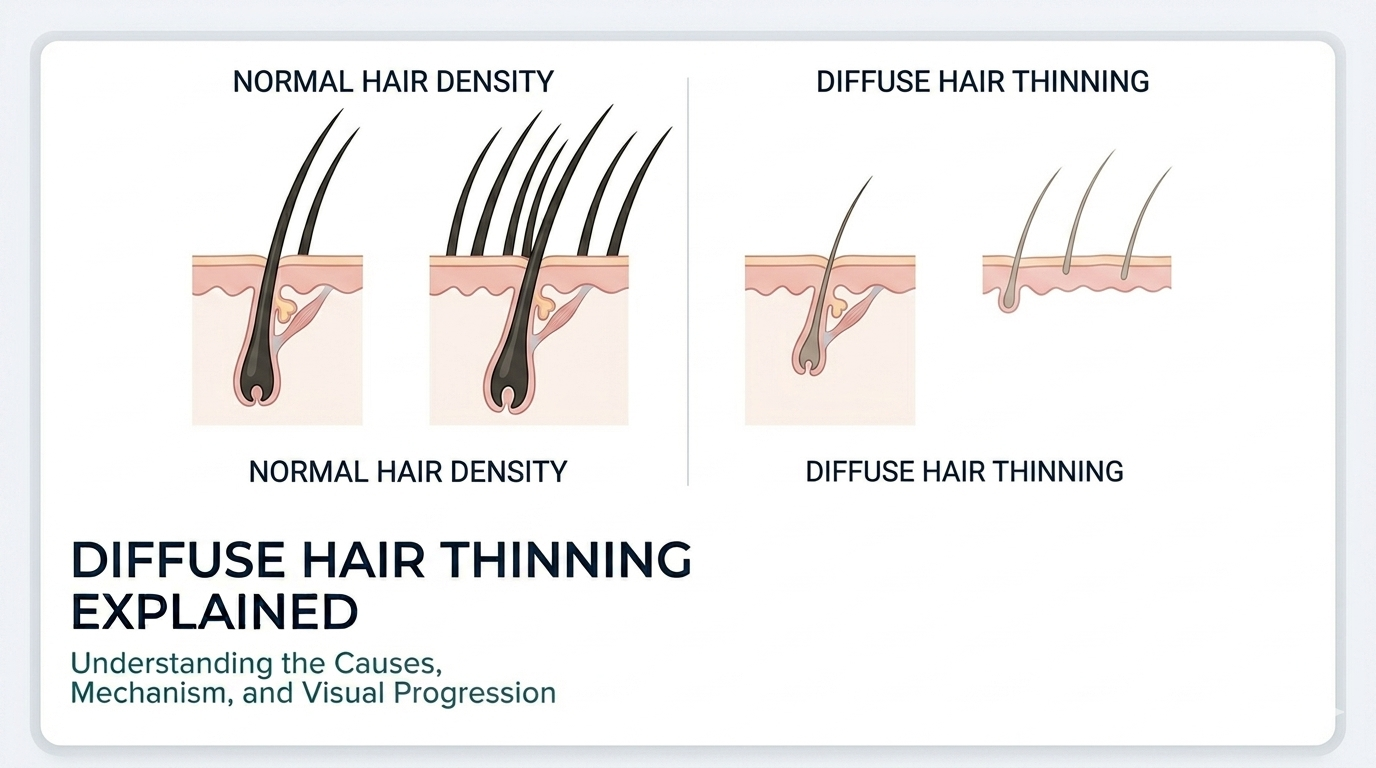
Hair thinning does not always follow a clear pattern. In many individuals, the change in hair appearance occurs gradually across the entire scalp rather than in specific areas. This type of change is often described as diffuse hair thinning.
In diffuse thinning, the overall volume of hair decreases, and the scalp may become more visible through the hair. The change usually develops slowly and may be noticed when the hair is wet, parted, or exposed to bright lighting.
Unlike some forms of hair loss that affect particular regions of the scalp, diffuse thinning involves a broader reduction in hair density or hair thickness.
What diffuse thinning means
Diffuse thinning refers to a general reduction in hair coverage across the scalp.
This reduction may occur for several reasons. In some cases, the number of hairs growing at a given time decreases. In others, the hair shafts themselves become thinner, providing less coverage of the scalp.
Because the change occurs across many follicles at once, the scalp may appear less dense without the formation of distinct bald areas.
Many individuals first notice that their hair feels lighter or that the part line appears wider than before.
The role of the hair growth cycle
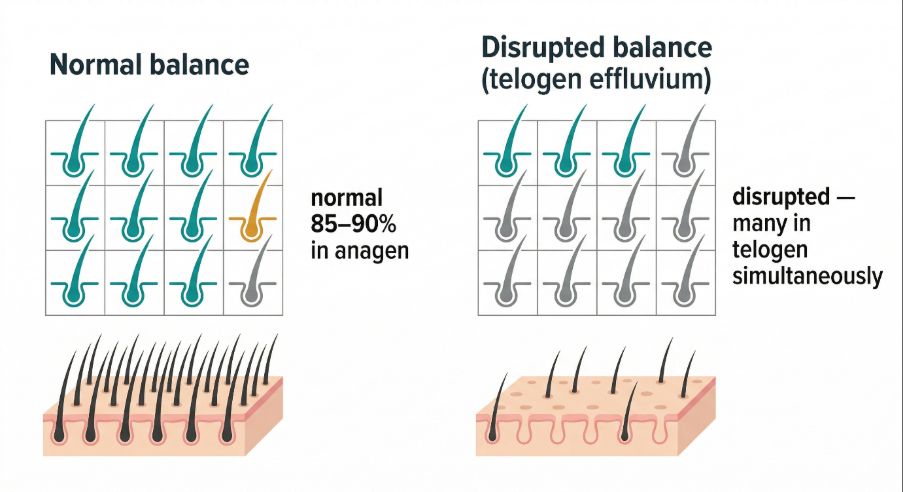
Changes in the hair growth cycle often contribute to diffuse thinning. Each follicle operates within a three-phase cycle, and disruption of any phase can alter the overall density of the scalp.
Each hair follicle on the scalp operates within a repeating three-phase biological cycle that governs how long and thick the hair can grow, and when it is shed.
- The anagen phase is the active growth period, lasting two to six years on the scalp. The duration of this phase directly determines the length and thickness of the hair shaft. Approximately 85 to 90 percent of scalp hairs are in anagen at any given moment.
- The catagen phase is a brief transitional period of approximately two to three weeks, during which the follicle shrinks and detaches from its blood supply.
- The telogen phase is the resting period, lasting approximately three months, after which the hair is shed and the follicle re-enters anagen to begin a new cycle. Because follicles cycle independently of one another, shedding is distributed gradually throughout the day rather than occurring all at once.
When this balance is disrupted — for example, when a large number of follicles are simultaneously pushed into telogen — more hairs enter the resting stage at once. The result is increased shedding and a temporary reduction in hair density several months later.
Changes in hair thickness
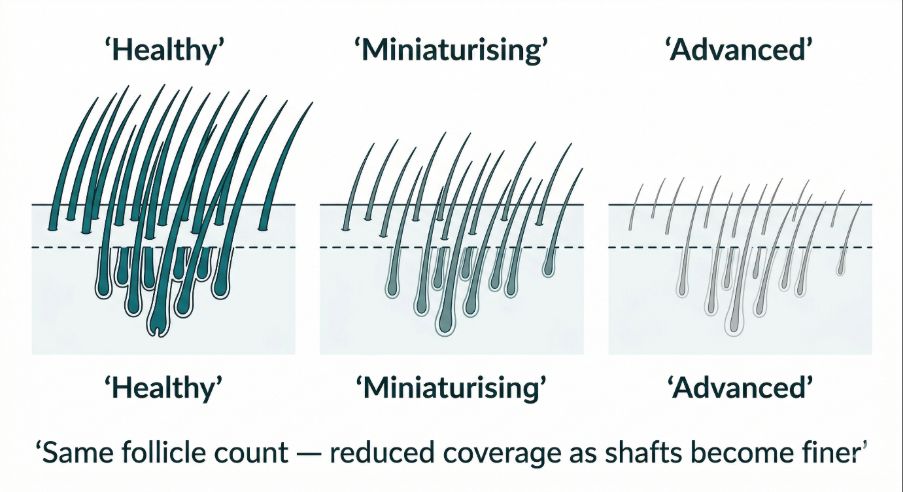
Diffuse thinning can also occur when hair follicles produce progressively thinner hair shafts.
If follicles gradually become smaller, the hair they produce may become finer during each growth cycle. Even if the number of follicles remains the same, thinner hairs provide less visible coverage of the scalp.
This process may develop slowly and may be difficult to notice in its early stages.
Over time, however, the reduction in hair thickness can make the scalp appear less covered.
Diffuse thinning in pattern hair loss
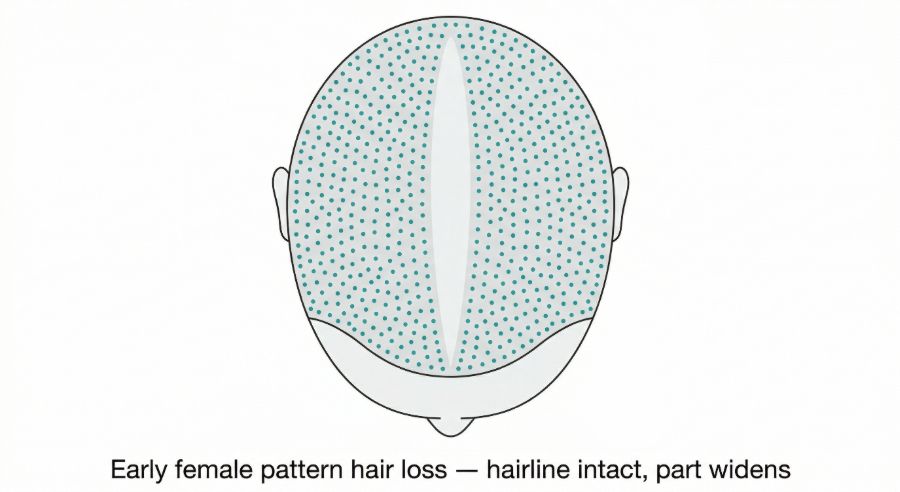
In some individuals, diffuse thinning may represent an early stage of androgenetic alopecia, particularly in women.
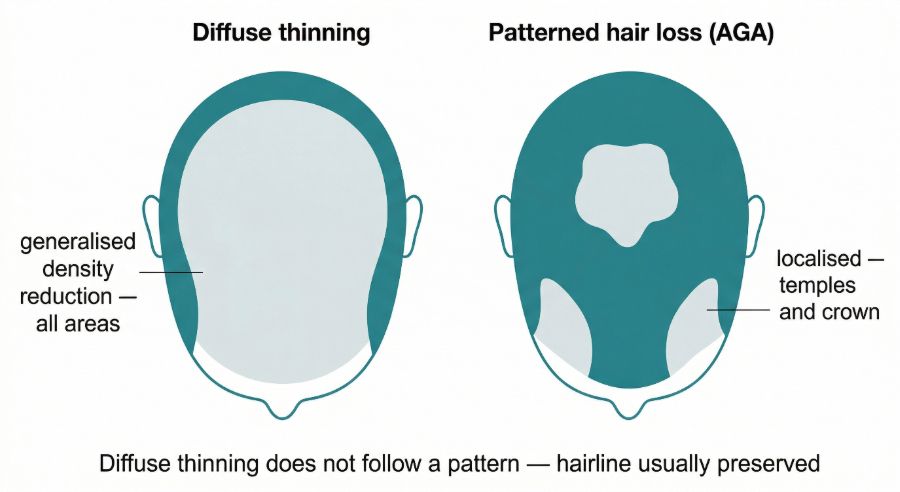
Rather than producing distinct patterns of hairline recession or crown thinning, some follicles across the top of the scalp begin to produce thinner hairs.
This gradual change in hair thickness may create the appearance of reduced density across the central scalp while the frontal hairline remains largely intact.
Because the thinning is spread across a wide area, it may initially appear subtle.
Other factors that may influence diffuse thinning
Several physiological and environmental factors can influence the behaviour of hair follicles.
Hormonal changes can alter the hair growth cycle and influence the thickness of the hair shaft. Nutritional factors may also affect the ability of follicles to produce healthy hair.
Certain illnesses, medications, or significant physical stress can temporarily disrupt the growth cycle and contribute to diffuse shedding.
Because many factors may interact, diffuse thinning can sometimes have more than one contributing cause.
Medications are a recognised cause of diffuse thinning. Anticoagulants such as heparin and warfarin, antihypertensive agents including beta-blockers, retinoids, hormonal treatments, and oncology drugs can all push a proportion of follicles prematurely into the telogen phase. Cytotoxic chemotherapy agents may additionally disrupt the anagen phase directly. In most cases, shedding begins two to four months after the causative drug is introduced.
Chemical exposures can also disrupt diffuse hair growth. Heavy metals including thallium, arsenic, and mercury are established causes, and exposure may occur occupationally or through contaminated environments. Industrial solvents and harsh chemical treatments applied to the hair can similarly impair follicle function. Identifying and removing the causative agent is the first step in allowing the cycle to normalise.
How diffuse thinning differs from patchy hair loss
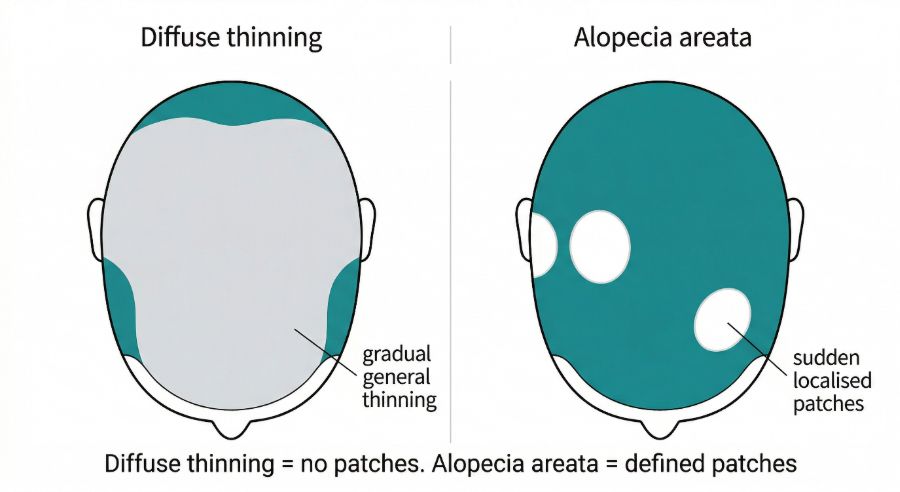
Diffuse thinning is different from forms of hair loss that produce clearly defined areas of baldness.
For example, in alopecia areata, hair loss usually appears as round or oval patches where hair is absent.
In diffuse thinning, hair loss is distributed across the scalp. The hairline usually remains intact, and the scalp does not develop isolated patches of complete hair loss.
Instead, the overall volume of hair gradually decreases.
Observing changes over time
Because diffuse thinning often develops gradually, it may be difficult to recognise the change immediately.
Individuals may notice that hairstyles feel different, that the scalp becomes more visible under bright light, or that the ponytail feels thinner than before.
Photographs taken months or years apart sometimes make these changes easier to recognise.
Tracking changes over time can provide useful information about how hair density is evolving.
Clinical evaluation
When diffuse thinning becomes noticeable or persistent, a clinical evaluation may help determine the underlying cause.
Clinicians may examine the scalp, review medical history, and consider factors such as recent illness, hormonal changes, or medications.
In some cases, additional tests may be used to assess factors that influence hair growth.
The aim of this evaluation is to understand how the hair cycle and follicle behaviour may have changed.
A broader view of diffuse thinning
Diffuse hair thinning reflects a change in the balance between hair growth, hair shedding, and the thickness of the hair shaft.
Because hair follicles remain present beneath the skin, the appearance of the scalp depends on how actively these follicles are producing hair and how thick the hair strands are.
Understanding this distinction helps clarify why thinning can occur without the sudden development of bald patches and why the appearance of the hair can change gradually over time.
Author: Dr. Priya Goswami
Medical review: Dr. Denis Broun
Next step
If you notice coverage changes without increased shedding, confirm what process is occurring.
Take the Hair Assessment to have a physician review your pattern, identify whether miniaturization is present, and determine appropriate staging and next steps.
Add Comment