Hair follicles are among the most active structures in the human body. They continuously produce hair through repeating cycles of growth, regression, rest, and renewal. Unlike many tissues that remain relatively stable, hair follicles are constantly changing their activity over time.
A common question is whether hair follicles have a fixed lifespan. The answer is more complex than a simple number of years. Hair follicles are capable of functioning for decades, but their activity and ability to produce thick hair can gradually change depending on genetics, hormones, ageing, inflammation, and general health.
Understanding how long a hair follicle lives requires understanding how the follicle continuously renews itself through the hair growth cycle.
Hair follicles are living mini-organs
A hair follicle is not simply a hole in the skin.
It is a highly specialised mini-organ composed of:
- the hair bulb
- dermal papilla
- outer and inner root sheaths
- stem cell regions
- sebaceous glands
- associated blood vessels and nerves
These structures work together to produce and support the hair shaft.
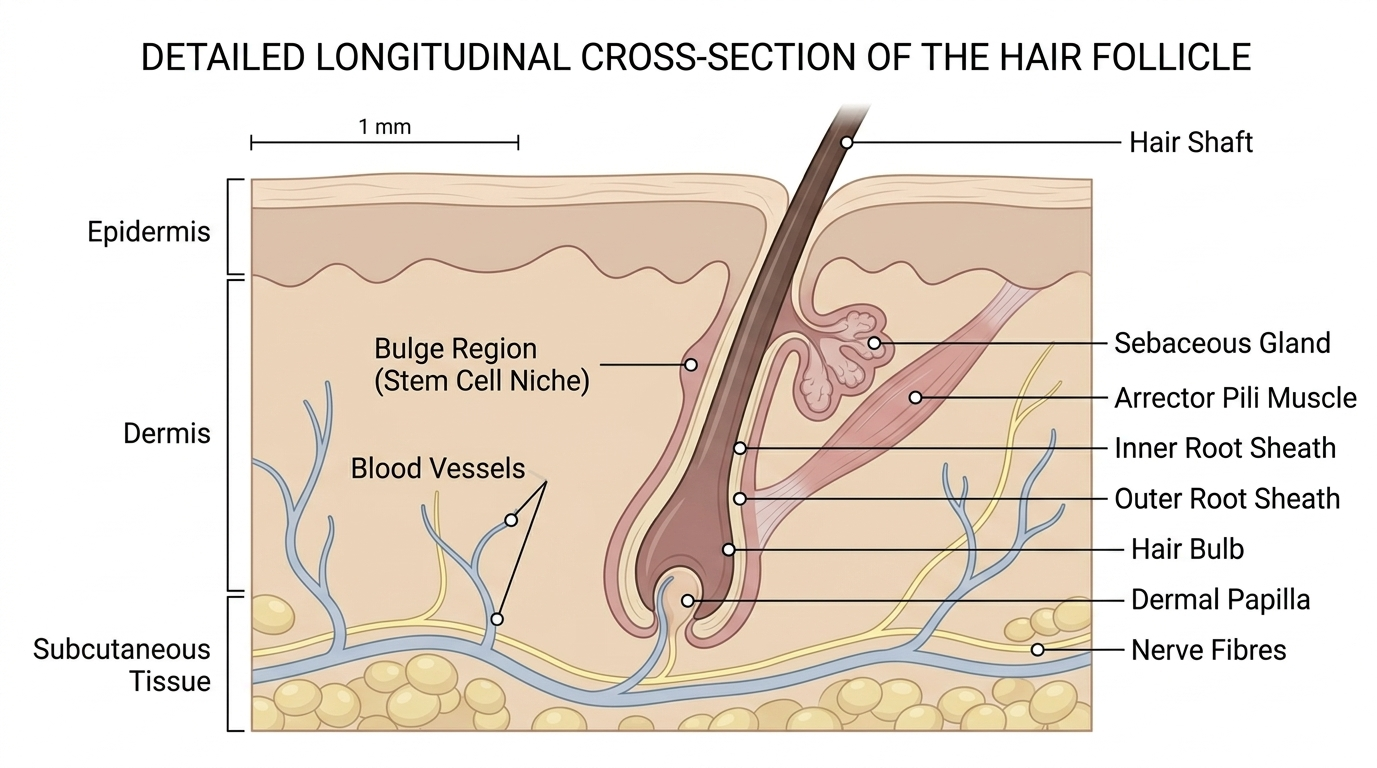
Because follicles contain active stem cell populations, they are capable of repeatedly regenerating new hairs throughout life.
The repeating hair growth cycle
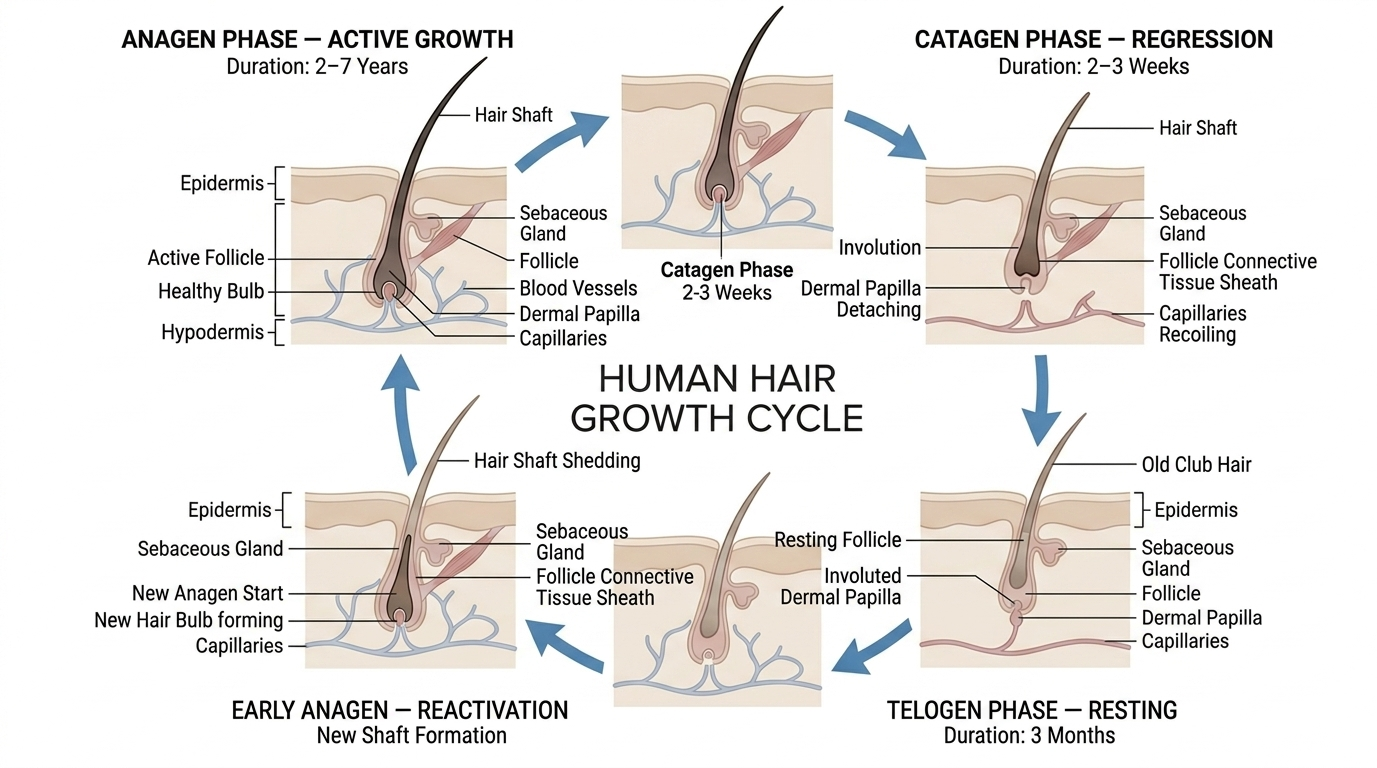
Hair follicles operate through repeating biological cycles.
These cycles include:
The anagen phase
This is the active growth phase.
During anagen:
- cells in the hair bulb divide rapidly
- the follicle enlarges
- the hair shaft grows continuously
On the scalp, this phase may last between two and seven years.
The catagen phase
This is a short transitional phase.
The follicle temporarily regresses and detaches from part of its blood supply.
The telogen phase
This is the resting phase.
The follicle remains inactive for several months before eventually shedding the old hair.
The new anagen phase
After resting, the follicle reactivates and begins producing a new hair shaft.
This cycle repeats continuously throughout life.
Hair follicles can function for decades
Healthy scalp follicles are capable of cycling for many decades.
A single follicle may produce dozens of hairs during a lifetime because each cycle creates a completely new hair shaft.
Unlike teeth or certain nerve cells, follicles are not designed for single use. Their stem cell populations allow repeated regeneration.
In many individuals, follicles remain active well into old age.
Follicles do not all age equally
Not all follicles behave in the same way over time.
Some remain large and productive throughout life, while others gradually change their behaviour.
These differences are influenced by:
- genetic predisposition
- hormonal sensitivity
- inflammatory signals
- ageing processes
- scalp health
This explains why some individuals retain dense hair into advanced age while others experience progressive thinning much earlier.
Miniaturisation changes follicle lifespan functionally
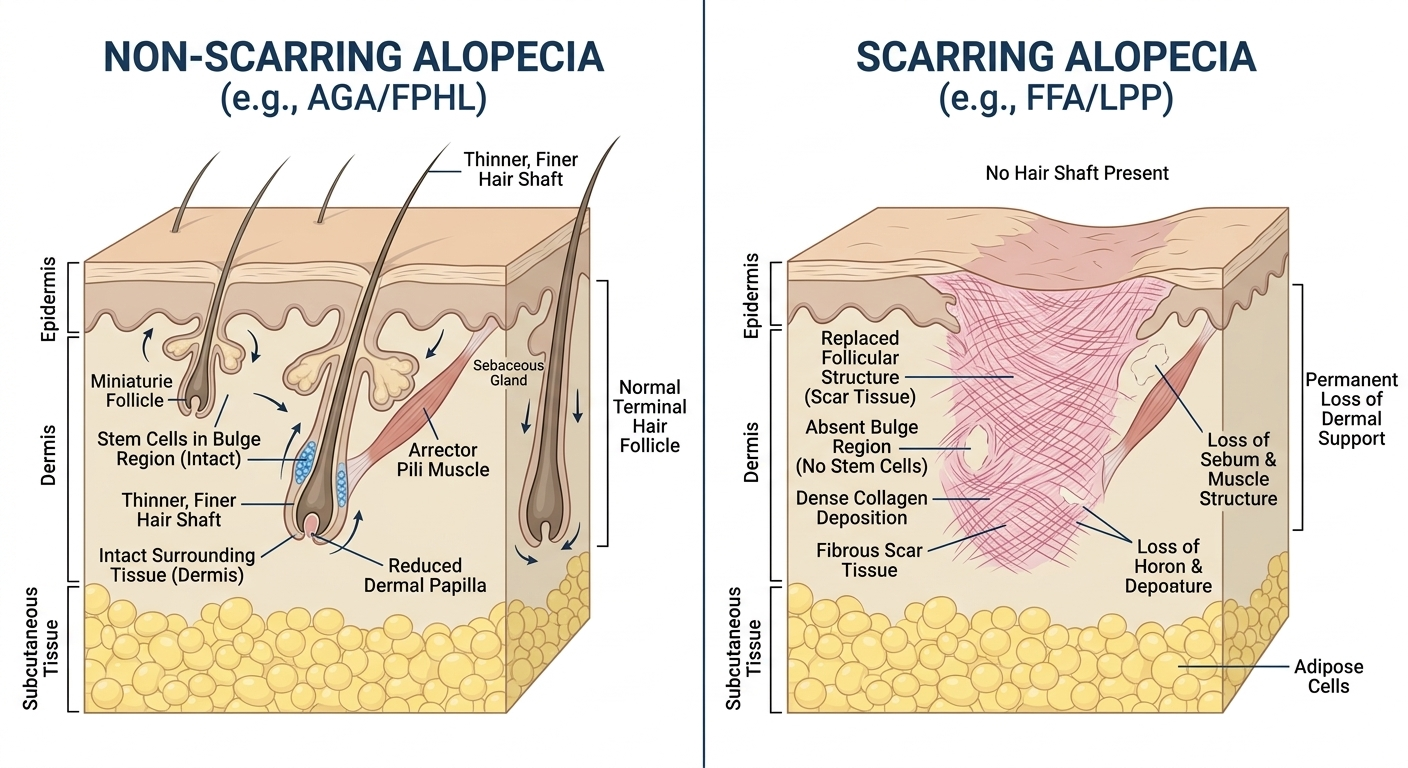
In androgenetic alopecia, follicles undergo miniaturisation.
Miniaturised follicles:
- become progressively smaller
- produce thinner hair shafts
- spend less time in the growth phase
- generate shorter hairs
Importantly, the follicle itself often remains alive beneath the skin.
The visible appearance of baldness therefore usually reflects altered follicle function rather than the complete disappearance of follicles.
Stem cells and follicle renewal
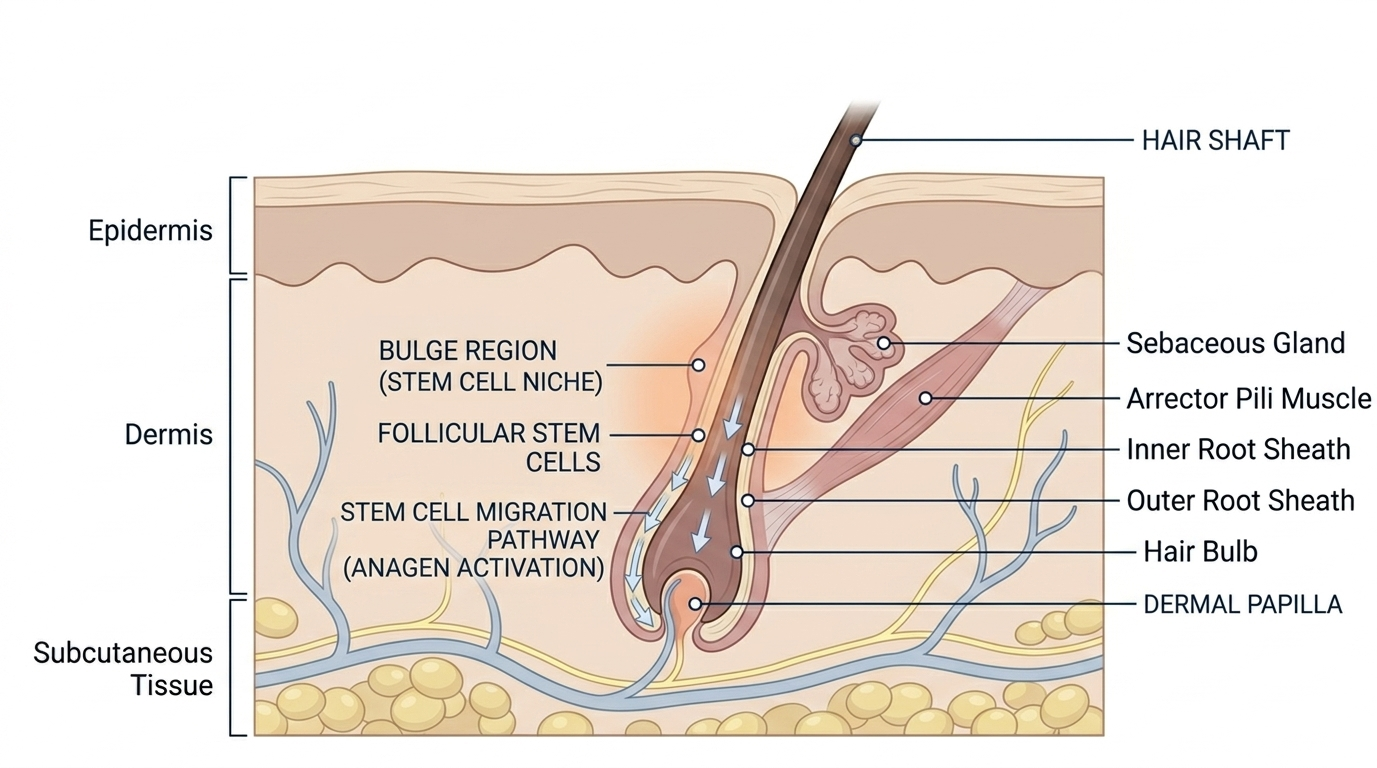
Hair follicle stem cells are essential for long-term follicle survival.
These stem cells reside in a region known as the bulge area of the follicle.
During each new growth cycle, they help regenerate the lower portion of the follicle and support the production of a new hair shaft.
Research suggests that in many forms of non-scarring alopecia, stem cells remain present even when follicles become miniaturised.
When follicles permanently stop functioning
Some conditions can permanently damage follicles.
This occurs mainly in scarringalopecias , where inflammation destroys the follicular structure and replaces it with scar tissue.
Once this happens:
- the follicle cannot regenerate
- hair production permanently stops in that area
This differs from androgenetic alopecia, where follicles are usually still present but produce very fine hair.
Ageing and follicle longevity
With age, follicle activity gradually changes.
Age-related changes may include:
- slower cellular turnover
- reduced dermal papilla activity
- shorter growth phases
- reduced pigment production
- thinner hair shafts
These changes can reduce visible hair density even though follicles remain alive.
Hair follicles are highly resilient structures
Despite continuous cycling, hair follicles are remarkably durable.
They can:
- recover after temporary shedding episodes
- resume growth after physiological stress
- regenerate new hairs repeatedly across decades
This regenerative ability is one reason temporary shedding conditions such as telogen effluvium usually resolve over time.
A long-lived regenerative system
Hair follicles do not have a simple fixed lifespan.
Instead, they function as long-lived regenerative structures capable of cycling repeatedly throughout life. Their ability to continue producing thick hair depends on:
- stem cell activity
- hormonal influences
- genetic factors
- ageing processes
- the health of the follicular environment
In many common forms of hair thinning, follicles remain alive but gradually lose their ability to produce robust terminal hairs.
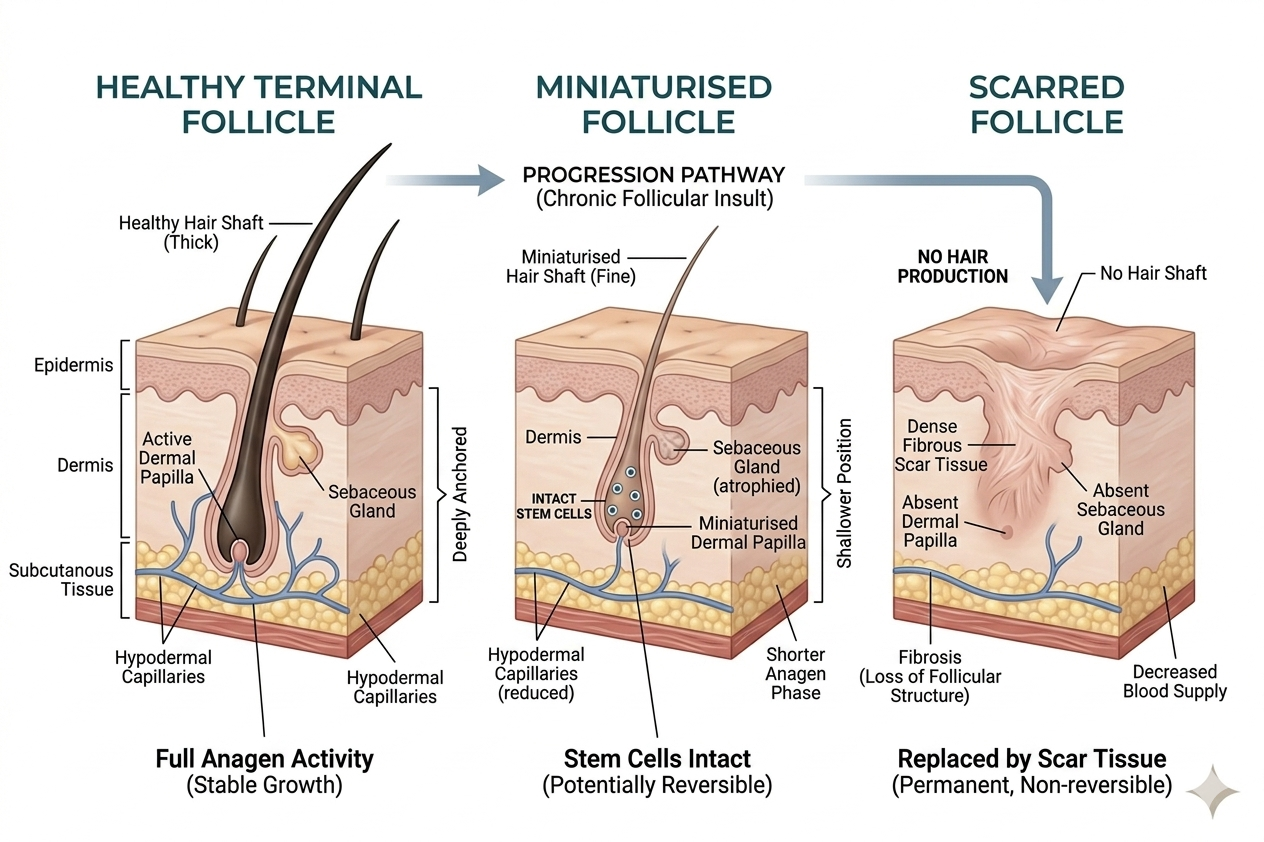
Understanding this distinction helps explain why hair density changes over time and why some forms of hair loss are potentially reversible while others are permanent.
Author: Dr. Priya Goswami
Medical review: Dr. Denis Broun
Next step
If you notice coverage changes without increased shedding, confirm what process is occurring.
Take the Hair Assessment to have a physician review your pattern, identify whether miniaturization is present, and determine appropriate staging and next steps.
Add Comment