Minoxidil is one of the most widely used topical treatments for hair thinning worldwide. It has been used for decades in both men and women and remains one of the few extensively studied treatments for androgenetic hair loss.
Despite this, many women remain uncertain about whether minoxidil works differently in female hair loss compared with male hair loss. Questions commonly include:
- whether women respond better or worse
- whether different strengths are needed
- whether the mechanism changes
- whether side effects differ
- whether female hair loss behaves differently biologically
The answer is nuanced. The core mechanism of minoxidil appears broadly similar in both sexes, but the pattern of hair loss, hormonal environment, scalp biology, treatment response, and tolerability may differ in important ways.
Female hair thinning is biologically different from male pattern baldness
Before discussing treatment, it is important to understand that female androgenetic hair thinning often behaves differently from classic male pattern baldness.
In men, thinning commonly affects:
- the temples
- frontal hairline
- crown
Progression often leads to clearly defined bald areas.
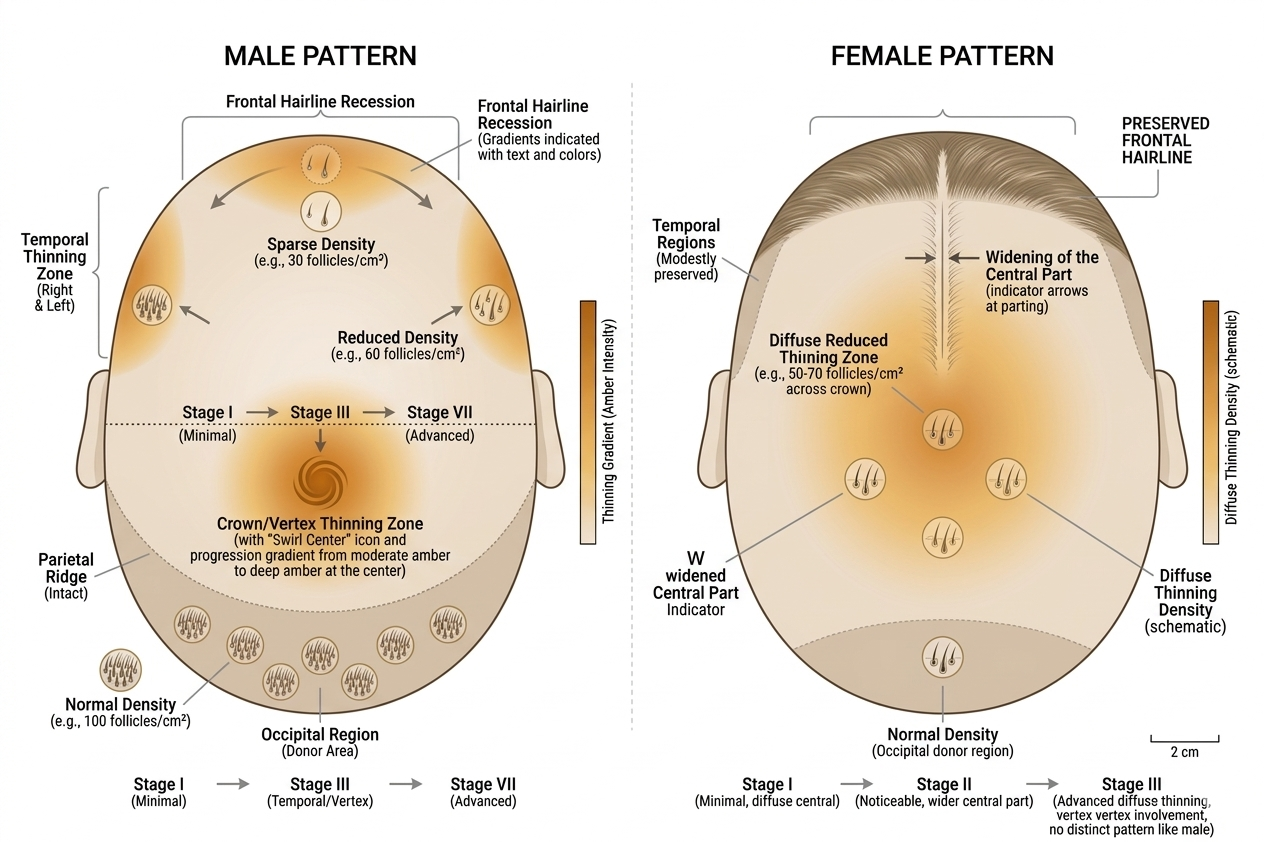
In women, thinning more commonly presents as:
- diffuse reduction in density
- widening of the central part
- reduced volume across the crown
- preservation of the frontal hairline in many cases
Because the patterns differ, women often notice:
- reduced density
- scalp visibility
- flattening of hairstyles
before obvious bald patches appear.
What minoxidil actually does
Minoxidil is not primarily a hormonal treatment.
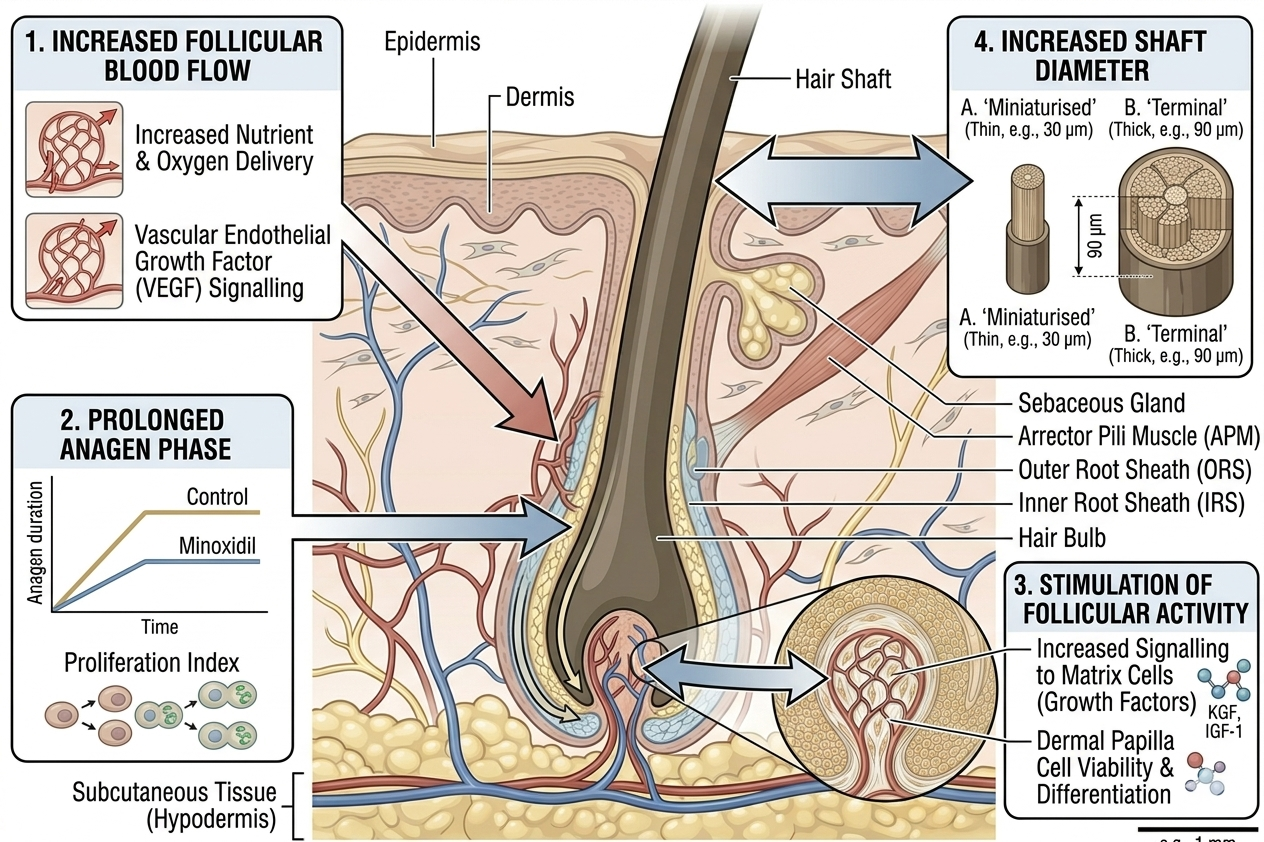
Its effects appear related to several biological mechanisms involving:
- follicular blood flow
- potassium channel activity
- prolongation of the growth phase
- stimulation of follicular activity
The treatment helps follicles remain in the active growth phase for longer periods and may help enlarge miniaturised follicles in some individuals.
This can increase:
- hair shaft thickness
- visible density
- duration of growth cycles
The mechanism appears similar in women and men
Current evidence suggests that the fundamental biological action of minoxidil is broadly similar in both sexes.
In both women and men, it may:
- prolong anagen duration
- stimulate miniaturised follicles
- increase shaft diameter
- improve visible density over time
The follicle itself responds to the medication through similar biological pathways regardless of sex.
Women may notice different cosmetic outcomes
Although the mechanism is similar, the visible response may differ because female thinning patterns are different.
Women often seek improvement in:
- central density
- scalp visibility
- ponytail thickness
- overall volume
Men more commonly focus on:
- frontal recession
- temple loss
- crown baldness
As a result, treatment success may be perceived differently even when biological follicular response is comparable.
Female follicles may remain active longer
In many women with androgenetic thinning:
- follicles miniaturise more slowly
- complete baldness is less common
- diffuse thinning predominates rather than total follicle disappearance
This means that many follicles remain biologically active for long periods, potentially allowing improvement in visible density when follicular activity is stimulated.
Concentrations may differ between women and men
Historically, lower concentrations were often recommended for women because of concerns regarding:
- scalp irritation
- unwanted facial hair growth
- tolerability
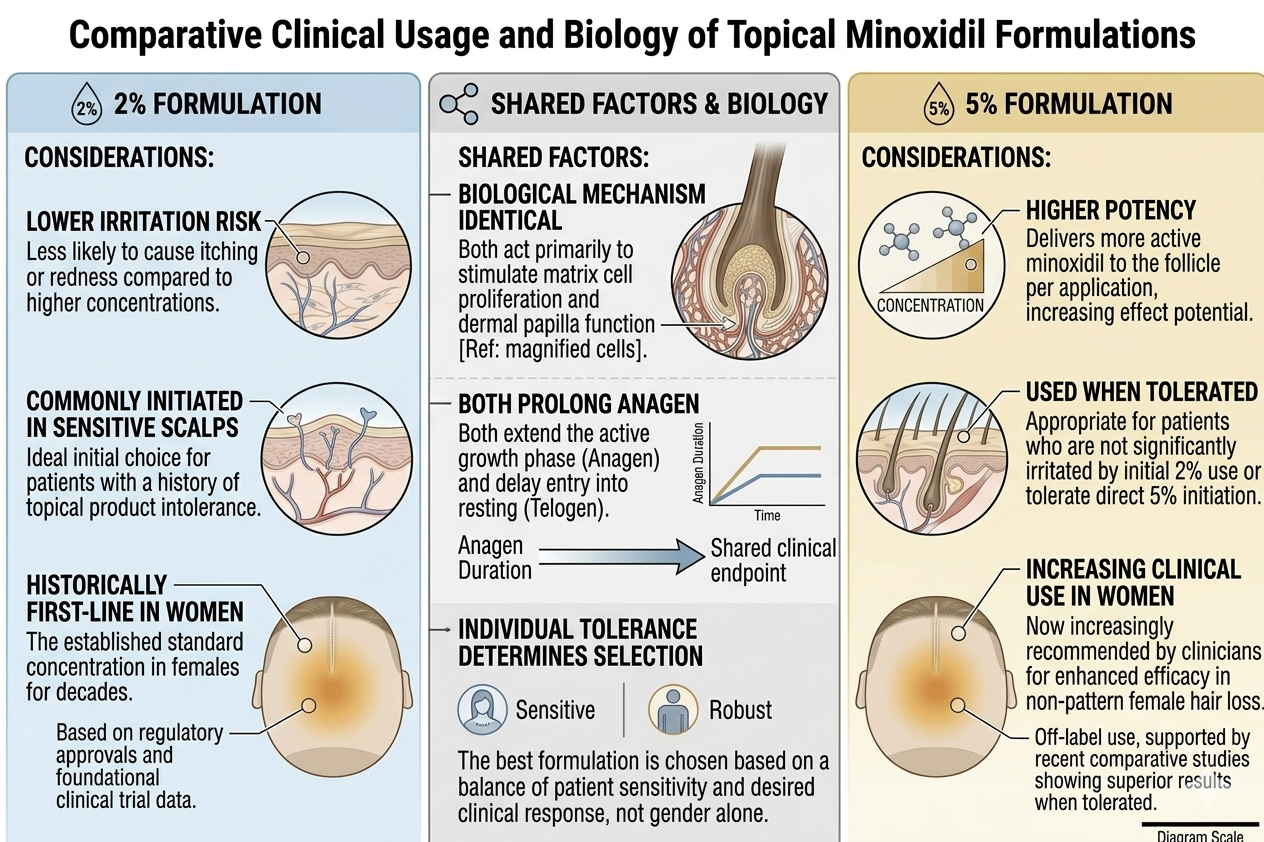
Today, both 2% and 5% formulations are used in women depending on:
- scalp sensitivity
- treatment goals
- medical guidance
- individual tolerance
The biological mechanism itself does not fundamentally change because of concentration differences.
Shedding may occur early in treatment
Some individuals experience increased shedding during the early phase of treatment.
This occurs because follicles may shift cycling patterns as growth phases are altered.
Temporary increased shedding can happen in both women and men and does not necessarily indicate worsening hair loss.
Women may be more sensitive to cosmetic side effects
Although the treatment mechanism is similar, cosmetic tolerability can differ.
Women may be more affected by:
- texture changes
- scalp irritation
- unwanted facial hair
- residue affecting styling
- changes in curl or volume behaviour
These concerns sometimes influence long-term adherence more strongly than in men.
Hormonal context differs between women and men
Female hair thinning often exists within a more complex hormonal environment.
Contributing influences may include:
- menopause
- ovarian hormone changes
- postpartum shifts
- thyroid dysfunction
- nutritional factors
As a result, female hair thinning is not always driven solely by androgen sensitivity in the same way as classic male pattern baldness.
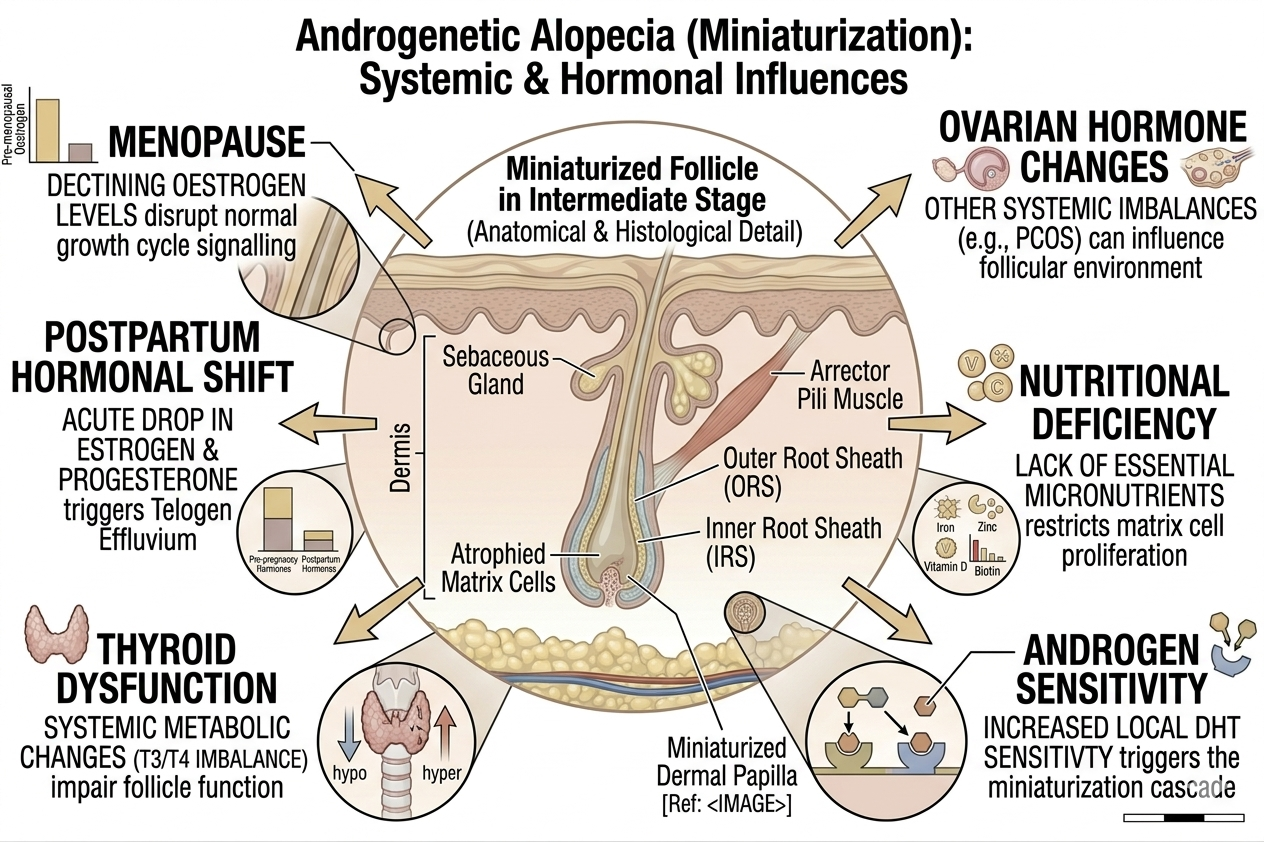
This can influence how treatment responses appear clinically.
Response timelines are usually gradual
Minoxidil does not produce immediate visible change.
Follicles function through long biological cycles, meaning visible changes usually require:
- several months of consistent use
- repeated growth cycles
- gradual shaft thickening over time
Women and men generally experience similarly gradual timelines.
Hair density improvement may be subtle
In women especially, the most noticeable effects may include:
- reduced scalp visibility
- improved fullness
- thicker appearing strands
- better styling coverage
rather than dramatic regrowth of completely bald areas.
Treatment response varies considerably
Not all individuals respond similarly.
Response variability depends on:
- follicular sensitivity
- stage of miniaturisation
- age
- scalp biology
- consistency of use
- underlying diagnosis
Some individuals experience visible improvement, while others mainly stabilise progression.
Female hair thinning requires careful diagnosis
Diffuse thinning in women may sometimes reflect conditions other than androgenetic alopecia, including:
- telogen effluvium
- iron deficiency
- endocrine disorders
- inflammatory scalp disease
Accurate diagnosis remains important because not all diffuse thinning behaves identically.
The biology is similar, but the clinical experience differs
Minoxidil appears to work through broadly similar biological mechanisms in women and men by influencing follicular activity and prolonging the growth phase.
However, the clinical experience often differs because female hair thinning follows different patterns, progresses differently, and exists within a distinct hormonal and cosmetic context.
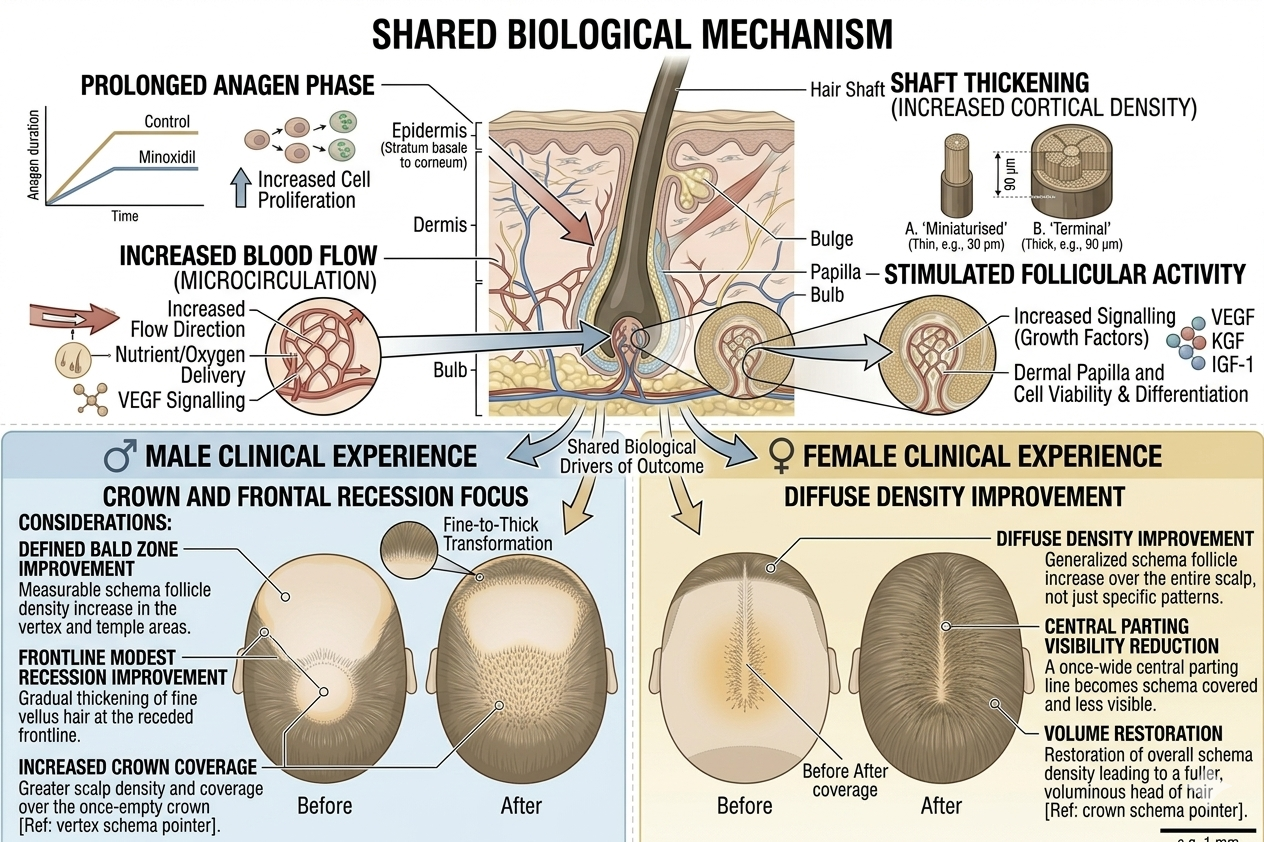
For many women, the most important changes involve improved density, reduced scalp visibility, and restoration of volume rather than reversal of complete baldness.
Author: Dr. Priya Goswami
Medical review: Dr. Denis Broun
Next step
If you notice coverage changes without increased shedding, confirm what process is occurring.
Take the Hair Assessment to have a physician review your pattern, identify whether miniaturization is present, and determine appropriate staging and next steps.
Add Comment