
A receding hairline is one of the most common reasons men begin to notice hair loss. It usually appears as a gradual backward movement of the hairline, especially around the temples. Over time, the frontal edge of the hair may become less dense, the corners may deepen, and the shape of the hairline may change.
A receding hairline does not always mean aggressive hair loss. Some hairline change can occur naturally with age. The important question is whether the hairline has stabilised or whether it is continuing to thin progressively.
Understanding the causes, stages, and warning signs helps place these changes in a clear biological context.
What a receding hairline means
A receding hairline refers to a gradual reduction of hair density along the front of the scalp.
It most commonly affects:
- the temples
- the frontal corners
- the central frontal hairline
- the region where the forehead meets the scalp
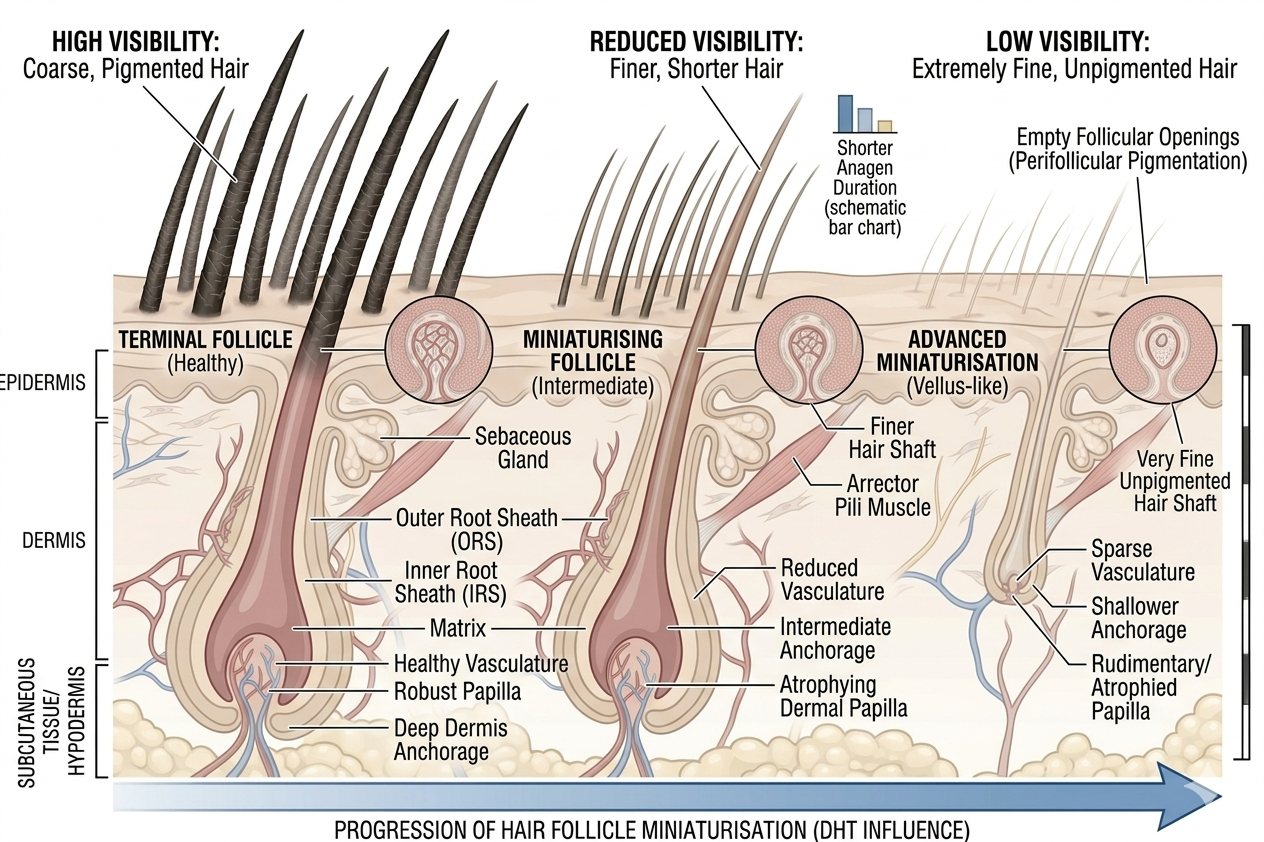
In many cases, the change is caused by progressive miniaturisation of hair follicles.
This means the follicles are still present, but they begin producing thinner, shorter, and less visible hairs over repeated growth cycles.
The difference between a mature hairline and recession
Not every change in the hairline represents hair loss.
Many men develop a mature hairline after adolescence.
A mature hairline may involve:
- slight movement upward from the teenage hairline
- mild temple reshaping
- stable density
- no continuing progression
A receding hairline, in contrast, usually shows:
- progressive backward movement
- reduced hair density at the temples
- thinner frontal hairs
- increasing scalp visibility over time
The key difference is progression.
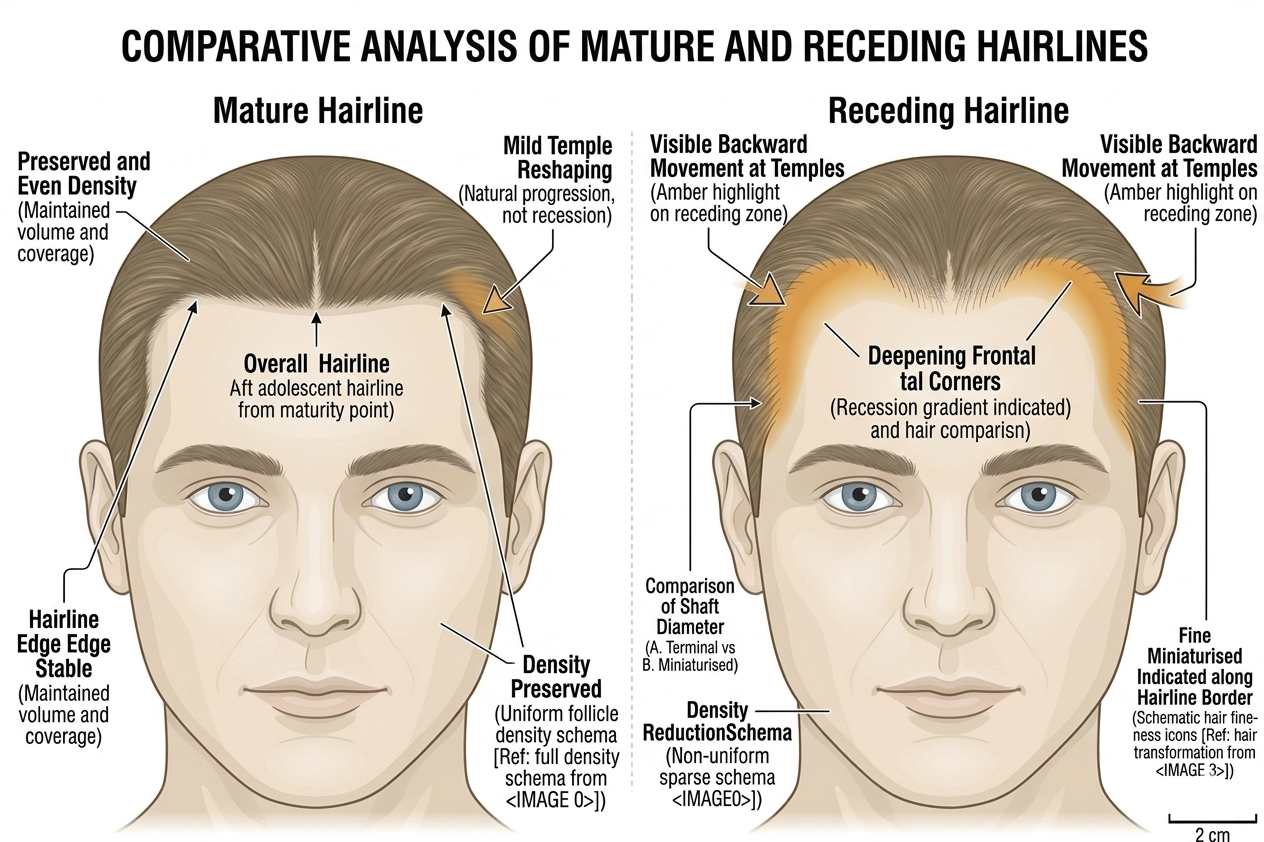
A mature hairline tends to stabilise. A receding hairline continues changing.
The most common cause
The most common cause of a receding hairline is androgenetic alopecia, also called male pattern hair loss.
In this condition, genetically sensitive follicles gradually respond to androgen-related signals by becoming smaller.
This process is known as follicle miniaturisation.
Miniaturised follicles produce hairs that are:
- finer
- shorter
- softer
- less pigmented
- less able to cover the scalp
Over time, this creates visible recession at the frontal hairline and temples.
Why the temples are often affected first
The temples are commonly one of the earliest affected areas because follicles in this region are often more sensitive to hormonal signalling in genetically predisposed individuals.
This does not mean all follicles on the scalp behave the same way.
Follicles on the sides and back of the scalp are usually less sensitive and may remain strong even when frontal hairline thinning progresses.
This regional difference explains why male pattern hair loss often follows recognisable patterns.
Early signs of a receding hairline
Early recession may be subtle.
Common signs include:
- temple corners becoming deeper
- frontal hairline looking less dense
- small fine hairs replacing thicker hairs
- increased scalp visibility under light
- difficulty styling the front of the hair
- hairline appearing different in old photographs
These changes often develop slowly over years.
Because the process is gradual, many people only recognise it when comparing current images with older ones.
Stages of hairline recession
Hairline recession is often described using the Norwood scale.
This classification system describes common patterns of male hair loss.
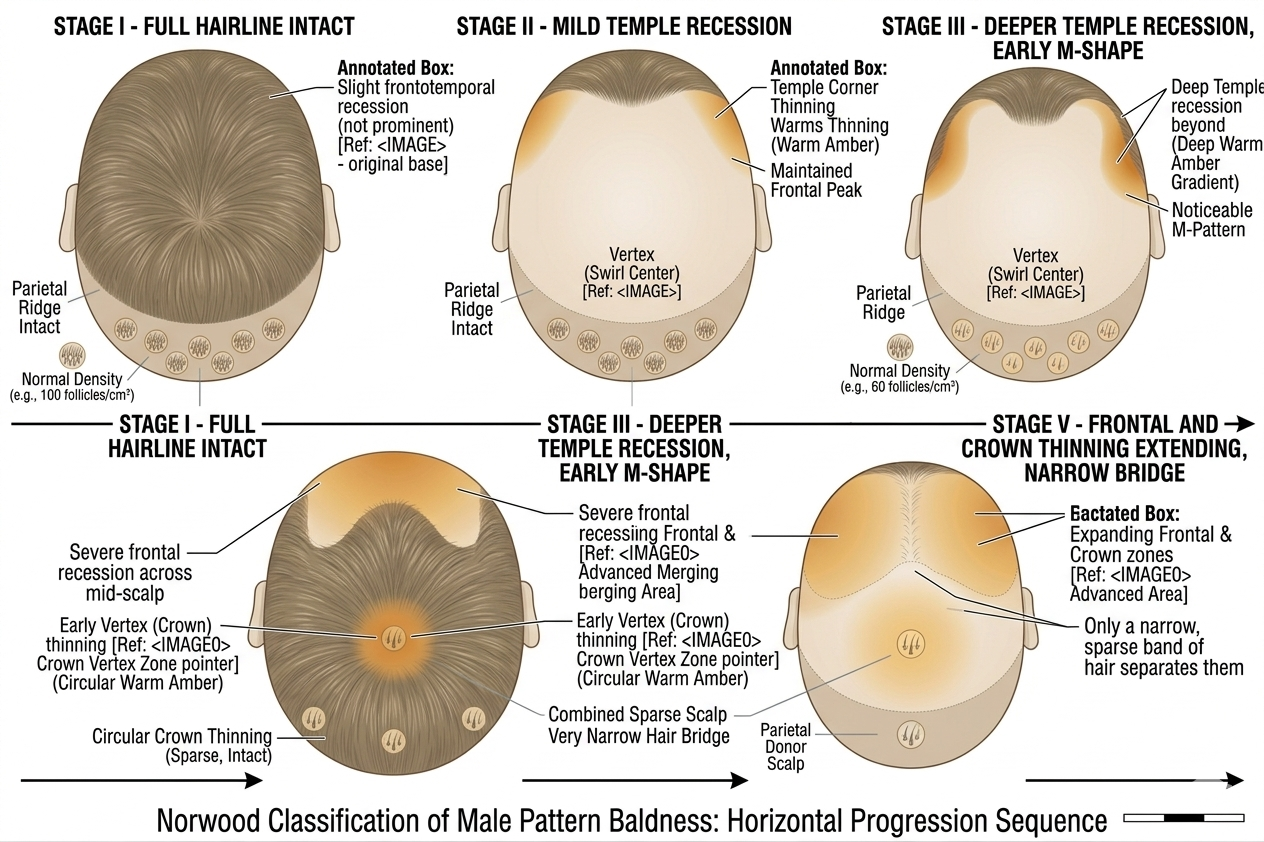
Early stage
The hairline may show mild temple recession.
Density remains mostly preserved, and the change may be difficult to distinguish from a mature hairline.
Moderate stage
The temples recede more clearly.
The hairline may begin forming an “M” shape. Frontal density may reduce, and fine miniaturised hairs may become visible along the leading edge.
Advanced stage
Recession extends further backward.
The frontal hairline becomes noticeably thinner, and crown thinning may also appear. In later stages, frontal and crown thinning may connect.
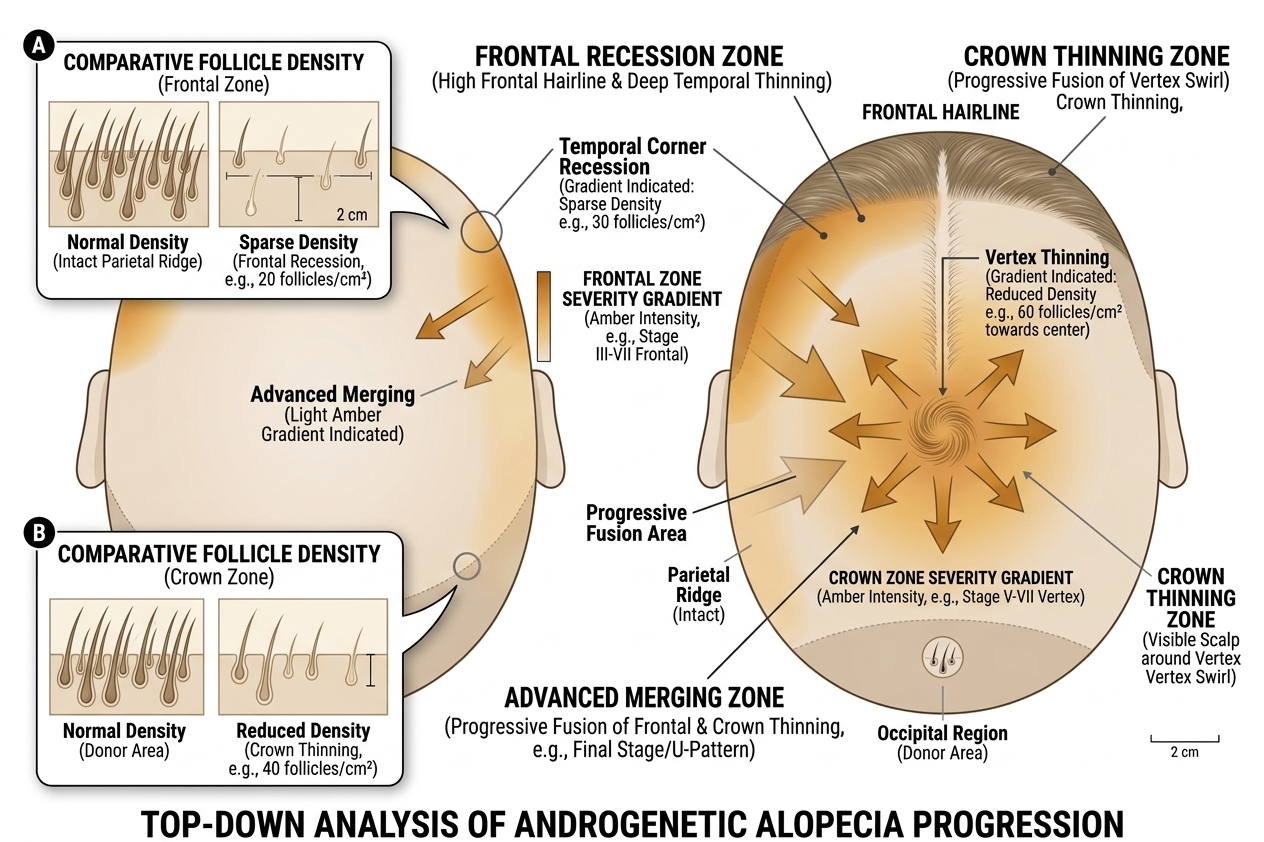
Crown thinning may occur with recession
A receding hairline may occur alone at first.
However, in male pattern hair loss, crown thinning often develops at some point.
The crown may show:
- reduced density
- increased scalp visibility
- thinning around the hair whorl
- flattening under overhead light
When frontal recession and crown thinning occur together, the pattern is more suggestive of progressive androgenetic alopecia.
Other causes of frontal hairline change
Although androgenetic alopecia is common, not all frontal hairline change has the same cause.
Other possible contributors include:
- traction from tight hairstyles
- inflammatory scalp conditions
- scarring alopecias
- nutritional or hormonal disturbances
- temporary shedding episodes
- repeated mechanical stress
This is why pattern, timing, symptoms, and scalp appearance matter.
When to get it checked
A receding hairline should be assessed if the change is progressive or associated with other concerning features.
Medical review is especially reasonable if there is:
- rapid recession over months
- patchy hair loss
- itching, redness, scaling, or pain
- sudden shedding
- visible thinning at the crown
- strong family history with early onset
- recession affecting confidence or daily life
Early evaluation can help distinguish normal maturation from progressive hair loss.
How clinicians evaluate a receding hairline
A clinician may assess:
- hairline shape
- density at the temples
- shaft diameter variation
- crown involvement
- scalp inflammation
- medical history
- family history
Dermoscopy may be used to examine the scalp under magnification.
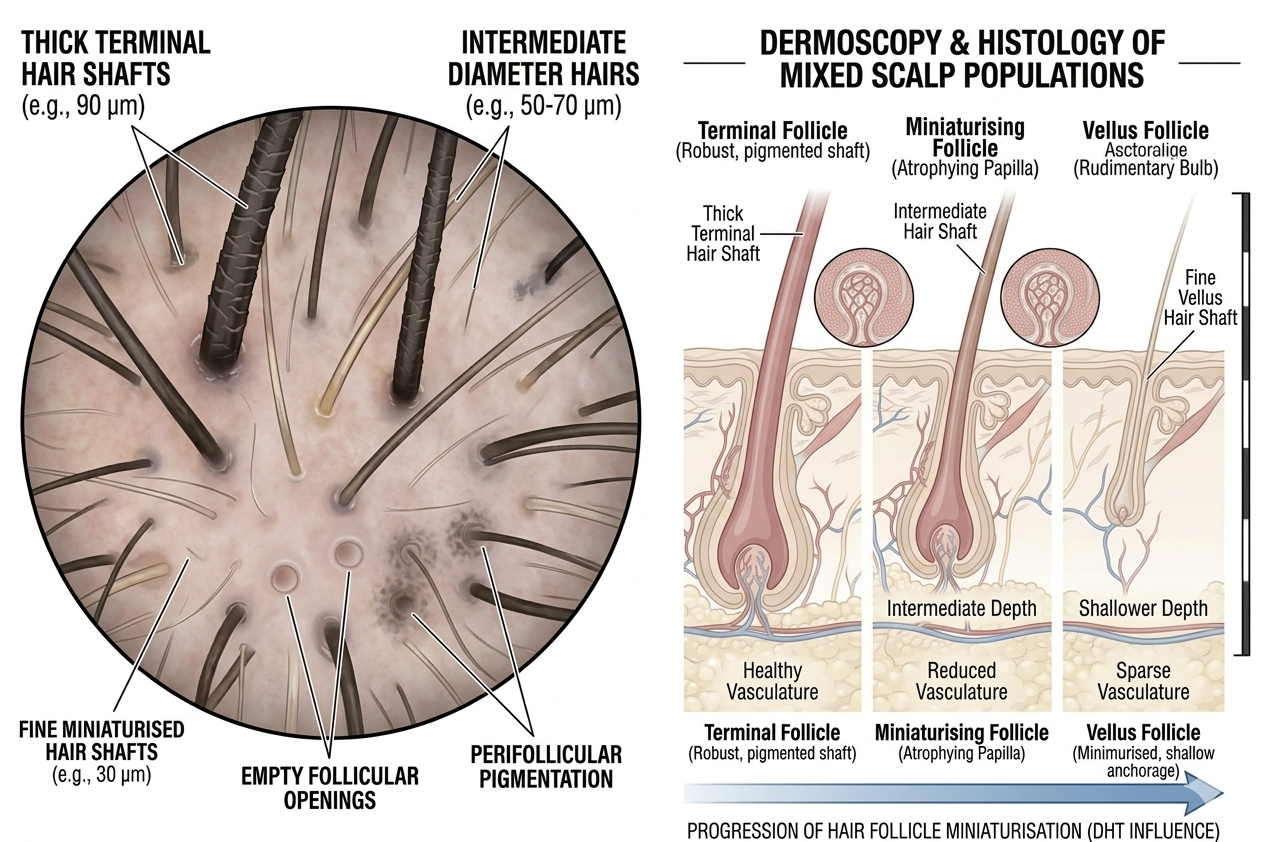
This can reveal miniaturised hairs and differences in hair shaft diameter that may not be obvious to the naked eye.
Why early assessment can be useful
Hair follicles often change gradually before large areas appear thin.
If miniaturisation is identified early, it may be easier to understand the pattern and likely direction of progression.
Early assessment does not mean immediate treatment is always required.
It means the underlying cause can be identified more accurately.
Hairline recession is usually gradual
A receding hairline often reflects slow biological change within the frontal follicles.
In androgenetic alopecia, follicles at the temples and frontal scalp gradually miniaturise, producing thinner hairs over repeated growth cycles.
The process may begin subtly, progress over years, and vary widely between individuals.
Understanding whether the change is stable or progressive is the key distinction. A stable mature hairline may be a normal adult pattern. Ongoing recession, especially with crown thinning or increasing miniaturisation, is more consistent with progressive male pattern hair loss.
Author: Dr. Priya Goswami
Medical review: Dr. Denis Broun
Next step
If you notice coverage changes without increased shedding, confirm what process is occurring.
Take the Hair Assessment to have a physician review your pattern, identify whether miniaturization is present, and determine appropriate staging and next steps.
Add Comment