Many people notice that their hair does not always remain the same throughout life. Hair that once appeared thick and dense may gradually become finer or less voluminous. This change often occurs slowly, sometimes over many years, and may be difficult to recognise in its early stages.
Hair becoming thinner over time is usually related to changes in the behaviour of hair follicles. These changes can affect how thick each hair strand becomes, how long it grows, and how much coverage it provides on the scalp.
Understanding why hair becomes thinner requires looking at how hair follicles function and how they change during the hair growth cycle.
How hair thickness is determined
The thickness of a hair strand depends largely on the size and activity of the hair follicle that produces it.
Each follicle contains a growth centre known as the hair bulb. Cells within the bulb divide rapidly and gradually form the hair shaft. As these cells move upward through the follicle, they become filled with keratin, the protein that gives hair its strength and structure.
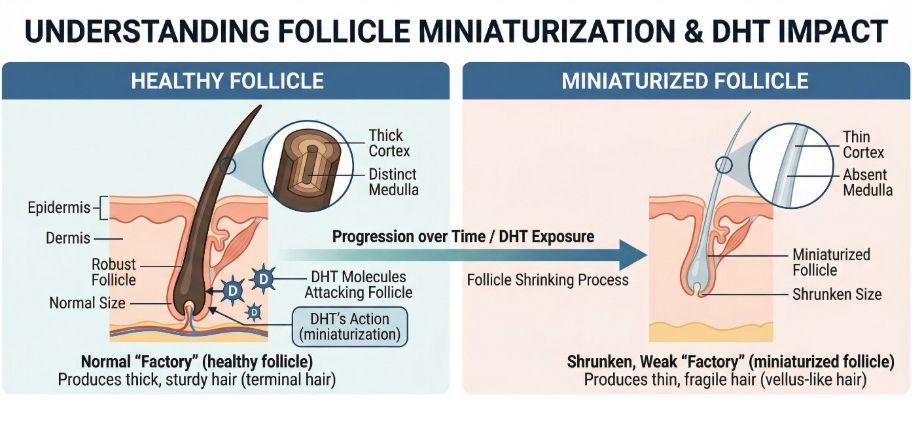
Larger follicles tend to produce thicker hair shafts, while smaller follicles produce finer hairs.
Because follicle size varies naturally between individuals, some people are born with thick hair while others have finer hair.
The role of the hair growth cycle
Hair does not grow continuously. Instead, each follicle follows a repeating cycle consisting of growth, transition, and rest.
During the growth phase, known as the anagen phase, the follicle actively produces hair. This phase can last several years on the scalp.
After this period, the follicle enters a brief transitional phase known as the catagen phase, lasting around two to three weeks, during which it shrinks and detaches from its blood supply. It then enters the telogen phase, a resting period of approximately three months, after which the hair is shed and the cycle begins again.
The duration of the growth phase influences how long and thick the hair can become.
Follicle miniaturisation
One of the most common reasons hair becomes thinner over time is a process called follicleminiaturisation .
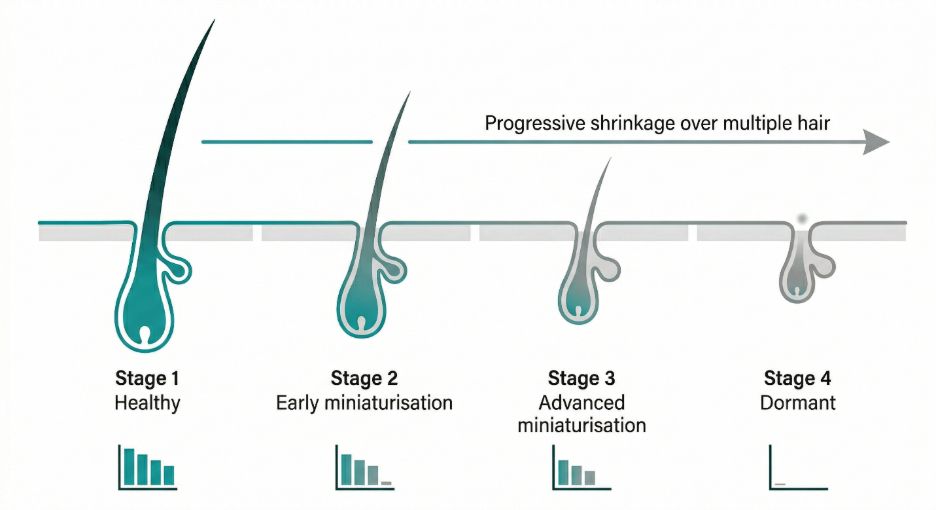
Miniaturisation occurs when the hair follicle gradually becomes smaller during successive growth cycles. As the follicle shrinks, the hair shaft produced during each cycle becomes thinner.
A hair that was once thick may gradually become finer over time. Eventually, some follicles may produce very thin hairs that resemble the fine hairs normally found on other parts of the body.
This process is central to androgenetic alopecia, the most common form of hair thinning in men and women.
Hormonal influences on the follicle
Hair follicles respond to a range of biological signals, including hormones.
In individuals who are genetically predisposed to androgenetic alopecia, certain follicles are sensitive to hormonal signals that influence their activity. Over time, this sensitivity can alter the growth cycle of the follicle.
The growth phase may become shorter, and the follicle may produce thinner hair during each cycle.
Because these changes occur gradually, the thinning of hair often develops slowly rather than suddenly.
Changes related to ageing
Hair characteristics may also change naturally with age.
As the body ages, the activity of hair follicles can gradually decline. Some follicles may produce slightly thinner hairs, while others may spend more time in the resting phase of the growth cycle.
These changes may lead to a subtle reduction in hair volume over time.
Age-related changes do not occur in exactly the same way for everyone. Some individuals maintain thick hair throughout life, while others experience more noticeable thinning.
Medications and chemical exposure
While miniaturisation and ageing are the most widely recognised causes of gradual hair thinning, medications and chemical exposures can also cause or accelerate the process. Certain drugs alter the hair cycle in ways that reduce the duration of the anagen phase or shift follicles prematurely toward telogen, both of which result in finer, shorter hairs. Medications commonly associated with this include retinoids, certain hormonal treatments, and some antihypertensive agents.
Prolonged exposure to heavy metals or harsh chemical treatments can similarly impair follicle function and contribute to a gradual reduction in hair thickness. In such cases, the thinning may be reversible once the causative substance is identified and removed, though recovery across the hair cycle may take several months.
The influence of the hair cycle on thickness
When the growth phase of the hair cycle becomes shorter, the hair produced during each cycle may not have enough time to reach its previous thickness or length.
A shorter growth phase means the hair spends less time developing before it enters the resting phase. This can contribute to the production of shorter and finer hairs.
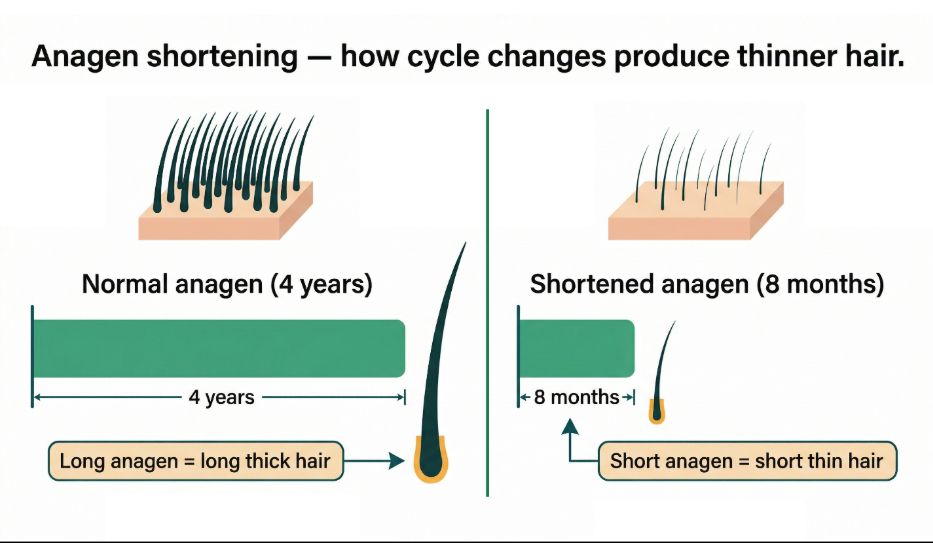
Over multiple cycles, these changes can gradually alter the overall appearance of the hair.
When thinning becomes noticeable
Hair thinning becomes noticeable when a sufficient number of follicles begin producing thinner hairs.
Because each hair provides slightly less coverage of the scalp, the scalp may gradually become more visible under certain lighting conditions or when the hair is wet.
The process often develops slowly and may only become apparent when comparing photographs taken several years apart.
In many cases, thinning occurs without a sudden increase in hair shedding.
Distinguishing thinning from hair shedding
Hair thinning and hair shedding are sometimes confused, but they represent different processes.
Hair shedding refers to the loss of hairs that have reached the end of their growth cycle. This is a normal process that occurs continuously.
Hair thinning, on the other hand, usually reflects changes in the size and activity of hair follicles. The follicles remain present but produce finer hair strands.
Understanding this distinction helps explain why hair can appear thinner even when daily shedding remains within normal limits.
A broader view of hair thinning
Hair becoming thinner over time usually reflects gradual changes in the behaviour of hair follicles rather than the sudden loss of hair.
Follicle miniaturisation, hormonal influences, and changes in the hair growth cycle can all contribute to the production of finer hair strands.
Because these changes develop slowly across multiple growth cycles, the overall appearance of the hair may change gradually rather than abruptly.
Recognising these biological processes provides a clearer understanding of why hair thickness can evolve over time and how different forms of hair thinning develop.
Author: Dr. Priya Goswami
Medical review: Dr. Denis Broun
Next step
If you notice coverage changes without increased shedding, confirm what process is occurring.
Take the Hair Assessment to have a physician review your pattern, identify whether miniaturization is present, and determine appropriate staging and next steps.
Add Comment