Male pattern hair loss usually develops gradually. In most men, the process begins with subtle changes in the behaviour of hair follicles long before obvious baldness appears. Because the changes occur slowly, the earliest signs are often easy to overlook.
Male pattern hair loss, medically known as androgenetic alopecia, affects the hair growth cycle and the thickness of the hair produced by certain follicles. Over time, these follicles begin to produce thinner hairs and the visible density of the scalp gradually decreases.
Recognising the early signs can help explain how the condition develops and why the changes tend to follow certain patterns.
The hair growth cycle
Many of the early signs of androgenetic alopecia are best understood in the context of how the hair growth cycle normally operates. Each follicle on the scalp moves through three repeating phases.
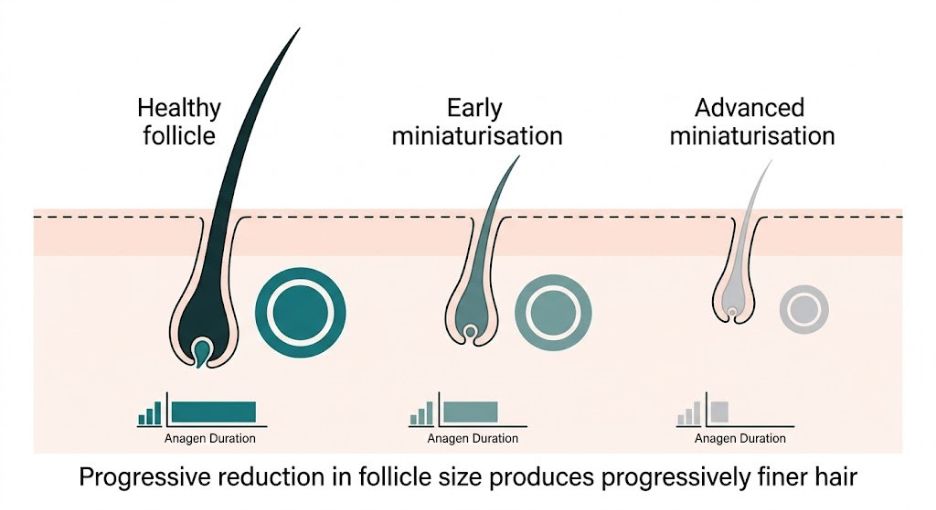
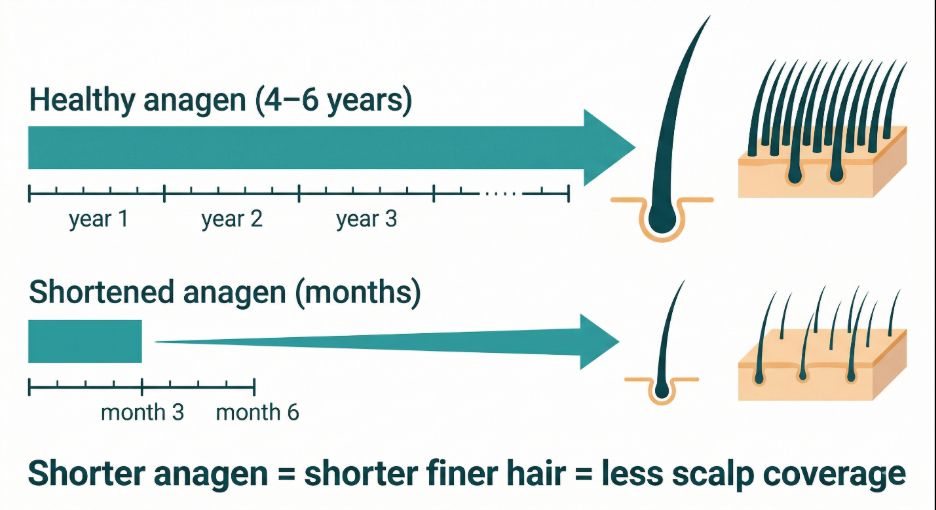
The anagen phase is the active growth period, lasting two to six years on the scalp. This phase determines how long and thick the hair can grow. In androgenetic alopecia, the progressive shortening of anagen with each successive cycle is the key biological event that produces thinner and shorter hairs over time.
The catagen phase is a brief transitional period of about two to three weeks during which the follicle shrinks and detaches from its blood supply.
The telogen phase is the resting period of approximately three months, after which the hair is shed and the cycle restarts. Understanding these phases explains why early pattern hair loss often produces subtly shorter, finer hair long before noticeable shedding begins.
Changes in the hairline
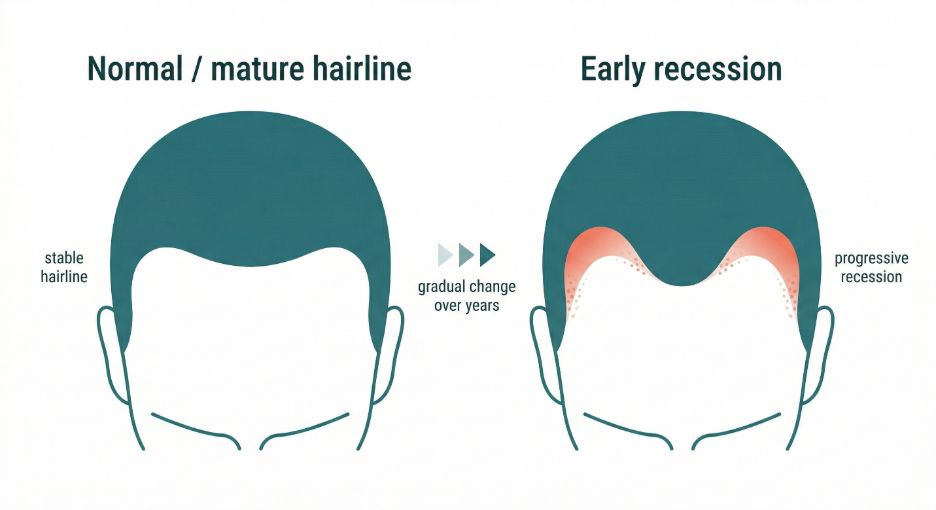
One of the earliest signs of male pattern hair loss involves the hairline at the temples.
In many men, the hairline begins to move slightly backward at the temples while the central portion of the hairline remains relatively stable. This process can create a subtle "M-shaped" contour across the front of the scalp.
These changes may develop slowly over several years. Because hairlines naturally vary between individuals, it is sometimes difficult to distinguish between a normal variation and the early stages of thinning.
Photographs taken at different points in time can sometimes make these changes easier to recognise.
Thinning at the crown
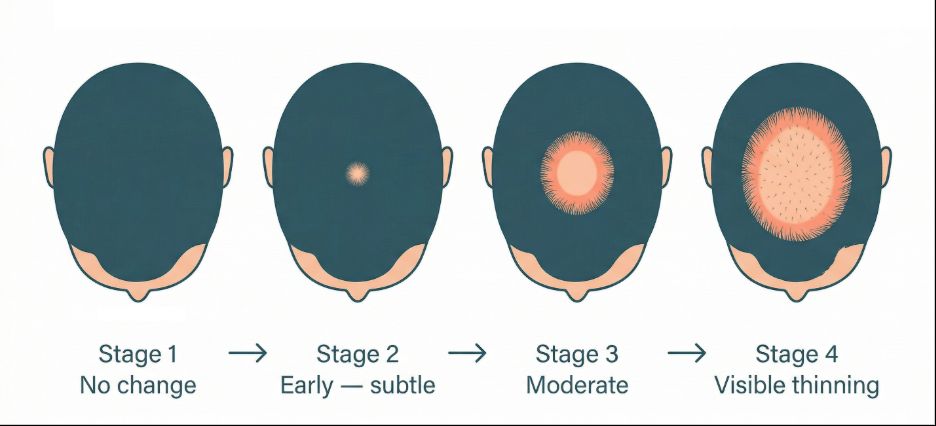
Another early area affected by male pattern hair loss is the crown, also known as the vertex.
In the early stages, hair in this region may appear slightly less dense than before. The scalp may become more visible under bright light or when the hair is wet.
Unlike sudden shedding, this change reflects a gradual shift in how follicles produce hair. Individual hairs in the affected area may become thinner over successive growth cycles.
Because the crown is located toward the back of the scalp, early thinning in this region may not be immediately noticed.
Gradual reduction in hair thickness
One of the most important early changes in androgenetic alopecia involves the thickness of individual hair strands.
Hair follicles that are sensitive to hormonal signals may gradually become smaller. As a result, the hairs produced during each growth cycle become finer.
This process is known as follicleminiaturisation .
In the early stages, only a small proportion of follicles undergo this change. Over time, more follicles may begin producing thinner hairs, which contributes to the gradual reduction in visible hair density.
Changes in hair texture
Some individuals notice subtle changes in how their hair feels or behaves.
Hair that was previously thick may begin to feel softer or finer. Styling the hair may become more difficult because the strands provide less volume or structure.
These changes occur because the hair shafts produced by miniaturising follicles contain less structural material.
Although these changes may appear minor at first, they can gradually influence the overall appearance of the hair.
Increased scalp visibility
As hair strands become thinner, the scalp may begin to appear more visible, particularly under strong lighting.
This effect often becomes noticeable when the hair is parted or when the hair is wet. Because thinner hairs provide less coverage, the scalp can sometimes be seen between strands even when the number of follicles has not changed.
The change reflects a difference in hair thickness rather than an immediate loss of hair follicles.
Slower hair growth in affected areas
Another feature of early pattern hair loss is a shortening of the hair growth phase.
In healthy follicles, the anagen phase of the hair cycle can last two to six years. In follicles affected by androgenetic alopecia, this phase gradually becomes shorter, while the telogen phase may become relatively longer.
Because the hair spends less time growing, it may appear shorter and finer than before.
This change can contribute to the appearance of thinning even before significant shedding occurs.
Why these changes occur
Male pattern hair loss develops because certain follicles are genetically sensitive to hormonal signals.
In susceptible individuals, these signals gradually alter the behaviour of the follicle. The follicle becomes smaller, the hair shaft becomes thinner, and the growth cycle becomes shorter.
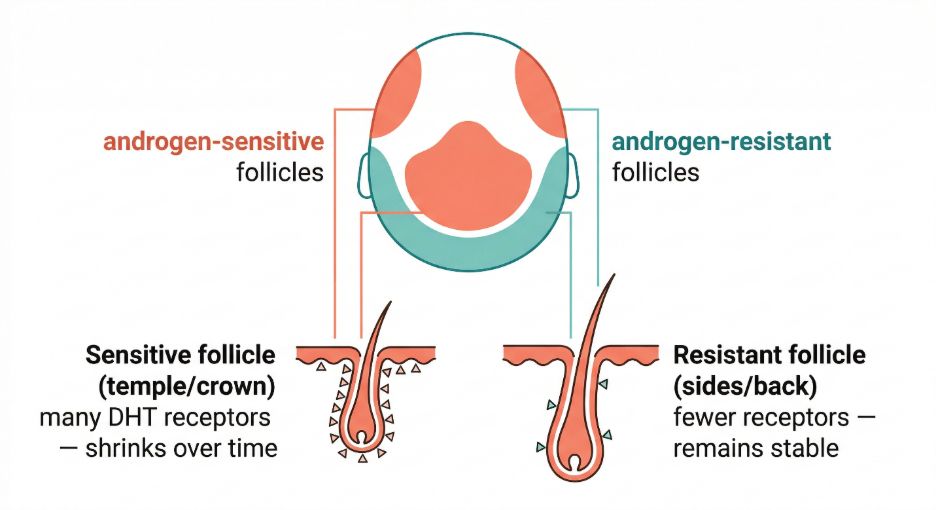
Not all follicles respond in the same way. This difference explains why hair thinning typically affects the temples and crown while other areas of the scalp remain relatively stable.
Medications and chemical factors
While genetic predisposition is the primary driver, certain medications and chemical exposures can accelerate or mimic the early signs of pattern hair loss. Some drugs influence the hair cycle or amplify hormonal sensitivity in genetically susceptible follicles, potentially hastening the onset of thinning. Categories associated with this include anabolic steroids, certain hormonal treatments, and retinoids.
Exposure to heavy metals or industrial chemical agents can also impair follicle function and produce changes in hair texture and thickness that resemble early miniaturisation. When early thinning appears to progress more rapidly than expected, or begins at an unusually young age, a review of medications and chemical exposures forms an important part of clinical assessment.
When early changes become more noticeable
The early signs of hair thinning may remain subtle for several years.
As more follicles undergo miniaturisation, however, the cumulative effect becomes easier to see. The hairline may continue to recede gradually, and thinning at the crown may become more visible.
These patterns of progression are commonly described using classification systems such as the Norwood scale, which outlines the stages of male pattern hair loss.
Understanding the early stages
The earliest signs of male pattern hair loss reflect gradual biological changes within the hair follicle rather than sudden hair loss.
Small changes in hair thickness, growth duration, and follicle size can slowly alter the appearance of the scalp over time. Because the process occurs across many growth cycles, the progression is usually slow.
Recognising these early changes helps explain how male pattern hair loss develops and why it tends to follow characteristic patterns across the scalp.
Author: Dr. Priya Goswami
Medical review: Dr. Denis Broun
Next step
If you notice coverage changes without increased shedding, confirm what process is occurring.
Take the Hair Assessment to have a physician review your pattern, identify whether miniaturization is present, and determine appropriate staging and next steps.

Add Comment