People often use the terms hair thickness and hair density as if they mean the same thing. In reality, they describe two different characteristics of hair. Both influence how full the scalp appears, but they depend on different biological factors.
Hair thickness refers to the diameter of an individual hair strand. Hair density refers to how many hair follicles are presentin a given area of the scalp . The combination of these two features determines how much coverage the hair provides.
Understanding the difference between thickness and density helps explain why two people can have very different hair appearance even when they have the same number of hairs on the scalp.
Hair thickness
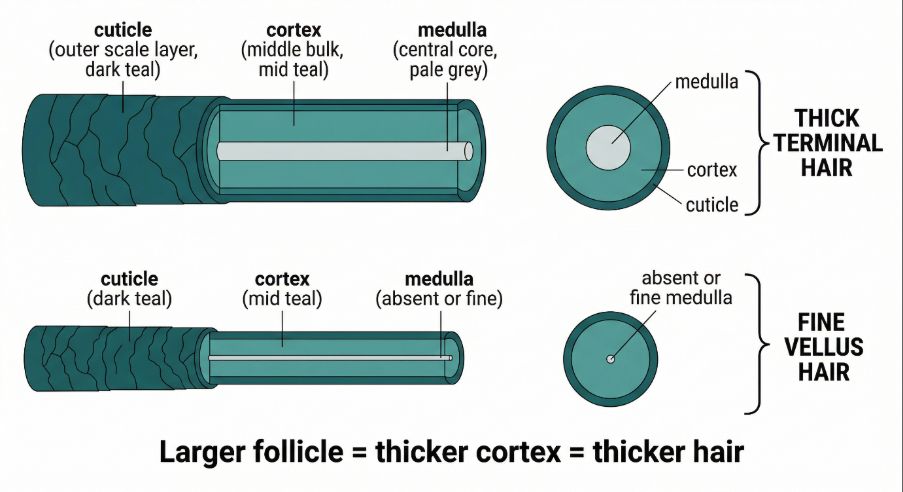
Hair thickness is determined primarily by the diameter of the hair shaft. Some hairs are naturally thicker and stronger, while others are fine and delicate.
The diameter of a hair strand is controlled by the size and activity of the hair follicle that produces it. Larger follicles tend to produce thicker hairs. Smaller follicles produce finer hairs.
Hair thickness varies widely between individuals. Genetic factors play a major role in determining the characteristics of the hair shaft, including its diameter, shape, and strength.
Hair shafts also differ in their internal structure. The outer layer of the hair, called the cuticle, surrounds the cortex, which contains keratin fibres that provide strength and rigidity. In thicker hairs, the cortex is usually more developed, contributing to a larger overall diameter.
Because thicker hairs occupy more space, they can provide greater visual coverage of the scalp even when the number of hairs is the same.
Hair density
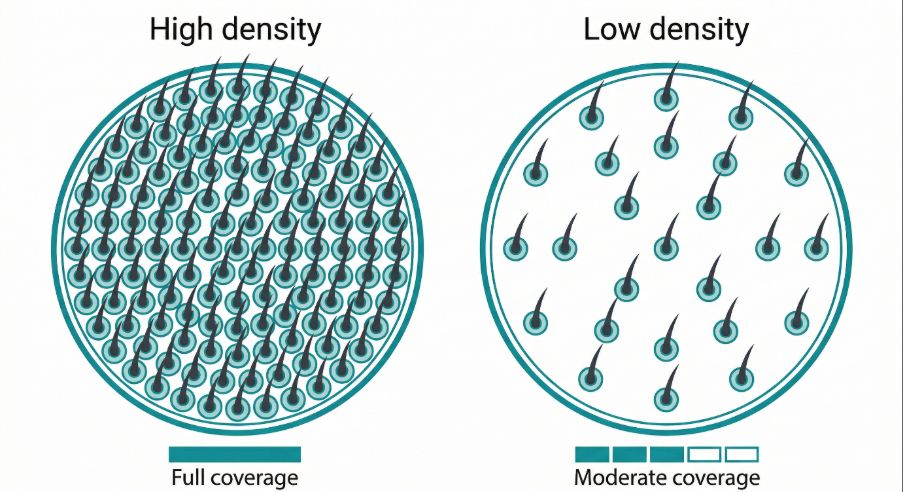
Hair density refers to the number of hair follicles present in a given area of the scalp. It is usually described as the number of hairs per square centimetre.
The number of follicles a person has is largely determined before birth. During early development, the skin forms a fixed number of follicles that remain throughout life. New follicles generally do not form after birth.
This means that people are born with different natural hair densities. Some individuals have a high concentration of follicles and therefore a dense appearance of hair. Others have fewer follicles per area of scalp.
Although the number of follicles remains relatively constant, the activity of those follicles can change over time.
If follicles produce thick terminal hairs, the scalp appears fuller. If follicles produce finer hairs, the same number of follicles may provide less visible coverage.
The hair growth cycle
Each hair follicle on the scalp operates within a repeating three-phase biological cycle that governs how long and thick the hair can grow, and when it is shed.
The anagen phase is the active growth period, lasting two to six years on the scalp. The duration of this phase directly determines the length and thickness of the hair shaft. Approximately 85 to 90 percent of scalp hairs are in anagen at any given moment.
The catagen phase is a brief transitional period of approximately two to three weeks, during which the follicle shrinks and detaches from its blood supply.
The telogen phase is the resting period, lasting approximately three months, after which the hair is shed and the follicle re-enters anagen to begin a new cycle. Because follicles cycle independently of one another, shedding is distributed gradually throughout the day rather than occurring all at once.
Terminal hair and vellus hair
Another important factor in hair thickness is the type of hair produced by the follicle.
Follicles can produce two main types of hair. These are terminal hair and vellus hair.
Terminal hairs are thick, pigmented hairs that provide the visible coverage of the scalp. They contain a well-developed cortex and have a larger diameter.
Vellus hairs are much finer and lighter in colour. These hairs are often short and may be difficult to see.
The presence of a large number of terminal hairs contributes to the appearance of thick hair. When follicles begin to produce vellus-like hairs, the scalp may appear less dense even if the number of follicles remains the same.
The role of follicle size
The size of the hair follicle influences both the thickness of the hair shaft and the type of hair produced.
Large follicles typically produce thick terminal hairs. Smaller follicles produce finer hairs with less structural support.
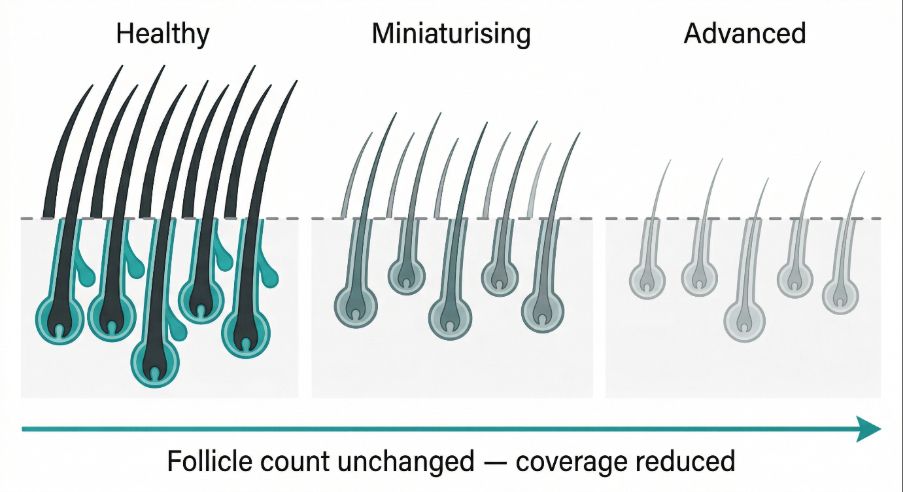
Over time, some follicles may gradually become smaller. This reduction in follicle size is known as miniaturisation.
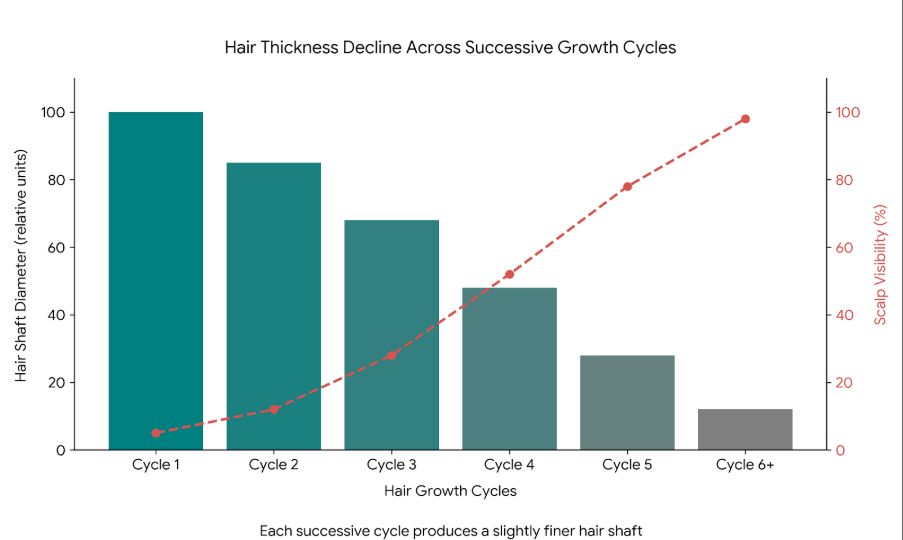
When miniaturisation occurs, the follicle produces progressively thinner hairs with each growth cycle. These hairs may eventually resemble vellus hairs rather than terminal hairs.
This process plays an important role in androgenetic alopecia, a common form of hair thinning.
Genetic influences
Genetics strongly influence both hair thickness and density.
The number of hair follicles on the scalp is determined during early development and varies from person to person. Similarly, the size of follicles and the characteristics of the hair shaft are influenced by inherited genetic traits.
These genetic differences help explain why hair characteristics vary across populations and individuals. Some people naturally have thicker hair strands, while others have finer hair.
Genetic factors also influence how hair follicles respond to hormonal signals and how they behave over time.
Changes in thickness over time
Hair thickness can change gradually throughout life.
With ageing, some follicles may produce slightly thinner hair shafts. This change may occur slowly and may not always be noticeable in the early stages.
In certain conditions, such as androgenetic alopecia, the reduction in hair thickness becomes more pronounced. Follicles that once produced thick terminal hairs may begin to produce thinner hairs over successive growth cycles.
Because the hair shaft becomes smaller, the scalp may appear less covered even if the number of follicles has not changed.
Why density appears to decrease
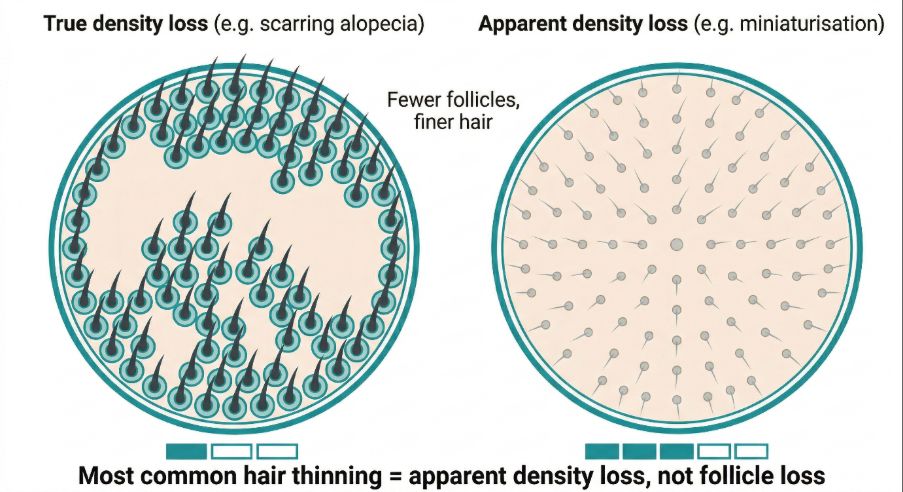
When hair thinning occurs, it is often described as a loss of density. In many cases, however, the actual number of follicles has not changed.
Instead, the follicles may be producing thinner hairs that provide less visible coverage of the scalp.
Because each hair occupies less space, the scalp may appear more visible. This can create the impression that hair density has decreased.
In reality, the change often reflects a difference in hair thickness rather than a reduction in the number of follicles.
Factors that influence hair appearance
Several factors influence how thick or dense hair appears.
Genetics plays the most important role. However, other influences may also affect hair characteristics over time.
Hormonal signals can alter the behaviour of follicles. Ageing may affect the growth cycle and the thickness of the hair shaft. Certain medical conditions can also influence how follicles produce hair.
Because many of these factors interact, hair characteristics may change gradually throughout life.
Medications and chemical exposure
Certain medications can disrupt the hair growth cycle and contribute to hair loss or thinning. Drug categories known to affect the follicle include anticoagulants such as heparin and warfarin, antihypertensive agents including beta-blockers, retinoids, hormonal treatments, and oncology drugs. Cytotoxic chemotherapy agents are particularly notable — they can directly impair the anagen phase, causing rapid and pronounced hair loss within weeks of treatment beginning.
Chemical exposures are a further recognised cause. Heavy metals including thallium, arsenic, and mercury can damage follicle function, with exposure occurring through occupational contact, contaminated environments, or ingestion. Industrial solvents and aggressive chemical hair treatments may similarly impair follicle health. Identifying and removing the causative substance is the primary step toward allowing the hair cycle to normalise.
A practical perspective
Hair thickness and hair density are two distinct but closely related characteristics. Thickness refers to the diameter of each individual hair strand, while density refers to the number of hair follicles present on the scalp.
The combination of these factors determines how full the hair appears. Thick hairs can provide significant coverage even when density is moderate, while very fine hairs may appear sparse even when the number of follicles is relatively high.
Understanding these differences helps explain why hair thinning often occurs gradually and why changes in hair thickness can have a noticeable effect on the overall appearance of the scalp.
Author: Dr. Priya Goswami
Medical review: Dr. Denis Broun
Next step
If you notice coverage changes without increased shedding, confirm what process is occurring.
Take the Hair Assessment to have a physician review your pattern, identify whether miniaturization is present, and determine appropriate staging and next steps.
Add Comment