When hair is already shedding, thinning, brittle, chemically damaged, or recovering from illness, the goal of hair care changes.
It is no longer about making the hair look perfect every day. It is about reducing avoidable breakage, protecting the scalp, and keeping the hair shaft as stable as possible while the underlying cause is assessed or treated.
Gentle hair care cannot cure androgenetic alopecia, alopecia areata, telogen effluvium, scarring alopecia, thyroid-related hair loss, iron deficiency, or medication-related shedding. But it can make a real difference to how much hair snaps, frays, tangles, and looks thinner than it is. It can also help people avoid making an already fragile situation worse.
Compromised hair needs lower tension, less heat, fewer chemicals, softer handling, and more patience.
What compromised hair means
Compromised hair usually means the hair or scalp is under stress. That stress may come from the hair shaft itself, the follicle, the scalp, or the body as a whole.
Common situations include:
- Hair that breaks easily
- Hair that sheds more than usual
- Hair that feels rough, dry, limp, or weak
- Hair that tangles quickly
- Hair after bleaching, colouring, relaxing, perming, or frequent heat styling
- Hair during telogen effluvium
- Hair affected by androgenetic alopecia
- Hair affected by alopecia areata
- Hair growing back after illness, childbirth, nutritional deficiency, or treatment
- Hair with scalp inflammation, itching, scaling, or tenderness
- Hair after traction from tight hairstyles, extensions, or frequent pulling
These situations are not the same medically. A person with telogen effluvium may have normal follicles but increased shedding after a trigger. A person with androgenetic alopecia may have gradual follicle miniaturisation. A person with scarring alopecia may have inflammation that can permanently damage follicles if not treated early.
Still, many people with different types of hair loss share one problem: the remaining hair feels more precious and more vulnerable. That is where careful handling matters.
Gentle care does not mean doing nothing
Some people become afraid to wash, brush, or touch their hair when it is shedding. This is understandable. Seeing hair in the drain or brush can feel alarming.
But avoiding normal hygiene usually does not stop true shedding. In telogen effluvium, for example, many hairs have already shifted into the resting phase before they fall. They may come out during washing because washing releases hairs that were ready to shed. Cleveland Clinic notes that telogen effluvium can cause a noticeable increase in shedding, often after a stressor or body change, and many cases improve once the trigger is corrected or passes.
So the aim is not to stop touching the hair entirely. It is to handle it in a way that avoids extra mechanical damage.
Gentle hair care means washing appropriately, detangling carefully, reducing friction, avoiding unnecessary tension, and choosing products that support the hair shaft without irritating the scalp.
Start with the scalp
Healthy hair care begins at the scalp, especially when hair is thinning or shedding.
A compromised scalp may be itchy, flaky, oily, painful, red, burning, or tender. These symptoms matter. They can point to seborrhoeic dermatitis, psoriasis, contact dermatitis, folliculitis, traction injury, or inflammatory alopecia.
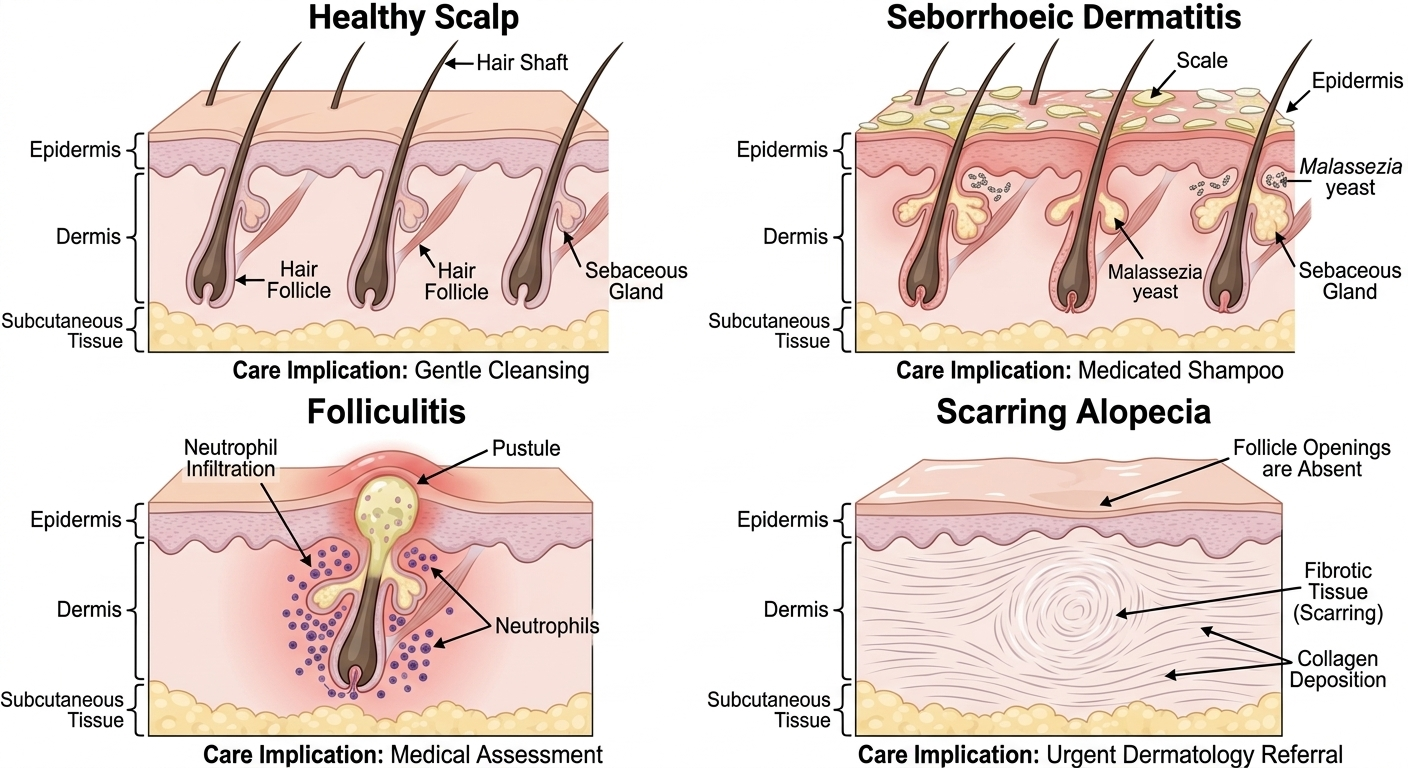
Mild flaking and oiliness may improve with appropriate anti-dandruff or anti-inflammatory shampoos. But pain, redness, pustules, scaling plaques, smooth bald patches, scarring, or rapid hair loss should not be treated as a cosmetic issue.
A dermatologist should assess scalp symptoms when they are persistent, worsening, painful, or associated with patchy loss. This is especially important because some inflammatory and scarring alopecias need early treatment to reduce the risk of permanent follicle damage.
Gentle scalp care includes:
- Using fingertips rather than nails when washing
- Avoiding aggressive scalp scrubbing
- Rinsing shampoo thoroughly
- Avoiding fragranced or irritating products if the scalp reacts easily
- Not applying oils or heavy products to an inflamed scalp unless advised
- Avoiding repeated scratching, picking, or scraping flakes
A clean scalp is not harmful to hair growth. In fact, leaving sweat, scale, heavy oils, and styling residue on the scalp can make itching and inflammation worse in some people.
Washing compromised hair
There is no single correct washing frequency. It depends on scalp oiliness, activity level, hair texture, styling habits, and scalp conditions.
People with oily scalp or seborrhoeic dermatitis may need more frequent washing. People with very dry, curly, coily, or chemically treated hair may need less frequent washing and more conditioning. The key is not the number of washes per week. It is how the hair is washed.
A gentle washing routine looks like this:
- Wet the hair fully before applying shampoo
- Apply shampoo mainly to the scalp
- Massage with fingertips, not nails
- Let the lather move through the lengths rather than scrubbing the ends
- Rinse well
- Apply conditioner mainly to the mid-lengths and ends
- Detangle with conditioner in the hair if tangling is a problem
- Rinse gently
- Blot with a towel rather than rubbing hard
Hair is more vulnerable when wet. Wet hair stretches more easily, and rough handling can increase breakage. This is especially relevant for bleached, relaxed, fine, long, curly, or ageing hair.
A mild shampoo can be useful when the scalp is not inflamed. A medicated shampoo may be needed when dandruff, seborrhoeic dermatitis, psoriasis, or fungal overgrowth is present. The right choice depends on the scalp, not only the hair.
Conditioner is not optional for fragile lengths
Conditioner does not repair the living follicle. It does not reverse medical hair loss. But it can reduce friction between strands, improve combability, decrease tangling, and make the hair shaft less likely to break during handling.
This matters because breakage can mimic thinning. A person may think they are losing hair from the root when much of the visible loss is actually snapping along the shaft.
Conditioner is especially important for:
- Long hair
- Fine hair that tangles easily
- Curly or coily hair
- Bleached or coloured hair
- Relaxed or chemically straightened hair
- Hair exposed to heat styling
- Hair that feels rough, dry, or straw-like
For very fine hair, a lightweight conditioner may be enough. For dry or textured hair, richer conditioners or leave-in products may help. The right product should leave the hair easier to manage, not coated, sticky, or irritated.
Detangling without causing extra breakage
Detangling is one of the most common points where compromised hair breaks.
A harsh brush, fast combing, or pulling through knots can snap the shaft and increase traction at the root. The safer approach is slow and boring, but it works better.
Start at the ends, not the roots. Hold the section above the tangle to reduce pulling on the scalp. Use a wide-tooth comb or a brush designed for gentle detangling. Work upward gradually. Add conditioner, leave-in conditioner, or a detangling spray if the hair is dry or knot-prone.
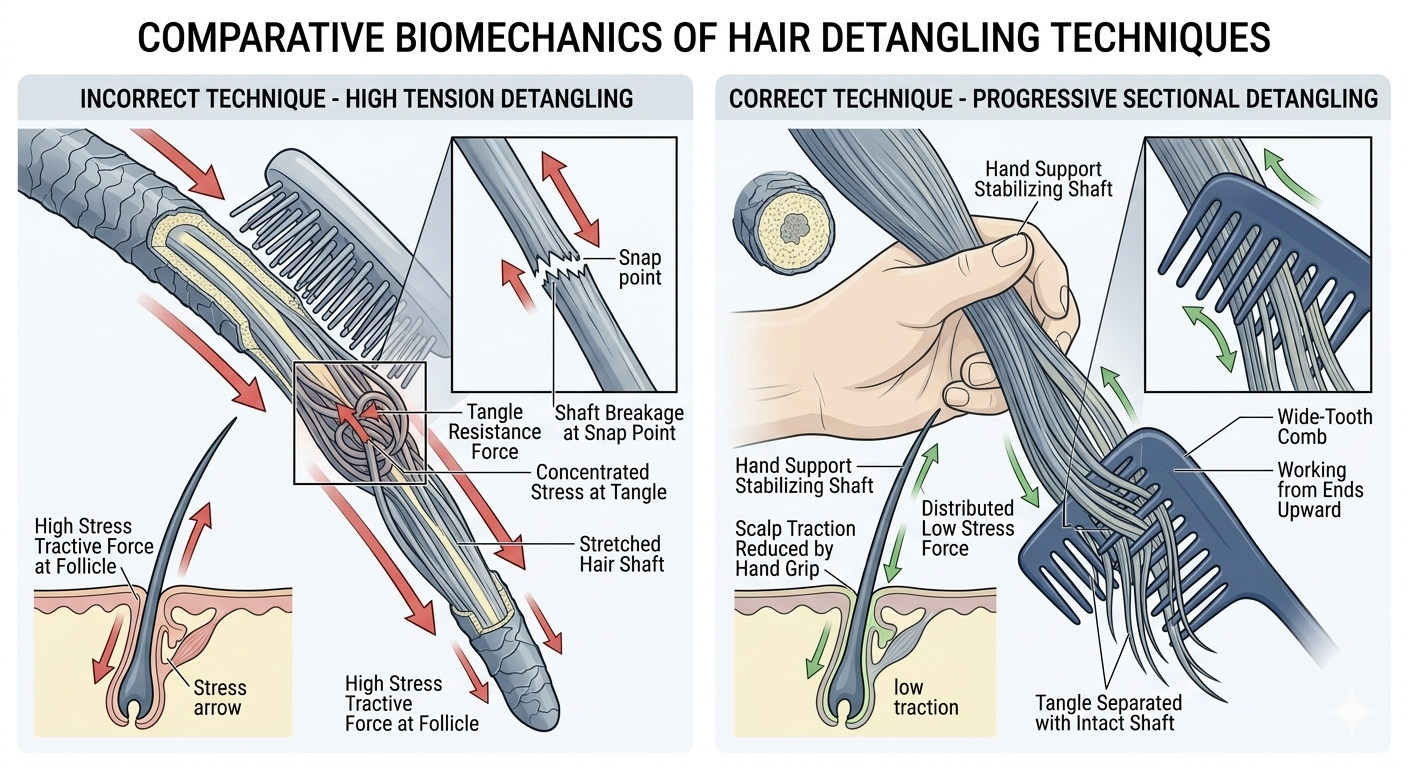
For curly and coily hair, detangling while damp and conditioned is often gentler than dry brushing. For very fine straight hair, detangling when mostly dry may reduce stretching. The best method depends on the hair type, but the rule is the same: do not force through resistance.
Knots should be loosened, not ripped out.
Heat styling when hair is fragile
Heat can weaken the hair shaft, especially when used often or at high temperatures. Blow dryers, straighteners, curling irons, hot brushes, and heated rollers can all contribute to dryness, roughness, split ends, and breakage.
People with compromised hair do not always need to avoid heat completely. But they should reduce it.
A safer approach includes:
- Air drying partway before blow drying
- Using the lowest effective heat setting
- Keeping the dryer moving
- Avoiding direct heat on the same section repeatedly
- Using a heat protectant if heat is used
- Limiting straighteners and curling irons
- Avoiding heat on hair that is already brittle or chemically overprocessed
Flat irons and curling wands are usually more damaging than careful blow drying because they apply intense direct heat to the shaft. Wet-to-dry straightening is particularly harsh and should be avoided when hair is fragile.
Chemical treatments need caution
Bleaching, permanent colour, relaxers, perms, keratin treatments, and repeated chemical processing can weaken the hair shaft. When hair is already shedding or thinning, chemical damage may make the loss look worse by adding breakage.
This does not mean every person with hair loss must stop colouring forever. But timing and technique matter.
Avoid chemical treatments when:
- The scalp is inflamed, painful, or broken
- Hair is actively snapping
- Hair feels gummy, stretchy, or extremely dry
- There has been a recent chemical treatment
- You are experiencing heavy unexplained shedding
- You are starting treatment for a scalp condition and the skin has not settled
If colouring is important, less damaging options may be safer, such as root-only application, longer intervals between treatments, lower-volume developer where appropriate, avoiding overlapping bleach, and having the process done by someone experienced with fragile hair.
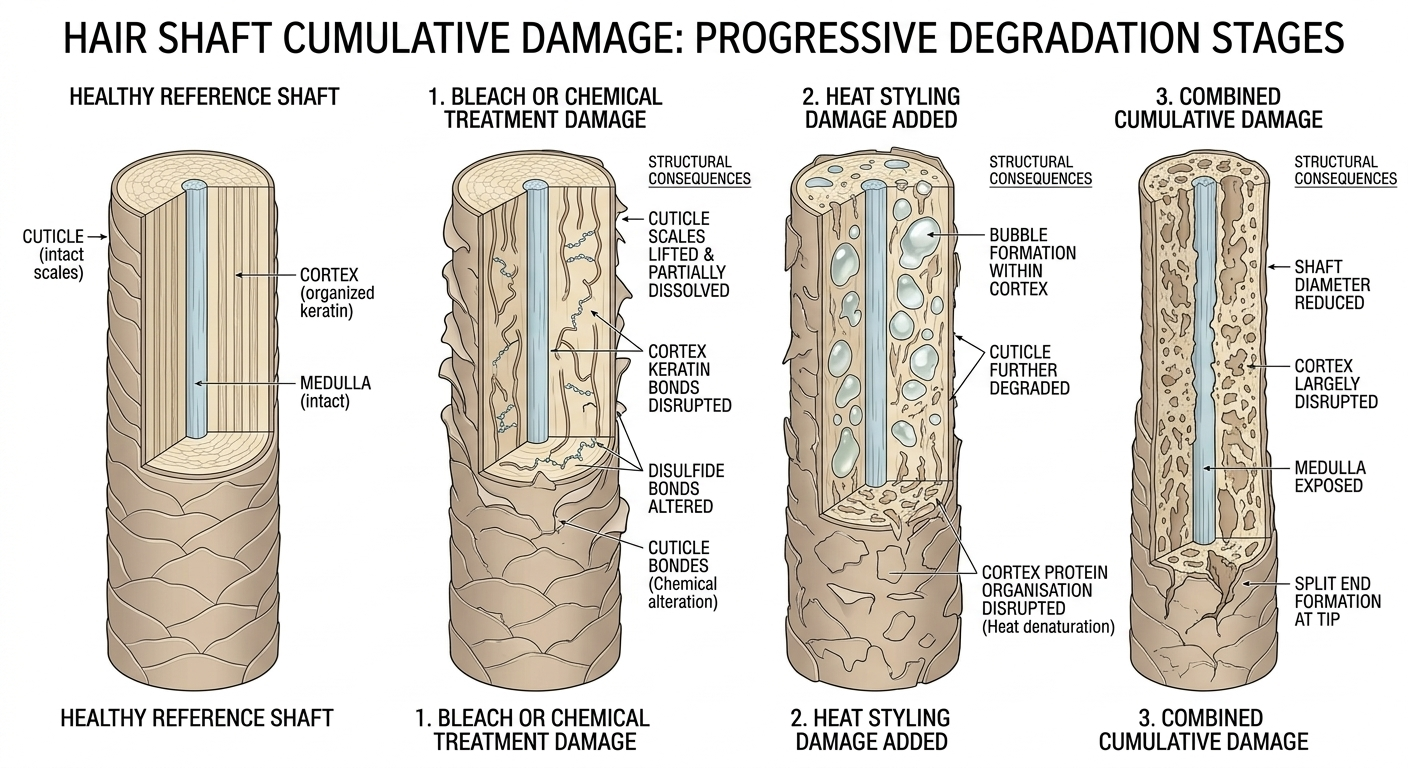
Chemical straightening and bleaching are among the highest-risk treatments for already compromised hair. Combining them with frequent heat styling increases the risk further.
Hairstyles that protect rather than pull
Tension is a major issue in compromised hair. Tight ponytails, buns, braids, weaves, extensions, cornrows, and slicked-back styles can pull on follicles and increase breakage. Over time, repeated traction can contribute to traction alopecia.
Warning signs include scalp soreness, bumps, itching, broken hairs around the hairline, thinning at the temples, or needing pain relief after a hairstyle. A hairstyle should not hurt.
Gentler choices include:
- Loose styles
- Soft scrunchies instead of tight elastics
- Low-tension braids
- Changing the parting regularly
- Avoiding heavy extensions
- Not sleeping with tight styles
- Giving the scalp rest between protective styles
- Avoiding styles that pull at the same hairline points repeatedly
Protective styling is only protective if it protects both the shaft and the follicle. A style that hides the hair but pulls on the roots is not gentle.
Night care and friction
Hair can also break during sleep. Friction against cotton pillowcases, tight sleeping styles, and going to bed with tangled hair can all increase mechanical damage.
Helpful options include:
- A silk or satin pillowcase
- A loose braid or loose bun for long hair
- A soft bonnet or scarf for textured hair
- Detangling gently before bed
- Avoiding tight elastics overnight
- Not sleeping with wet hair if it causes tangling or breakage
These steps will not treat medical alopecia, but they can reduce avoidable shaft damage.
Be careful with oils and home remedies
Many people turn to oils, onion juice, rice water, masks, essential oils, and herbal mixtures when hair is shedding. Some may improve lubrication or make the hair feel softer. But they can also irritate the scalp, worsen dermatitis, trigger allergy, or make washing more difficult.
Essential oils deserve particular caution. They are concentrated substances and can cause contact dermatitis. Applying them directly to the scalp without dilution is not safe. Even diluted oils can irritate some people.
Heavy oiling can also be a problem when someone has seborrhoeic dermatitis or folliculitis. It may increase itch, scale, or greasiness in some scalps.
A simple rule is useful: if a product makes the scalp burn, itch, sting, flake more, or turn red, stop using it.
Natural does not always mean gentle.
What to avoid when hair is compromised
The main avoidable harms are friction, tension, heat, irritation, and repeated chemical stress.
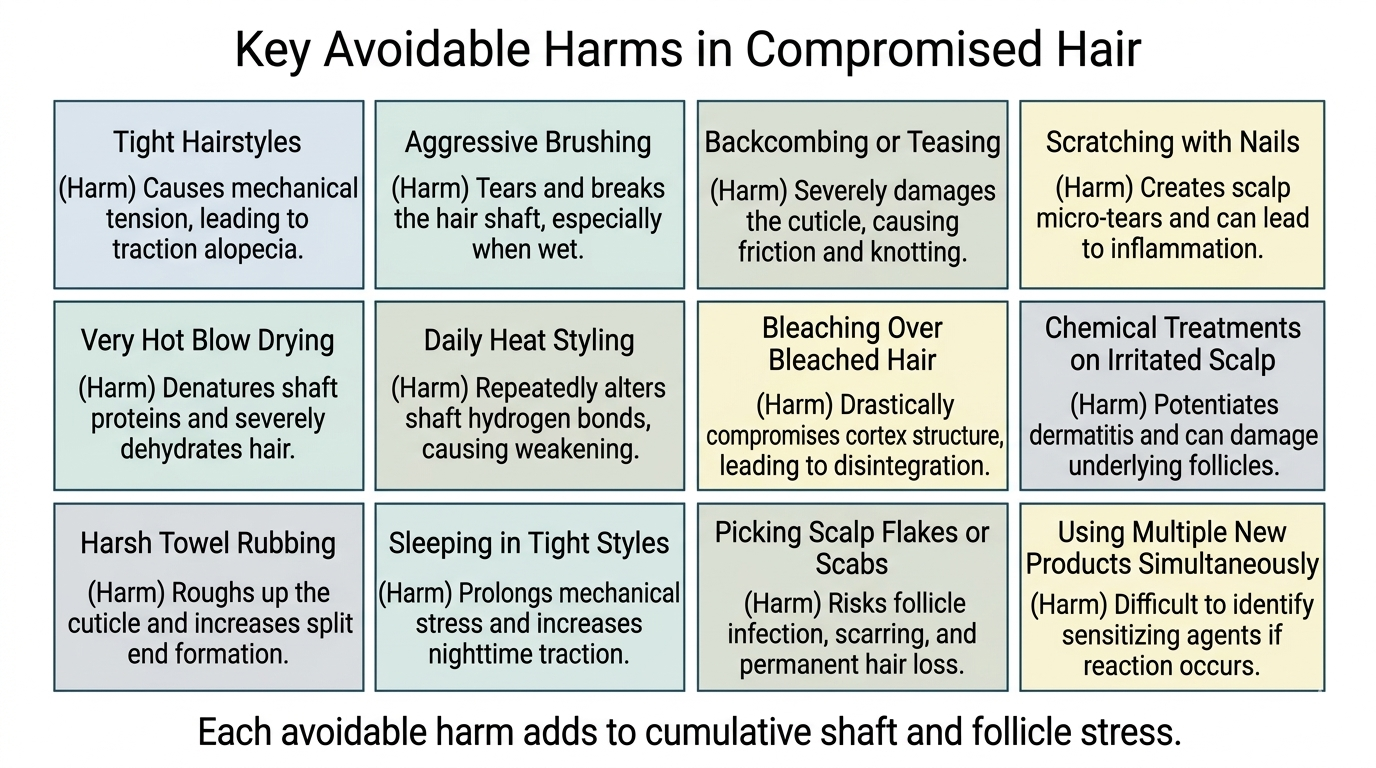
Try to avoid:
- Tight hairstyles
- Aggressive brushing
- Backcombing or teasing
- Scratching the scalp with nails
- Very hot blow drying
- Daily straightening or curling
- Bleaching over already bleached hair
- Chemical treatments on irritated scalp
- Harsh towel rubbing
- Sleeping with tight styles
- Picking flakes or scabs
- Using multiple new products at once
- Relying on supplements without checking for deficiency
The last point matters. Supplements are often marketed as harmless, but they are not always useful. Hair loss can be linked to iron deficiency, thyroid disease, vitamin D deficiency, medication changes, hormonal conditions, inflammatory scalp disease, or recent illness. Taking random supplements may delay proper diagnosis and can sometimes cause side effects or abnormal blood test results.
When gentle care is not enough
Gentle care is supportive. It is not a diagnosis.
Medical assessment is important when hair loss is sudden, patchy, painful, scarring, or persistent. It is also important when shedding is associated with fatigue, heavy periods, weight change, acne, irregular cycles, scalp scaling, fever, recent illness, new medication, or nutritional restriction.
Seek medical advice promptly if you notice:
- Smooth bald patches
- Scalp pain, burning, or tenderness
- Redness, pustules, or thick scale
- Loss of eyebrows or eyelashes
- Hairline recession with soreness or bumps
- Rapid thinning over weeks
- Shedding lasting more than six months
- Signs of scarring, such as shiny skin or loss of follicle openings
- Hair loss after starting a new medicine
- Hair loss with severe tiredness or other systemic symptoms
A clinician may consider scalp examination, pull test, dermoscopy, blood tests, medication review, or scalp biopsy depending on the pattern.
The emotional side of handling fragile hair
Compromised hair changes how people behave. Some avoid washing. Some count every strand. Some stop going out. Some try too many treatments at once because doing nothing feels impossible.
It is worth saying clearly: hair shedding is not caused by noticing it. Washing does not create telogen effluvium. Brushing does not cause androgenetic alopecia. But rough handling can add breakage, and fear can make routine care feel harder than it needs to be.
A calm, consistent routine is usually better than constantly changing products. Hair grows slowly. The visible result of improved care may take months, especially if the main issue is shedding from the follicle rather than breakage along the shaft.
A simple gentle routine
For many people with compromised hair, a basic routine is enough.
Wash the scalp as often as needed to keep it comfortable and clean. Use a mild shampoo if the scalp is normal, or a suitable medicated shampoo if there is dandruff or inflammation. Condition the lengths every wash. Detangle slowly from the ends upward. Dry by blotting, not rubbing. Reduce heat. Avoid tight styles. Protect the hair during sleep. Pause harsh chemical treatments until the hair and scalp are stable.
Then focus on diagnosis. If hair is shedding from the root, the cause is often internal, inflammatory, hormonal, genetic, nutritional, medication-related, or stress-related. Hair care can protect what remains, but it should not replace medical investigation when the pattern is concerning.
The bottom line
Gentle hair care is not a cure for hair loss, but it is still important. It reduces breakage, protects fragile lengths, lowers traction, and helps keep the scalp calmer while the real cause of the problem is being addressed.
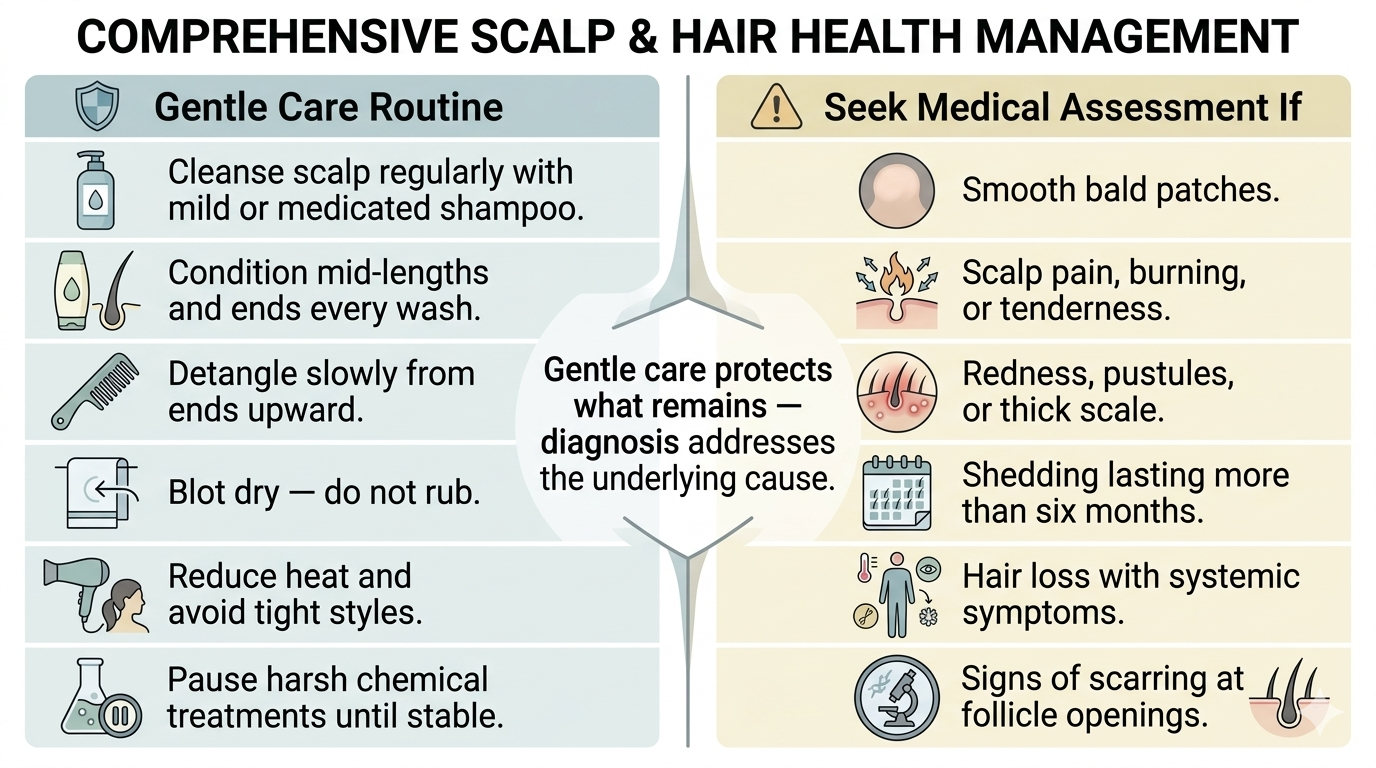
The best routine is usually simple: clean the scalp, condition the lengths, detangle slowly, reduce heat and chemicals, avoid painful hairstyles, and take scalp symptoms seriously.
When hair is compromised, the question is not “What can I do to force growth quickly?” It is “How can I stop adding extra damage while the hair and scalp recover?”
That shift matters.
Author: Dr. Priya Goswami
Medical review: Dr. Denis Broun
Next step
If you notice coverage changes without increased shedding, confirm what process is occurring.
Take the Hair Assessment to have a physician review your pattern, identify whether miniaturization is present, and determine appropriate staging and next steps.
Add Comment