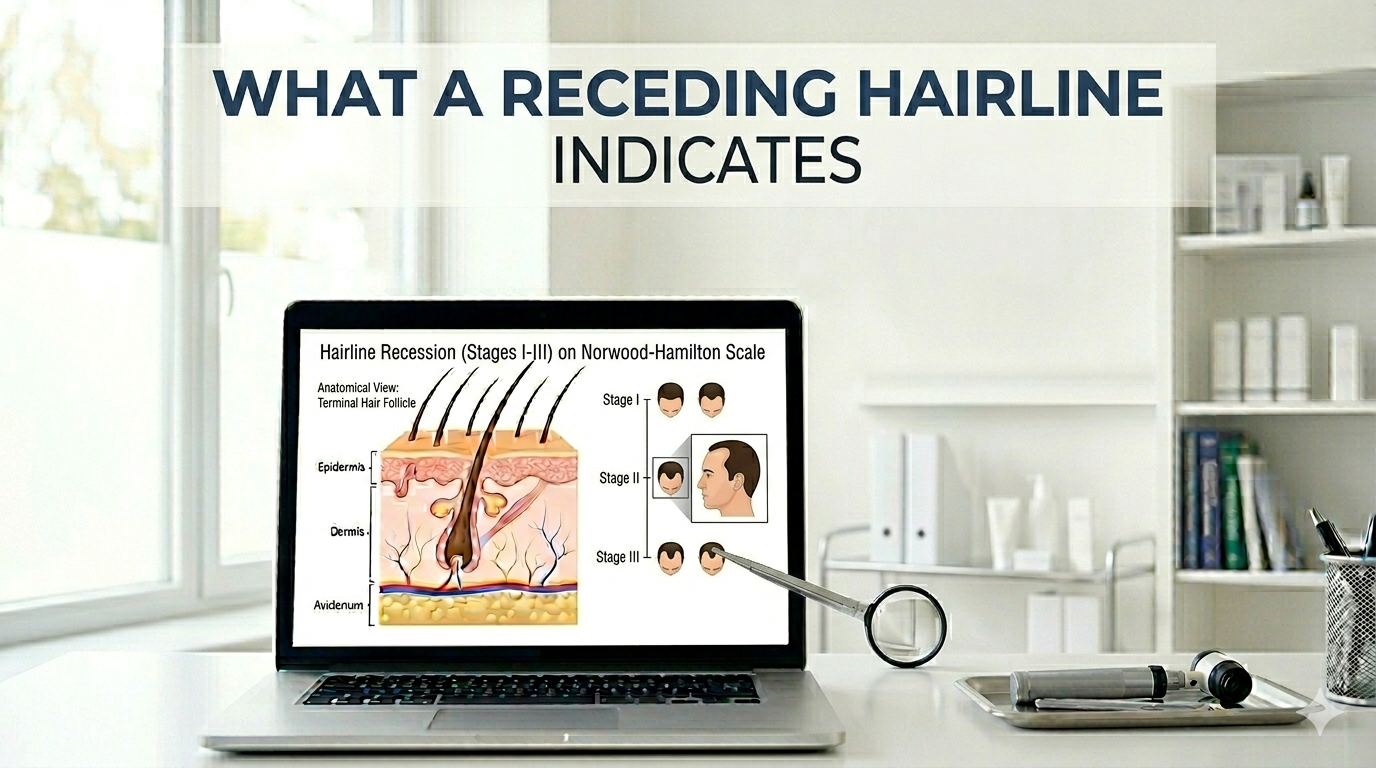
Changes in the hairline are often one of the first signs that lead men to think about hair loss. A receding hairline typically refers to a gradual movement of the hairline backward at the temples, which may create a more pronounced contour across the front of the scalp.
Although the change can be concerning, it is important to understand that not every shift in the hairline represents hair loss. Hairlines naturally change as people move from adolescence into adulthood. In some individuals this change remains stable throughout life, while in others it may progress as part of a condition known as androgenetic alopecia, or male pattern hair loss.
Understanding what a receding hairline represents biologically helps clarify why these changes occur and why they often follow predictable patterns.
The hair growth cycle
Each hair follicle on the scalp operates within a repeating three-phase cycle that determines how long and thick the hair it produces can grow.
The anagen phase is the active growth period, lasting two to six years on the scalp. The longer the anagen phase, the longer and thicker the hair produced. In androgenetic alopecia, one of the earliest changes in affected follicles is a progressive shortening of this phase with each successive cycle.
The catagen phase is a brief transitional period of approximately two to three weeks in which the follicle shrinks and separates from its blood supply.
The telogen phase is the resting period, lasting around three months, at the end of which the hair is shed and the cycle restarts. Because hairline follicles cycle independently of one another, recession at the temples develops gradually rather than all at once.
The structure of the frontal hairline
The hairline is formed by a group of hair follicles located at the front of the scalp. These follicles produce terminal hairs that create the visible border between the forehead and the scalp.
In adolescence, the hairline often sits relatively low and straight across the forehead. As the body matures, it is common for the hairline to move slightly higher and develop a more defined shape.
This transition is sometimes referred to as the development of a mature hairline. It does not necessarily indicate hair loss and may remain stable for many years.
The difference between a mature hairline and hair loss
A mature hairline usually involves mild recession at the temples without significant thinning across the rest of the scalp.
In this situation, the follicles at the temples remain healthy and continue to produce thick terminal hairs. The hairline simply settles into a slightly higher position than it had during adolescence.
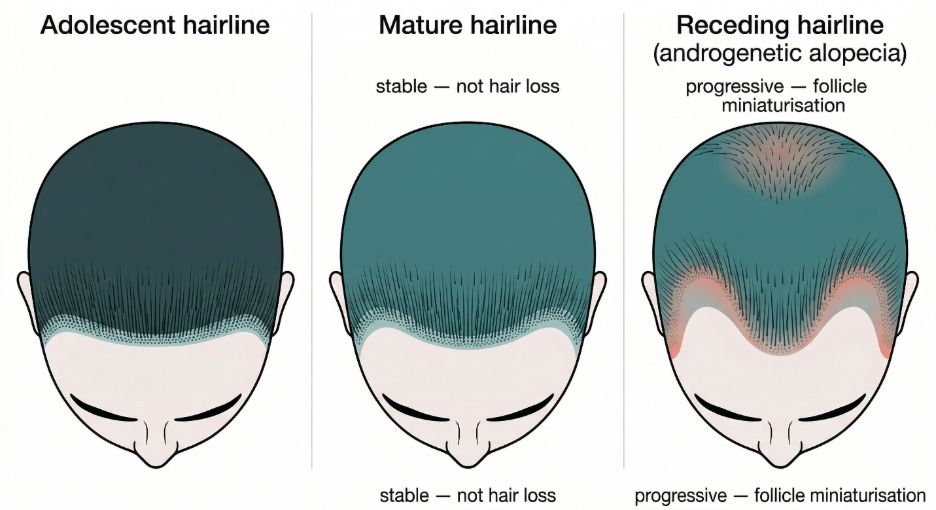
Male pattern hair loss, however, involves gradual biological changes within the hair follicle. These changes affect the thickness of the hair produced and the duration of the hair growth cycle.
As a result, the hairline may continue to move backward over time rather than remaining stable.
Follicle miniaturisation and the hairline
The underlying process that causes progressive recession of the hairline is known as follicleminiaturisation .
In androgenetic alopecia, certain follicles become increasingly sensitive to hormonal signals. Over successive growth cycles, these follicles gradually become smaller.
As the follicle shrinks, the hair shaft it produces becomes thinner and shorter. This means the hair provides less visible coverage of the scalp.
When this process affects multiple follicles along the hairline, the density of hair decreases and the hairline gradually appears to recede.
Why the temples are affected first
The temples are often the first area where these changes occur.
Hair follicles in this region tend to be more sensitive to certain hormonal influences in individuals who are genetically predisposed to androgenetic alopecia. Over time, this sensitivity can lead to progressive miniaturisation of the follicles located there.
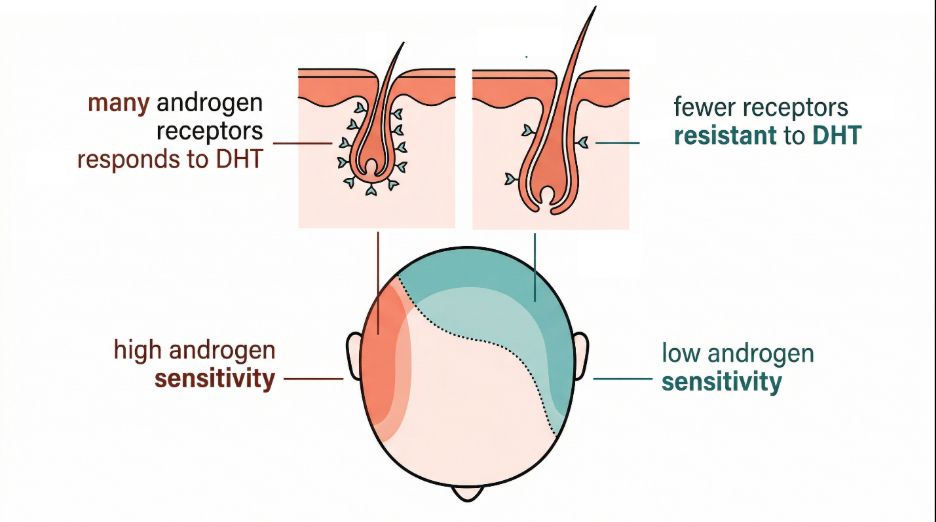
Because the temples frame the front of the scalp, even small changes in hair thickness or density can make the hairline appear noticeably different.
This is why early stages of male pattern hair loss often involve subtle recession at the temples.
Patterns of hairline recession
Hairline recession does not occur in exactly the same way for every individual.
In many men, the temples gradually recede while the central portion of the hairline remains relatively stable. This pattern creates a shape sometimes described as an "M-shaped" hairline.
In other cases, the hairline may move backward more evenly across the front of the scalp.
These variations reflect differences in how follicles across the scalp respond to hormonal signals and genetic influences.
Gradual progression over time
When a receding hairline is part of androgenetic alopecia, the changes usually occur gradually over many years.
The hairline may move backward slowly as additional follicles undergo miniaturisation. At the same time, the thickness of the hair in affected areas may continue to decrease.
Because the process unfolds across multiple hair growth cycles, the progression is typically slow rather than sudden.
The relationship to the Norwood scale
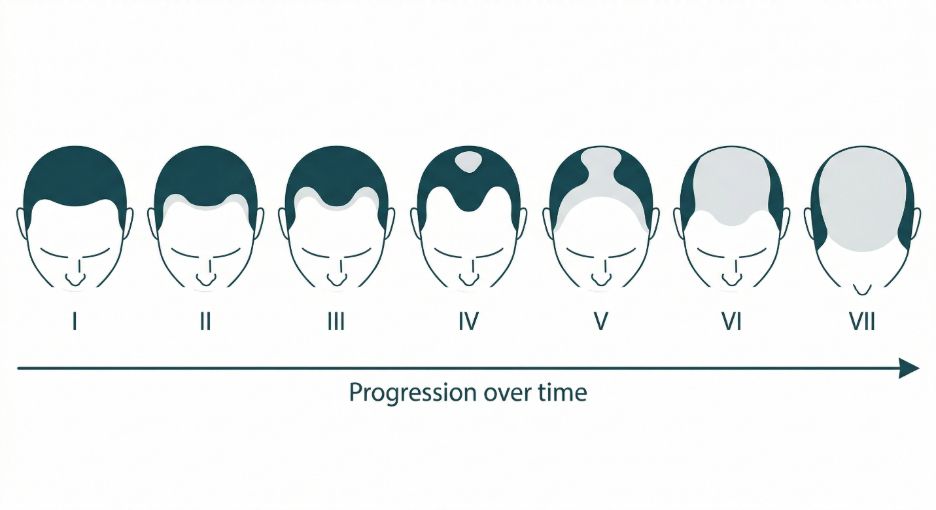
The progression of hairline recession is often described using the Norwood scale, a classification system used to outline the stages of male pattern hair loss.
In the early stages of the Norwood scale, the main feature is mild recession at the temples. As the condition progresses, thinning may also develop at the crown of the scalp.
Although the Norwood scale provides a useful framework for describing these patterns, it does not predict exactly how hair loss will progress in any individual.
Medications and chemical factors
While genetic predisposition is the primary driver of hairline recession, certain medications and chemical exposures can accelerate or compound the process. Some drugs — including retinoids, certain hormonal treatments, and anabolic steroids — are known to influence the hair cycle or amplify hormonal sensitivity in genetically susceptible follicles, potentially hastening recession in individuals already predisposed to androgenetic alopecia.
Exposure to heavy metals or persistent chemical agents can also damage follicle function more broadly. When hairline recession appears to progress more rapidly than expected, a thorough review of medications and potential chemical exposures forms an important part of any clinical assessment.
Looking at hairline changes in context
Changes in the hairline should be considered together with other aspects of hair growth, such as hair thickness, hair density, and thinning in other regions of the scalp.
A stable mature hairline may remain unchanged for many years. In contrast, progressive thinning at the temples combined with crown thinning may suggest ongoing changes in follicle behaviour.
Understanding the biological processes involved helps place hairline changes within the broader context of how hair follicles function and how certain forms of hair thinning develop.
Author: Dr. Priya Goswami
Medical review: Dr. Denis Broun
Next step
If you notice coverage changes without increased shedding, confirm what process is occurring.
Take the Hair Assessment to have a physician review your pattern, identify whether miniaturization is present, and determine appropriate staging and next steps.


Add Comment