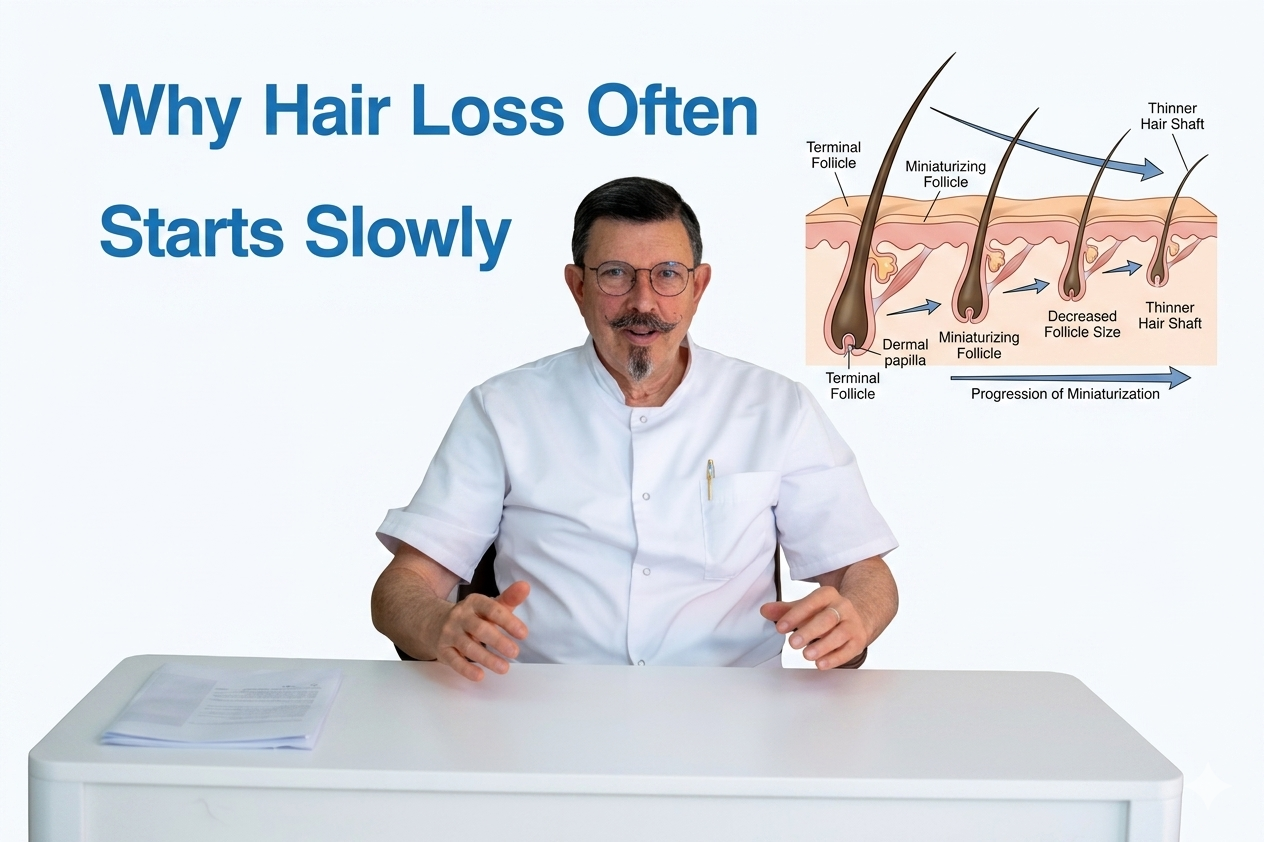
Hair loss rarely begins suddenly. In most cases, the process develops gradually over many years before becoming clearly visible. People often notice subtle changes first, such as reduced volume, increased scalp visibility under bright light, or a gradual shift in the hairline.
This slow progression reflects the biology of the hair follicle and the long duration of the hair growth cycle. Hair follicles do not usually stop functioning abruptly. Instead, they undergo progressive changes over repeated cycles that slowly alter the appearance of the hair.
Understanding why hair loss often starts slowly helps explain why early thinning can be difficult to recognise and why noticeable changes may take years to develop.
Hair follicles function through long cycles
Each scalp follicle follows a repeating biological cycle composed of:
- a growth phase
- a transition phase
- a resting phase
The active growth phase, known as the anagen phase, may last several years on the scalp.
Because follicles spend such long periods producing hair, visible changes occur slowly when follicular behaviour begins to change.
Follicles change gradually over time
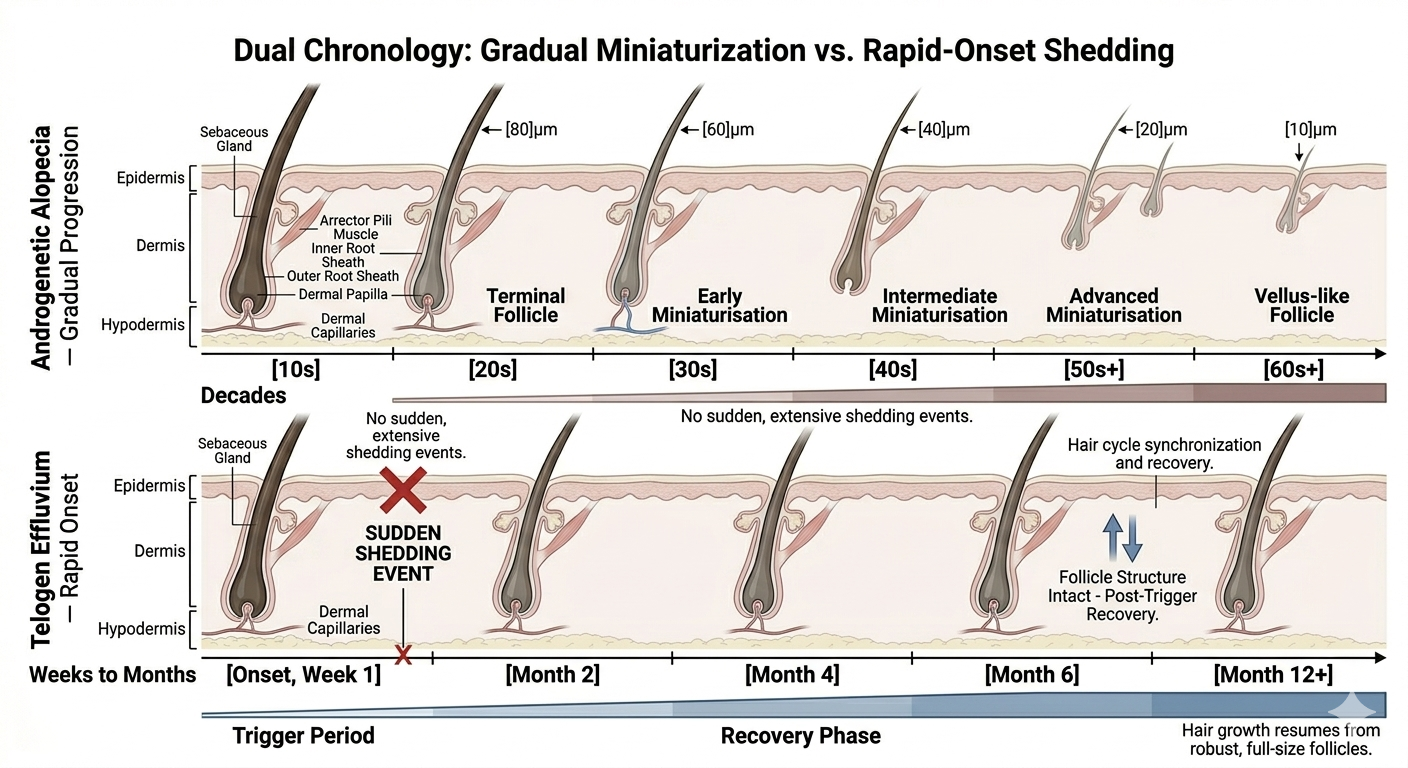
In androgenetic alopecia, follicles do not suddenly disappear.
Instead:
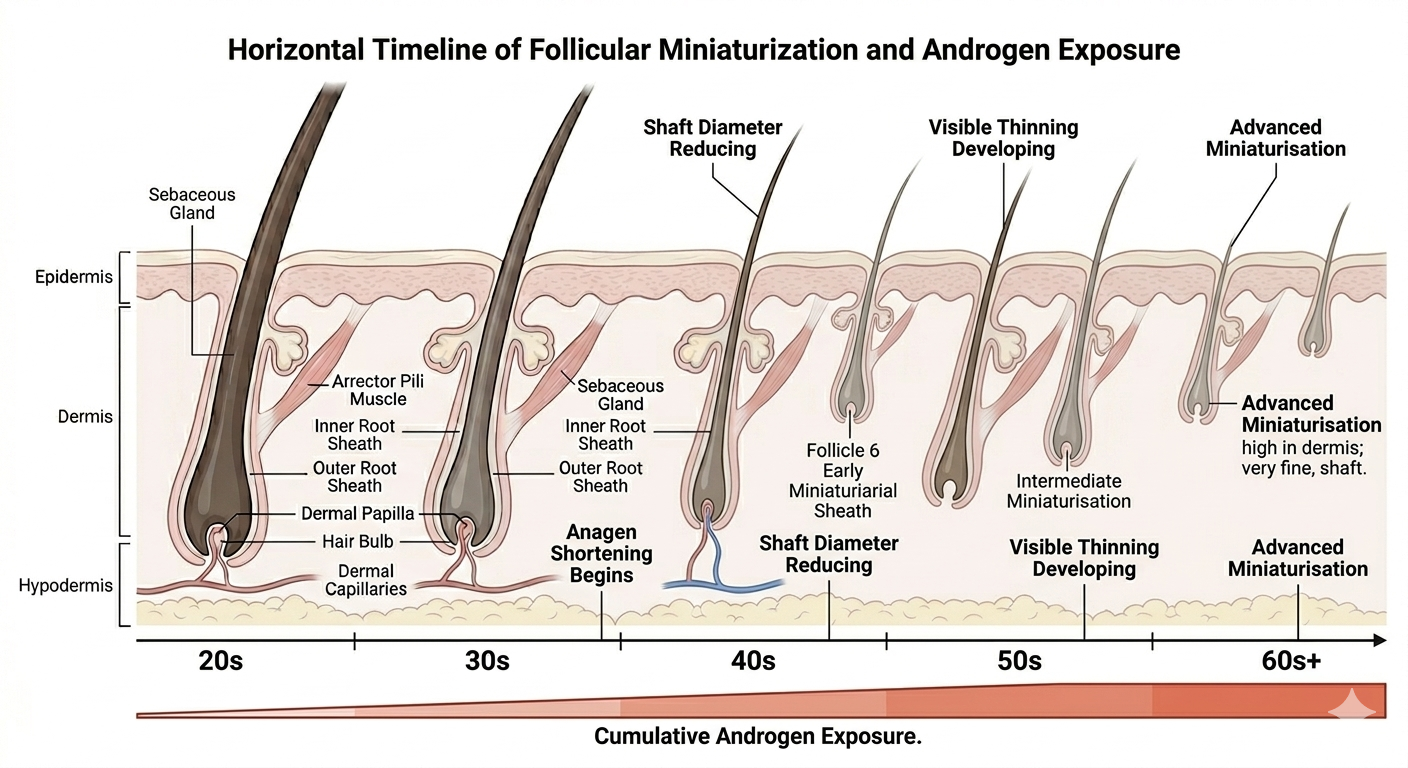
- follicles slowly become smaller
- growth phases shorten gradually
- hair shafts become progressively finer
This process is known as follicle miniaturisation.
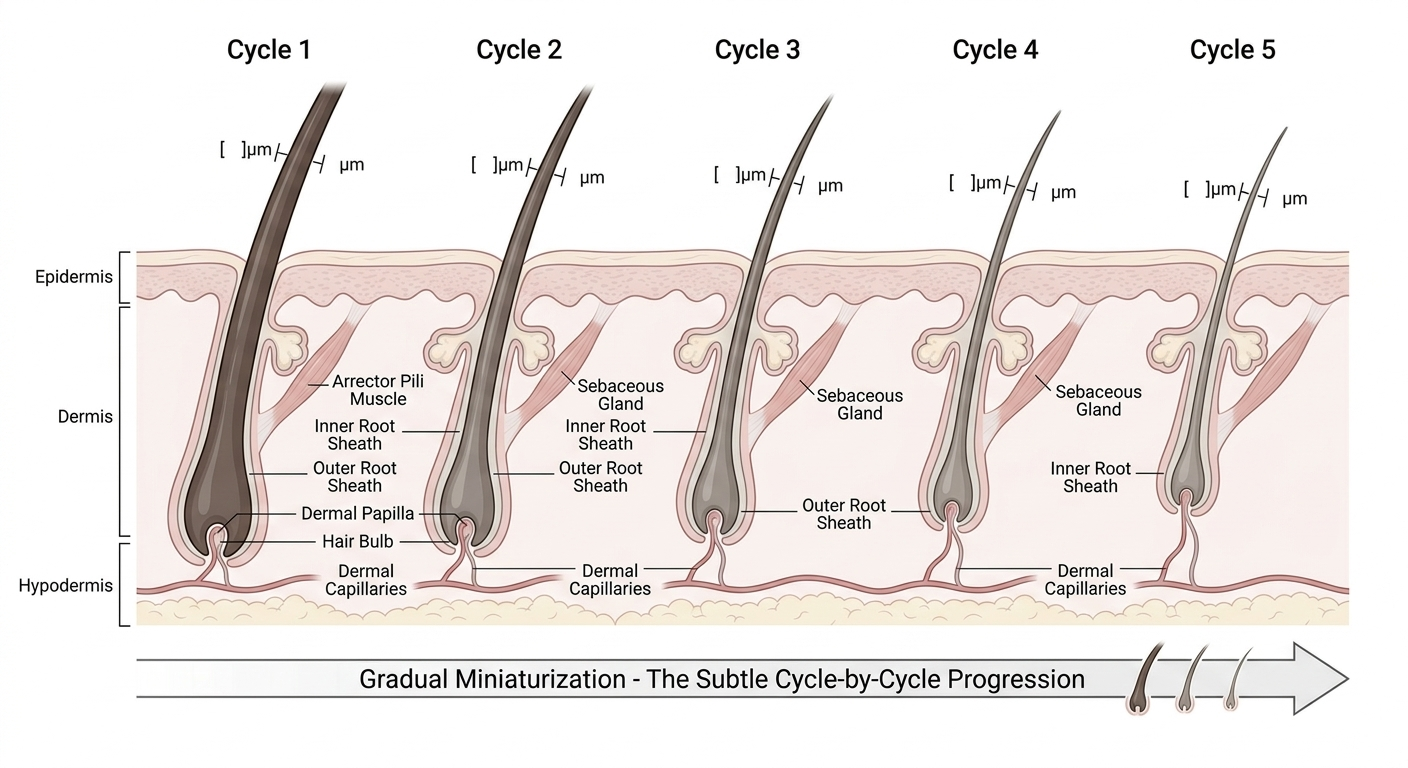
Each new cycle may produce hair that is only slightly thinner than the previous cycle. The cumulative effect becomes noticeable only after many cycles.
Miniaturisation develops over years
A single scalp growth cycle may last:
- two years
- five years
- sometimes longer
If the follicle produces hair that is only marginally finer during each cycle, it may take many years before the difference becomes clearly visible.
This explains why people often struggle to identify exactly when hair thinning began.
The scalp still appears covered initially
In the early stages:
- many normal terminal hairs remain present
- only a proportion of follicles are miniaturised
- scalp coverage is still relatively preserved
Because unaffected hairs continue providing density, early thinning may remain subtle.
Only when a larger number of follicles become affected does visible scalp thinning become obvious.
Hair diameter changes before density changes
One of the earliest changes in hair loss is reduction in hair shaft diameter rather than loss of follicle number.
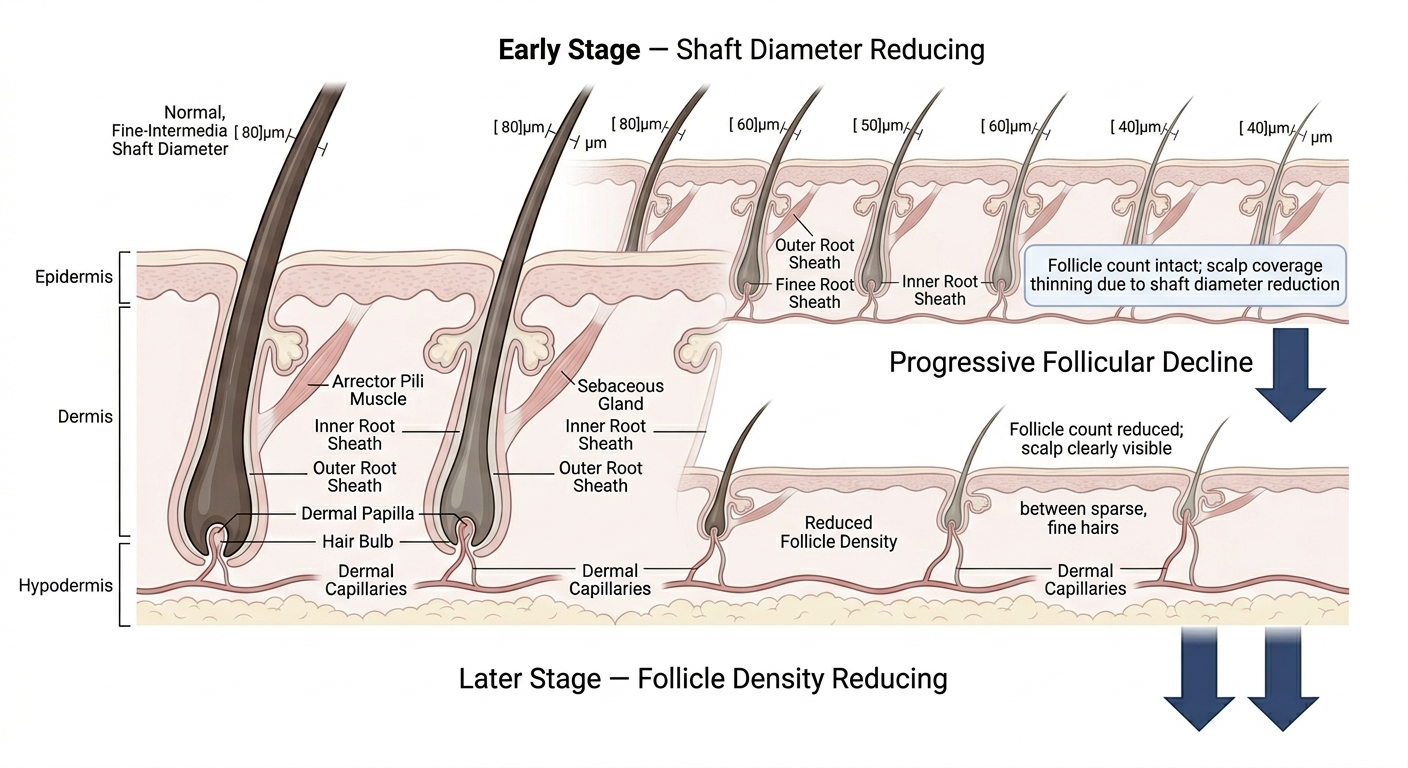
Finer hairs:
- occupy less space
- provide less coverage
- reflect light differently
As a result, hair may gradually appear:
- flatter
- less voluminous
- softer
- thinner under certain lighting conditions
before obvious bald areas develop.
Different follicles progress at different rates
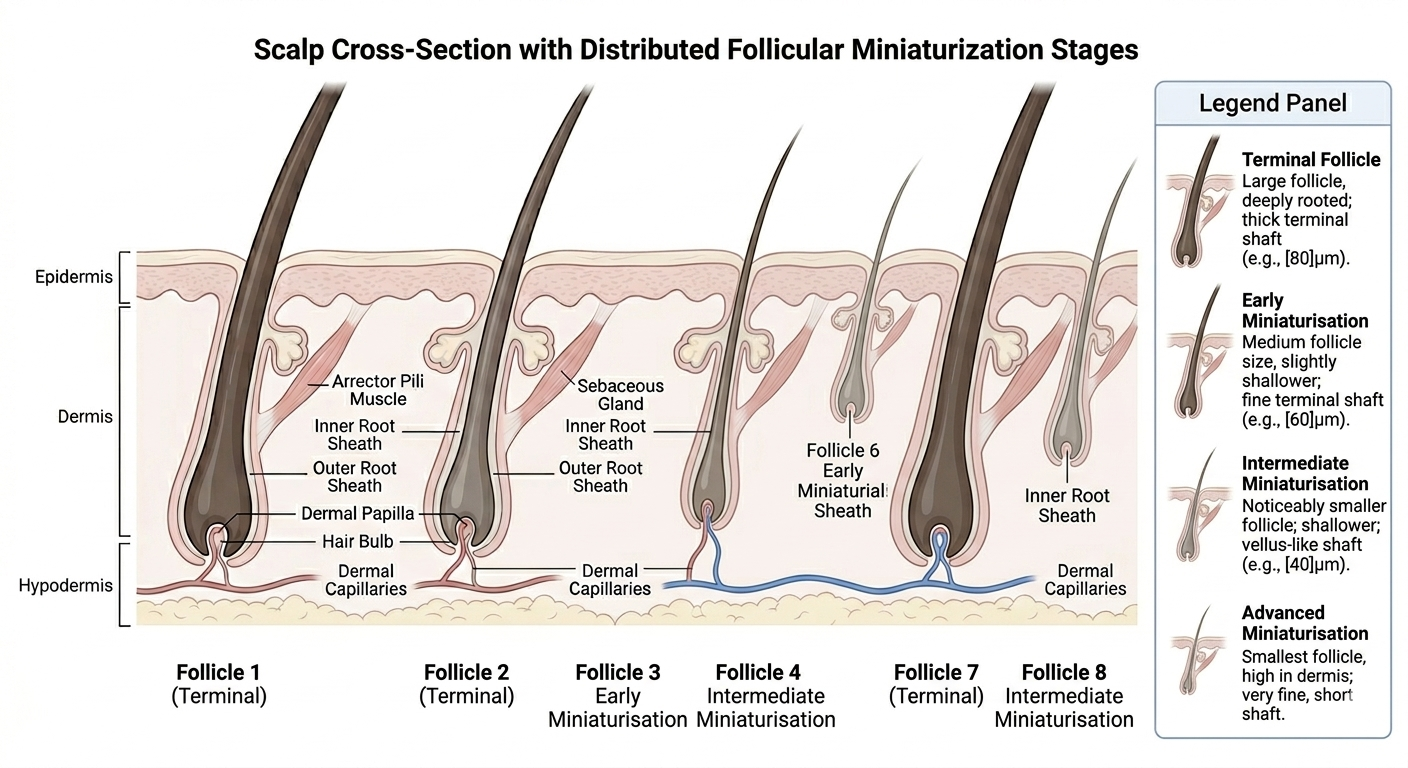
Hair follicles do not all miniaturise simultaneously.
Some follicles remain healthy while others become progressively smaller.
This asynchronous progression contributes to the slow and uneven development of thinning across the scalp.
The growth phase shortens gradually
Healthy scalp follicles remain in anagen for several years.
As hair loss progresses:
- follicles leave the growth phase earlier
- hairs spend less time growing
- final hair length decreases gradually
Because this shortening develops progressively, the visible effects also emerge slowly.
Shedding is not always dramatic
Many individuals expect hair loss to involve excessive shedding.
However, early androgenetic alopecia often progresses without major increases in daily hair fall.
Instead:
- follicles continue cycling
- hairs continue growing
- replacement hairs simply become progressively finer
This slow reduction in shaft calibre contributes to gradual thinning.
Ageing also contributes gradually
Age-related changes further slow follicular activity over time.
With ageing:
- cellular turnover decreases
- dermal papilla activity may decline
- follicles may spend longer resting
These gradual changes can combine with genetic influences to produce progressive thinning over decades.
Hormonal influences accumulate slowly
Androgen-related effects on susceptible follicles occur over prolonged periods.
The cumulative exposure of follicles to hormonal signalling gradually alters:
- growth cycle timing
- follicle size
- keratin production
- shaft thickness
Because these hormonal effects accumulate slowly, visible thinning also progresses gradually.
The brain adapts to gradual change
Another reason hair loss is often recognised late is psychological adaptation.
When changes occur slowly:
- daily appearance differences are minimal
- the brain adapts to progressive shifts
- thinning becomes more noticeable only in retrospect or through photographs
This makes early progression difficult to detect.
Sudden shedding is different
Not all hair loss develops slowly.
Conditions such as:
- telogen effluvium
- alopecia areata
- severe physiological stress-related shedding
may produce more rapid changes.
However, the most common forms of patterned hair loss typically progress gradually because of the biology of follicle miniaturisation.
A long-term biological process
Hair loss often starts slowly because hair follicles function through long biological cycles and change progressively over time.
Miniaturisation develops gradually across repeated growth cycles, producing progressively finer hairs while many follicles continue functioning normally during the early stages.
This slow evolution explains why early thinning may be subtle, why scalp changes develop over years rather than weeks, and why hair loss is often recognised only after significant follicular changes have already occurred.
Author: Dr. Priya Goswami
Medical review: Dr. Denis Broun
Next step
If you notice coverage changes without increased shedding, confirm what process is occurring.
Take the Hair Assessment to have a physician review your pattern, identify whether miniaturization is present, and determine appropriate staging and next steps.

Add Comment